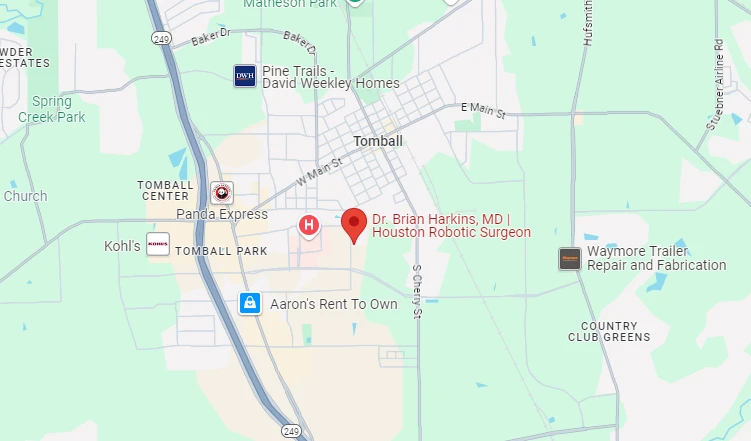
455 School St. Suite 10 Tomball, Texas 77375
Mon-Thu: 9:00 am – 5:00 pm | Fri: 9:00 am – 2:00 pm

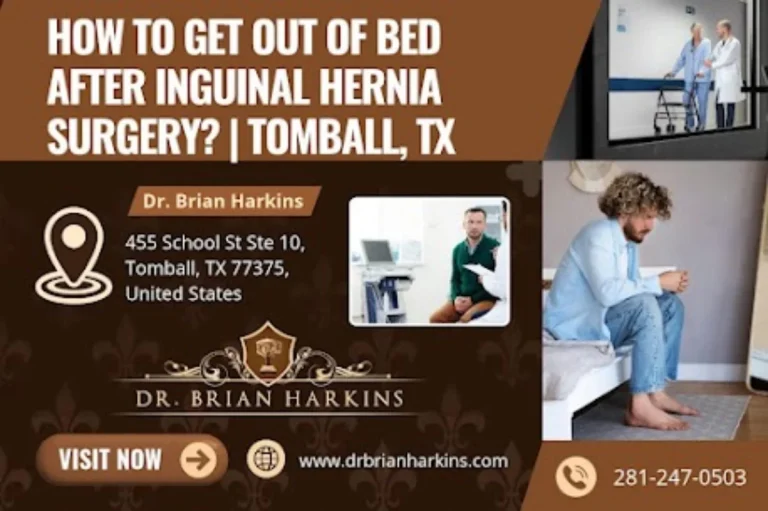
A commonly shared way to get out of bed after inguinal hernia surgery is to roll onto your side, bend your knees so your legs hang over the edge, push up with your arms, pause, then stand slowly. You may feel soreness and stiffness at first, especially when moving about, and your surgeon's instructions always come first.
The first time you try to sit up and stand after inguinal hernia surgery, a movement you have made every morning of your life may suddenly feel like something you need to plan. If you are recovering at home in Tomball, Northwest Houston or elsewhere in the greater Houston area, a clear and steady way to rise from bed may help you approach those first days with more confidence.
This guide sets out that general advice in plain steps, alongside what sourced recovery guidance says about soreness, rest, lifting and warning signs. It may be useful whether you are reading about the Tomball office of Dr. Brian Harkins or preparing for an operation somewhere else in the area, and your own surgeon's instructions come first in every part of it.
In this guide, you'll learn a step-by-step method for getting out of bed after inguinal hernia surgery, what soreness recovery guidance describes as expected when you move, which activities to hold back on while you heal, how walking and your normal routine return, which signs mean calling your surgeon, and what Dr. Brian Harkins provides for hernia patients in Tomball.
The method commonly shared for getting out of bed after inguinal hernia surgery has five steps: roll onto your side, bend your knees so your legs hang over the edge, push up with your arms, pause, then stand slowly. These steps are general recovery advice rather than a clinical instruction, and your surgeon's instructions come first wherever the two differ.
This guide assumes an adult recovering at home after inguinal hernia repair, and it does not give advice for any one person's recovery. Each step below is described on its own, in the order it is usually shared.
The first step is to roll onto your side. You may notice some soreness or stiffness as you turn, which recovery guidance describes as something you may have at first, especially when moving about.
With your knees bent, the second step is to bring your legs over the edge of the bed so that they hang down toward the floor.
The third step is to push yourself up with your arms until you are sitting on the edge of the bed, with your legs still hanging over the side of the bed and your feet toward the floor.
Once you are sitting up, the general advice is to pause for a moment on the edge of the bed.
The final step is to stand up slowly. General advice also suggests having someone nearby when you get up, and your surgeon can tell you whether anything about your own operation changes these steps.
The table below brings the five steps together in one place, so you can keep them beside the bed in the first days at home.
| Step | What to do | Note |
|---|---|---|
| 1. Roll onto your side | Roll onto your side | Soreness and stiffness may be felt at first, especially when moving about |
| 2. Legs over the edge | Bend your knees so your legs hang over the edge of the bed | General recovery advice, not a clinical instruction |
| 3. Push up with your arms | Use your arms to push yourself up to a sitting position | General recovery advice |
| 4. Pause | Sit for a moment on the edge of the bed | General recovery advice |
| 5. Stand slowly | Rise slowly, with someone nearby | Your surgeon's instructions come first |
Some pain, soreness and stiffness are expected at first after inguinal hernia surgery, and recovery guidance notes these may be felt especially when you are moving about. Getting out of bed is one of those movements, and it helps to know in advance that some soreness as you rise is described as something you may have at first.
General reference material on the operation also notes that residual soreness for a couple of days is not uncommon. Severe pain or soreness is different, and it sits on the list of reasons to call your surgeon that appears later in this guide.
The table below sets out what you may notice when you move and what recovery guidance says about each.
| What you notice | What recovery guidance says | What to do |
|---|---|---|
| Pain, soreness and stiffness when moving about | You may have these at first | Follow your surgeon's instructions |
| Residual soreness for a couple of days | Not uncommon | Follow your surgeon's instructions |
| Severe pain or soreness | A reason to contact your surgeon | Call your surgeon |
Heavy lifting, strenuous activity and driving while you take narcotic pain medicine are the three things recovery guidance asks you to avoid after inguinal hernia surgery. Each one has its own guide, and your surgeon may give you different limits for your own recovery.
Recovery guidance says not to lift more than 10 pounds (4.5 kilograms) for 4 to 6 weeks, or until your surgeon says it is OK. Ask your surgeon how long your own limit should last.
Strenuous activity is not advised for a few weeks after inguinal hernia surgery. Your surgeon is the right person to ask when it is reasonable to begin again in your own case.
Recovery guidance says not to drive while you are taking narcotic pain medicine. Driving is also one of the normal activities that you may gradually resume when you are ready, and your surgeon can tell you whether anything else in your recovery affects when you get back behind the wheel.
Walking comes back early: reference material on inguinal hernia surgery says patients are encouraged to make strong efforts in getting up and walking around the day after surgery. Getting out of bed with the steps above is the first part of that.
Recovery guidance separately advises resting plenty in the first 2 to 3 days after you go home. Your surgeon can tell you how getting up, walking and resting fit together in your own recovery plan.
You may gradually resume normal activities, such as walking, driving and sexual activity, when you are ready. Most people return to normal activities within a few weeks, and your surgeon decides the timing for your own return. If you are reading ahead before robotic hernia repair, this general guidance is a starting point for planning, and your surgeon's instructions take priority wherever they differ.
The table below sets each activity beside what general guidance says and the timing it gives.
| Activity | What general guidance says | Timing |
|---|---|---|
| Getting up and walking around | Patients are encouraged to make strong efforts to do this | The day after surgery |
| Rest at home | Rest plenty | The first 2 to 3 days after going home |
| Lifting | Do not lift more than 10 pounds (4.5 kilograms) | 4 to 6 weeks, or until your surgeon says it is OK |
| Strenuous activity | Not advised | A few weeks |
| Driving | Do not drive while taking narcotic pain medicine | Resume gradually when you are ready |
| Normal activities | Resume gradually when you are ready | Most people within a few weeks; your surgeon decides |
Recovery guidance lists specific signs that mean calling your surgeon after inguinal hernia surgery, and knowing them in advance may help you act quickly if one appears while you are getting up and moving at home.
| Warning sign | What to do |
|---|---|
| Severe pain or soreness | Call your surgeon |
| Difficulty breathing | Call your surgeon |
| Chills, or a fever of 101 F (38.3 C) or higher | Call your surgeon |
| Trouble urinating | Call your surgeon |
| Swelling or pain in the testicles that is getting worse | Call your surgeon |
A follow-up visit is usually set for about 2 weeks after surgery. If you have a question before then that is not one of these warning signs, you can contact Dr. Harkins' office about moving safely after hernia surgery and ask how the general advice applies to you.
Dr. Brian Harkins, MD, FACS (Fellow of the American College of Surgeons), is a board-certified general surgeon through the American Board of Surgery and has practiced in the Northwest Houston area since 1997. You can read more about the background of general surgeon Dr. Brian Harkins and a practice built on safety, efficacy, and minimally invasive surgery, with personalized treatment plans.
Hernia care. Dr. Harkins treats inguinal hernias and other hernias, and robotic hernia surgery is among the procedures the practice offers for patients in Tomball and the greater Houston area.
Hospital affiliation in Tomball. Dr. Harkins is affiliated with HCA Houston Healthcare Tomball, formerly known as Tomball Regional Medical Center, and sees patients from Tomball, Northwest Houston and the greater Houston area.
Reference material on inguinal hernia surgery says patients are encouraged to make strong efforts to get up and walk around the day after surgery. Your surgeon sets the timing for your own recovery.
Recovery guidance says you may have pain, soreness and stiffness at first, especially when moving about. Severe pain or soreness is different and means calling your surgeon.
General advice suggests having someone nearby when you get up after inguinal hernia surgery. Your surgeon can tell you whether you need more help than that in your own case.
The sources behind this guide give no specific advice on stairs after inguinal hernia surgery. Ask your surgeon how and when to use stairs during your own recovery.
Recovery guidance says not to lift more than 10 pounds (4.5 kilograms) for 4 to 6 weeks, or until your surgeon says it is OK.
Recovery guidance says not to drive while taking narcotic pain medicine, and driving is one of the normal activities you may gradually resume when you are ready. Your surgeon can confirm the timing.
Recovery guidance advises resting plenty in the first 2 to 3 days after going home. Getting up and walking around is also encouraged early, so ask your surgeon how to balance the two.
A follow-up visit is usually set for about 2 weeks after surgery. Your surgeon's office will give you the date for your own visit.
Call your surgeon for severe pain or soreness, difficulty breathing, chills or a fever of 101 F (38.3 C) or higher, trouble urinating, or swelling or pain in the testicles that is getting worse.
The general sources used for this guide do not separate open, laparoscopic and robotic-assisted repair in their advice. Your surgeon's instructions for your own operation come first.
Getting out of bed after inguinal hernia surgery usually follows five commonly shared steps: roll onto your side, bend your knees so your legs hang over the edge, push up with your arms, pause, then stand slowly, with someone nearby, as general advice suggests. Soreness and stiffness when moving are expected at first, and severe pain or soreness is a reason to call your surgeon.
Around those steps, recovery guidance encourages getting up and walking early, resting plenty in the first 2 to 3 days at home, lifting no more than 10 pounds for 4 to 6 weeks, and avoiding strenuous activity for a few weeks. Keep the warning signs in mind, and let your own surgeon's instructions shape every step of your plan.
Ask about getting up safely after hernia surgery.
Call 281-247-0503 to schedule your consultation.
This information is educational and is not a substitute for professional medical advice. Every patient is different. Dr. Brian Harkins will discuss whether robotic-assisted surgery is right for your specific situation based on your anatomy, health, and goals.


Dr. Brian Harkins is a renowned surgeon specializing in advanced, minimally invasive, and robotic surgical techniques. With a dedication to innovation and personalized patient care, he has transformed countless lives by delivering exceptional outcomes.
I want a website like this, where do i start?