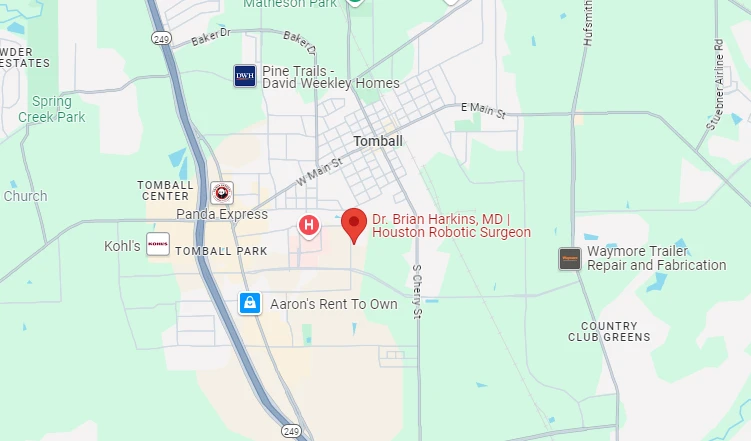
455 School St. Bldg. 1, Suite 10 Tomball, Texas 77375
Mon-Thu: 9:00 am – 5:00 pm | Fri: 9:00 am – 2:00 pm


When a colon polyp is removed, the doctor usually cuts or snares it off through the colonoscope, then sends the tissue to a pathology lab to check for precancerous or cancerous cells. Most people have mild cramping, bloating, or light spotting afterward, and the lab result guides when the next colonoscopy is due.
A colon polyp is a small growth of extra tissue on the inside wall of the large intestine, and most people never feel one. Many adults in Tomball and the greater Houston area first hear the word after a screening colonoscopy, when the doctor mentions that a polyp was found and taken out during the same visit. That news usually raises a handful of practical questions about what the removal involved, how long the area takes to heal, and what the lab will say.
This guide explains the sequence in plain language, using patient information from MedlinePlus, the American Cancer Society, and published patient guidance from endoscopy units. It describes what usually happens to patients in general, and it cannot tell you what your own result means, because only the doctor who treated you has your report and your history.
In this guide, you'll learn how doctors remove polyps, when surgery is discussed instead, what recovery usually feels like, how to read the general meaning of a pathology result, and which symptoms need a call to your doctor.
Most polyps are removed through the colonoscope itself, a thin, flexible tube with a camera that the doctor guides through the colon while you are sedated.
According to MedlinePlus, the National Library of Medicine's health information service, polyps are removed during colonoscopy, and the removed tissue is then tested to learn whether it is precancerous or cancerous. Because most polyps cause no symptoms and some can turn into cancer over time, doctors routinely take them out when they are found rather than waiting to see what they do. Patient guidance from a university medical school notes that the scope can grab and snip off polyps that are relatively small, which is why many people leave the endoscopy suite on the same day with the polyp already gone.
| Step | What usually happens | What you notice |
|---|---|---|
| Preparation | You follow the bowel preparation your doctor gives you so the colon is clear enough to see | Frequent trips to the bathroom the day before |
| Sedation | You receive medicine to keep you comfortable during the colonoscopy | Little or no memory of the visit |
| Finding the polyp | The doctor guides the colonoscope through the colon and spots the growth on a video screen | Nothing, since you are sedated |
| Removal | The doctor takes the polyp off with small forceps or a wire loop called a snare, passed through the scope | Usually nothing during the removal itself |
| Retrieval | The removed tissue is collected and sent to a pathology lab | You wake up in a recovery area |
The forceps and snare options reflect general endoscopy practice rather than a rule for every patient. Your doctor chooses the tool based on what the polyp looks like.
Surgery is used in certain cases, such as when a polyp cannot be removed safely through the colonoscope or when the lab finds cancer, and the surgeon then removes the affected part of the colon.

MedlinePlus states that surgery, called a large bowel resection, may be needed in some situations. The American Cancer Society adds that when a removed polyp contains cancer, doctors typically order imaging to check whether the cancer has spread beyond the colon, and they may refer the patient to a colorectal surgeon for further treatment if it is needed. In that second situation the polyp has already been removed, and the question becomes whether additional tissue should come out as well.
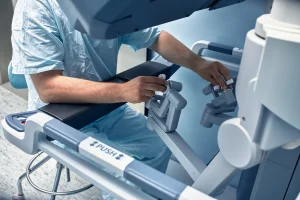
This is where robotic colorectal surgery can enter the conversation. The surgeon operates the da Vinci system from a console and works through a few small incisions rather than one large one, which typically means less tissue trauma than open surgery. Laparoscopy can do as well for some patients, and some operations need to be converted to open surgery for safety, so the approach is a decision for you and your surgeon after a full review.
| Situation | Usual route | Who decides |
|---|---|---|
| Small polyp seen during colonoscopy | Removed through the colonoscope | The doctor performing the colonoscopy |
| Polyp that cannot be removed safely through the scope | Surgery to remove that section of colon may be discussed | The surgeon, after reviewing imaging and history |
| Cancer found in a removed polyp | Imaging first, then a referral to a colorectal surgeon if more treatment is needed | The care team, including the surgeon |
| Precancerous polyp fully removed | Usually no surgery, with repeat colonoscopy later | The doctor, based on the lab report |
Most people feel mild cramping, bloating, or light spotting of blood for a short time, while larger polyps carry a small risk of bleeding or a hole in the bowel wall during the healing period of up to two weeks.
Patient guidance from endoscopy units describes cramp-like discomfort, tenderness, and bloating in the abdomen as common after a polyp is taken out, along with slight blood spotting. These effects usually settle without treatment. The same guidance explains that after removal of larger polyps, those bigger than about one centimeter, there is a risk of bleeding or a hole forming in the bowel wall while the area heals, and that the healing period can last up to two weeks. For that reason many units ask patients to avoid heavy lifting, strenuous exercise, and demanding work for about two weeks after a larger polyp comes out.
Your own instructions come first, since the doctor knows how large your polyp was and where it sat. The table below shows the general pattern.
| Time after removal | What is common | What to do |
|---|---|---|
| First hours | Sleepiness from sedation, gas, and bloating | Follow the discharge instructions you were given |
| First few days | Mild cramping, tenderness, and slight spotting | Rest and watch for the warning signs listed below |
| Up to two weeks | The area heals, and delayed bleeding is possible after larger polyps | Avoid heavy lifting and strenuous activity if your doctor advises it |
| Lab result | The pathology report reaches your doctor | Ask when and how you will hear the result |
Because the healing window can stretch to two weeks, a problem that appears several days after you feel fine still deserves a call to your doctor.
The pathology report says what type of polyp it was and whether any cancer cells were present, and that type guides how soon you need your next colonoscopy.

The American Cancer Society explains that removed polyps are tested and the results go to your doctor, and that the type of polyp matters more than the number. Benign types such as hyperplastic polyps are less concerning than precancerous adenomas, which are polyps with cells that can develop into cancer over many years. Patient guidance from a university medical school adds that doctors also remove sessile serrated polyps, a flatter type that was once thought harmless and is now treated as a risk.
The ACS notes that people with precancerous polyps are usually asked to repeat the colonoscopy within one to three years, and sometimes as soon as six months, while people with benign polyps generally continue the standard screening schedule. Patient guidance from a university medical school describes a similar pattern, with low-risk findings such as one or two small polyps allowing a longer interval and higher-risk findings, such as large or numerous polyps, calling for a return in about three years or sooner.
| Result | What it generally means | Usual next step |
|---|---|---|
| Hyperplastic polyp | A benign type that is not precancerous | Standard screening schedule |
| Adenoma | A precancerous polyp that was removed | Repeat colonoscopy, often within one to three years |
| Sessile serrated polyp | A flatter polyp treated as a risk | Removal and a follow-up colonoscopy on your doctor's schedule |
| Cancer in the polyp | Cancer cells found in the removed tissue | Imaging, then a referral to a colorectal surgeon if more treatment is needed |
The final interval is always your doctor's decision, based on your report, your history, and your family history.
Call your doctor or endoscopy unit if you have more than a few tablespoons of fresh blood or clots, severe belly pain that does not ease, marked swelling, or a fever.
Patient guidance from endoscopy units lists these as the signs that need prompt medical attention after a polyp is removed: fresh blood or clots from the rectum beyond a few tablespoons, persistent severe abdominal pain, marked abdominal swelling, and a general feeling of illness with fever or flu-like symptoms. Light spotting is expected, but heavier bleeding is not, and the difference can be hard to judge on your own.
| Warning sign | What it may indicate | What to do |
|---|---|---|
| More than a few tablespoons of fresh blood or clots | Bleeding where the polyp was removed | Contact your doctor or emergency care right away |
| Severe belly pain that does not ease | A possible problem in the bowel wall | Seek urgent medical care |
| Marked swelling of the abdomen | A possible complication | Seek urgent medical care |
| Fever or flu-like illness | A possible infection or complication | Contact your doctor promptly |
If you are unsure whether a symptom is normal, calling is always reasonable.
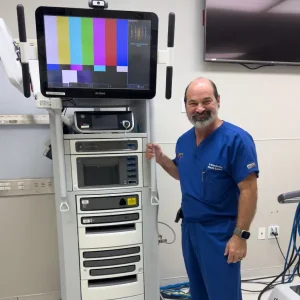
Houston-area general surgeon Dr. Brian Harkins treats colon and rectal conditions in Tomball, including colon and rectal cancer, diverticulitis, polyps, and colitis.
Credentials and experience: Dr. Harkins holds MD and FACS credentials and is certified by the American Board of Surgery. He has practiced in the Northwest Houston area since 1997, chairs the Robotics Committee at HCA Houston Healthcare Tomball, a Center of Excellence in Robotic Surgery, and sees patients who travel from across the United States and abroad.
Robotic colorectal surgery: Dr. Harkins operates the da Vinci Xi surgical system from a console, where he works with a magnified 3D view and instruments that filter hand tremor and bend with seven degrees of freedom. The system never operates on its own. Robotic surgery uses smaller incisions than open surgery, which typically means less tissue trauma and a faster recovery, and most patients return to light activity within 2 to 3 weeks compared with 6 to 8 weeks after open surgery, although full recovery takes longer.
An honest look at fit: Robotic surgery is not the right choice for every patient or every condition, and laparoscopy can do as well for some. Surgery carries real risks, and an operation may need to be converted to open surgery. The consultation is where the surgeon reviews your report and imaging and explains whether surgery makes sense for you.
Most people feel little during the removal because they are sedated. Afterward, mild cramping and bloating are common and usually settle within a short time.
The removal itself is usually a short part of the colonoscopy, though the length varies with the number, size, and location of the polyps. Your doctor can tell you what to expect for your visit.
Many people resume light activity soon, but guidance for larger polyps often asks you to avoid heavy lifting and strenuous work for about two weeks. Follow the instructions from the doctor who removed yours.
Slight blood spotting is common. More than a few tablespoons of fresh blood or clots is not expected and should prompt a call to your doctor or emergency care.
A pathology lab examines the tissue to learn what type of polyp it was and whether it was precancerous or cancerous. The report goes to your doctor, who uses it to plan follow-up.
Removing polyps lowers the chance that a precancerous polyp becomes cancer later, which is why doctors take them out. It does not remove every future risk, so follow-up colonoscopies still matter.
The timing varies by facility. Ask the doctor who removed the polyp when to expect the report and how you will be contacted, so you are not left waiting without an answer.
New polyps can form over time, and having had one is a reason doctors recommend follow-up colonoscopies. The schedule depends on the type and number of polyps you had.
Surgery may be discussed when a polyp cannot be removed safely through the colonoscope or when the lab finds cancer. Many polyps never need it, and your surgeon decides after reviewing your results.
A doctor trained in colonoscopy removes most polyps during the exam, and a general surgeon becomes involved when surgery is needed. Dr. Harkins is a board-certified general surgeon who treats colon and rectal conditions in Tomball.
When a colon polyp is removed, the doctor usually takes it out through the colonoscope, a pathology lab tests the tissue, and the report decides when your next colonoscopy is due. Mild cramping and bloating are common afterward, larger polyps carry a short window of bleeding risk, and surgery is reserved for certain cases.
If a polyp was found and you want to talk through what comes next, you can schedule a consultation about colon polyp removal with a board-certified surgeon who can review your report and imaging. Patients across Texas look for a robotic surgeon in Texas when surgery is on the table, and the right answer always depends on your report, your history, and your goals.
Ask about your polyp results and next steps.
Call (281) 351-5409 to schedule your consultation.
This information is educational and is not a substitute for professional medical advice. Every patient is different. Dr. Brian Harkins will discuss whether robotic-assisted surgery is right for your specific situation based on your anatomy, health, and goals.

Dr. Brian Harkins is a renowned surgeon specializing in advanced, minimally invasive, and robotic surgical techniques. With a dedication to innovation and personalized patient care, he has transformed countless lives by delivering exceptional outcomes.
I want a website like this, where do i start?