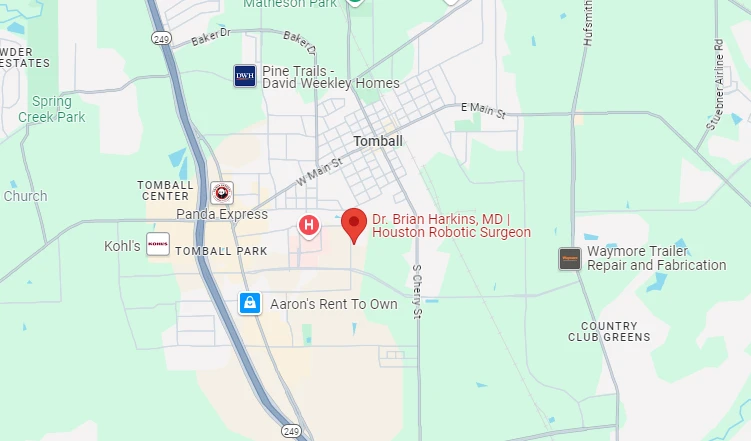
455 School St. Bldg. 1, Suite 10 Tomball, Texas 77375
Mon-Thu: 9:00 am – 5:00 pm | Fri: 9:00 am – 2:00 pm


An incisional hernia that is left untreated often stays a bulge that can cause discomfort, but in rare cases trapped tissue loses its blood supply, which is a medical emergency called strangulation. The National Institutes of Health notes that hernias are not usually life-threatening and that a hernia without symptoms may only need monitoring.
An incisional hernia forms at the site of a previous abdominal surgery, and many people who notice a bulge along an old scar wonder how long they can wait before it becomes a problem. Patients in Tomball and the greater Houston area ask this often, and the honest answer is that the risk depends on the hernia itself, the symptoms it causes, and the person's overall health.
This guide comes from a practice that offers da Vinci robotic surgery in Houston, and it draws its medical statements from National Institutes of Health sources so you can see what is known and what is not. It cannot tell you what to do about your own hernia, because that decision belongs to you and your surgeon after an exam.
In this guide, you'll learn what an incisional hernia is, what can happen when one goes untreated, which warning signs need urgent care, and how surgeons repair these hernias.
An incisional hernia is a bulge of tissue or an organ through a weakened area of the abdominal wall at the site of a previous surgical scar.
A hernia happens when part of an internal organ or tissue bulges through a weak area of muscle, and most hernias occur in the abdomen. According to the NIH guide to hernias, many types of surgery increase the risk of a new hernia because cutting into the internal structures that hold organs in place can weaken them. Organs can then push more easily through the weakened area, and the result is an incisional hernia.
Healing speed matters as well. The NIH notes that incisional hernias are more likely in people who smoke or have diabetes, because those conditions slow healing after surgery and lengthen the time the area stays weak.
| Factor | What the NIH says |
|---|---|
| Earlier abdominal surgery | Cutting into internal structures can weaken them, so organs can push through the weak area |
| Smoking or diabetes | These conditions can slow healing after surgery, which prolongs the weakness |
| Age, sex, and weight | Hernias are more likely in people who are older, are male, or carry excess weight |
| Long-term cough or sneeze | Listed among the conditions that make a hernia more likely |
Anybody can develop a hernia, and having one of these factors does not mean you will. A surgeon looks at your history and your exam to judge your own situation.
Not always, because a hernia that causes no symptoms may only need monitoring, but a hernia that causes problems generally calls for surgery, which the NIH calls the only permanent solution.

The NIH says a hernia may not need treatment if it is not causing symptoms, and a doctor might monitor it to make sure it does not get worse. MedlinePlus, the National Library of Medicine's health information service, adds that untreated hernias can cause pain and health problems. A surgeon quoted by the NIH points out that hernia symptoms can affect daily activities, sleep, and how people feel about their appearance.
A 2025 surgical case report indexed by the National Library of Medicine states that most incisional hernias require surgical treatment. The report explains that an untreated hernia can lead to obstructive and non-obstructive complications, including trapped bowel, blockage, tissue death, and even perforation. These outcomes are uncommon, but they are the reason a bulge along a scar deserves a professional look.
| Stage | What may happen | What it usually means |
|---|---|---|
| No symptoms | The hernia is present but causes no problems | A doctor may monitor it |
| Symptoms | A bulge, discomfort, or pain that can affect daily activities and sleep | Repair is usually discussed |
| Trapped tissue | Bowel can become trapped, called incarceration, or blocked | Needs prompt medical evaluation |
| Strangulation | Blood supply is cut off, causing severe pain, nausea, or vomiting | An emergency |
Progression differs from person to person, and this table describes possibilities rather than a timeline. Only an exam can show which row applies to you.
Sudden severe pain, nausea, or vomiting from a hernia can signal strangulation, a rare emergency in which trapped tissue loses its blood supply, and it needs urgent medical care.
The NIH explains that a strangulated hernia has had its blood supply cut off by the squeezing of the muscles around it. It can cause severe pain, nausea, or vomiting, and although the NIH stresses that hernias are not usually life-threatening, a strangulated one is the exception.
The 2025 case report shows how this can unfold. A woman had ignored a swelling over an old surgical scar for years, and she eventually developed vomiting and an inability to pass stool, which pointed to a strangulated bowel. She needed emergency surgery. The report describes an unusual case, so it illustrates a risk without predicting what will happen to any other person.
| Warning sign | What it may indicate | What to do |
|---|---|---|
| Severe pain at or near the hernia | Possible strangulation | Seek urgent medical care |
| Nausea or vomiting | Possible strangulation or blockage | Seek urgent medical care |
| Vomiting with an inability to pass stool | Bowel blockage, described in the 2025 case report | Seek emergency care |
If you have a known hernia and any of these signs appear, do not wait for a routine appointment. A surgeon or an emergency team can tell the difference between a hernia problem and something else, which no article can do.
Treatment is usually surgery to repair the opening in the muscle wall, and surgeons can perform it through an open incision, through laparoscopy, or with robotic assistance.

MedlinePlus states that treatment for a hernia is usually surgery to repair the opening in the muscle wall. The approach depends on the size and location of the hernia, the patient's health, and the surgeon's judgment, and the NIH adds an honest limit: even after surgery, the same organ may slip out of place again.
| Approach | How it is done | Where it fits |
|---|---|---|
| Open repair | One larger incision over the hernia | Used when the surgeon judges a larger incision is the right route |
| Laparoscopic repair | A camera and instruments pass through small incisions | A minimally invasive option for many patients |
| Robotic-assisted repair | The surgeon operates the da Vinci system from a console, using small incisions | Suitable for many patients, though not every patient or condition |
The surgeon performs every step of robotic hernia surgery, and the system extends what the surgeon can see and control. Because every hernia and every patient differs, the surgeon recommends the approach after examining you and reviewing your imaging.
Board-certified general surgeon Dr. Brian Harkins treats hernias in Tomball, including incisional, ventral, and inguinal hernias, along with hiatal hernias related to reflux.
Credentials and experience: Dr. Harkins holds MD and FACS credentials and is certified by the American Board of Surgery. He has practiced in the Northwest Houston area since 1997, chairs the Robotics Committee at HCA Houston Healthcare Tomball, a Center of Excellence in Robotic Surgery, and sees patients who travel from across the United States and abroad.
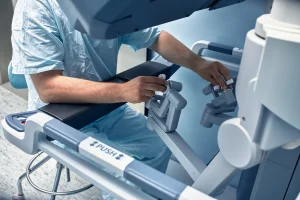
Robotic hernia surgery: Dr. Harkins operates the da Vinci Xi surgical system from a console, where he works with a magnified 3D view and instruments that filter hand tremor and bend with seven degrees of freedom. The system never operates on its own. Robotic surgery uses smaller incisions than open surgery, which typically means less tissue trauma and a faster recovery, and most patients return to light activity within 2 to 3 weeks compared with 6 to 8 weeks after open surgery, although full recovery takes longer.
An honest look at fit: Robotic surgery is not the right choice for every patient or every hernia, and some operations need to be converted to open surgery during the procedure for safety. Surgery of any kind carries real risks, and the consultation is where the surgeon examines the hernia, reviews your history, and explains whether repair makes sense for you.
No time limit applies to everyone. The NIH notes that a hernia without symptoms may only need monitoring, while one that causes problems generally needs surgery, so your surgeon decides based on your symptoms and exam.
Seek urgent care for sudden severe pain, nausea, or vomiting near a hernia, because these can signal strangulation. The NIH describes strangulation as a rare emergency in which trapped tissue loses its blood supply.
The NIH says hernias are not usually life-threatening. In rare cases a hernia becomes an emergency, and untreated incisional hernias can cause complications such as blocked bowel, so a bulge deserves an evaluation.
Sometimes. The NIH says a hernia that causes no symptoms may not need treatment, and a doctor might monitor it to make sure it does not get worse. Once it causes problems, surgery is the only permanent solution.
Surgery is the only permanent solution when a hernia causes problems, according to the NIH. Even after repair, the same organ may slip out of place again, which is why your surgeon reviews follow-up with you.
The NIH says many types of abdominal surgery raise the risk, and smoking or diabetes make an incisional hernia more likely by slowing healing. Older age, male sex, excess weight, and a long-term cough also raise the chance of a hernia.
A strangulated hernia is one in which the tissue pushing through the abdominal wall has its blood supply cut off by the surrounding muscles. The NIH says it can cause severe pain, nausea, or vomiting, and it is an emergency.
No. The NIH says the first sign of a hernia is often a bulge, and some hernias are painful while others are not, with some causing odd sensations or discomfort.
Robotic-assisted surgery is one minimally invasive way to repair a hernia, with the surgeon operating the da Vinci system from a console. It is not right for every patient or hernia, and your surgeon decides after an exam and imaging.
A general surgeon evaluates hernias and performs repairs. Dr. Harkins is a board-certified general surgeon who repairs incisional, ventral, and inguinal hernias in Tomball.
An untreated incisional hernia often stays a bulge that a doctor can monitor, but it can cause pain and complications over time, and in rare cases it becomes a strangulated hernia that needs emergency care. Surgery is the only permanent solution once a hernia causes problems, and even repair carries honest limits.
If you have a bulge along a surgical scar, you can schedule a consultation about incisional hernia repair so a board-certified surgeon can examine it and review your history and imaging. The right timing depends on your hernia, your symptoms, and your health, and that conversation is where the answer gets settled.
Ask about your incisional hernia options.
Call (281) 351-5409 to schedule your consultation.
This information is educational and is not a substitute for professional medical advice. Every patient is different. Dr. Brian Harkins will discuss whether robotic-assisted surgery is right for your specific situation based on your anatomy, health, and goals.

Dr. Brian Harkins is a renowned surgeon specializing in advanced, minimally invasive, and robotic surgical techniques. With a dedication to innovation and personalized patient care, he has transformed countless lives by delivering exceptional outcomes.
I want a website like this, where do i start?