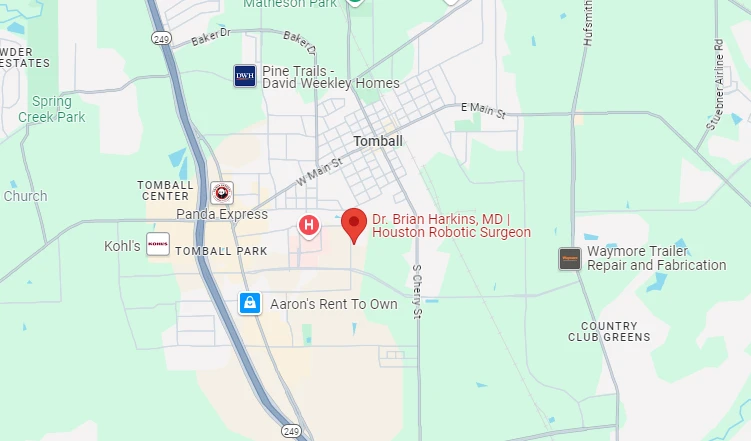
455 School St. Bldg. 1, Suite 10 Tomball, Texas 77375
Mon-Thu: 9:00 am – 5:00 pm | Fri: 9:00 am – 2:00 pm

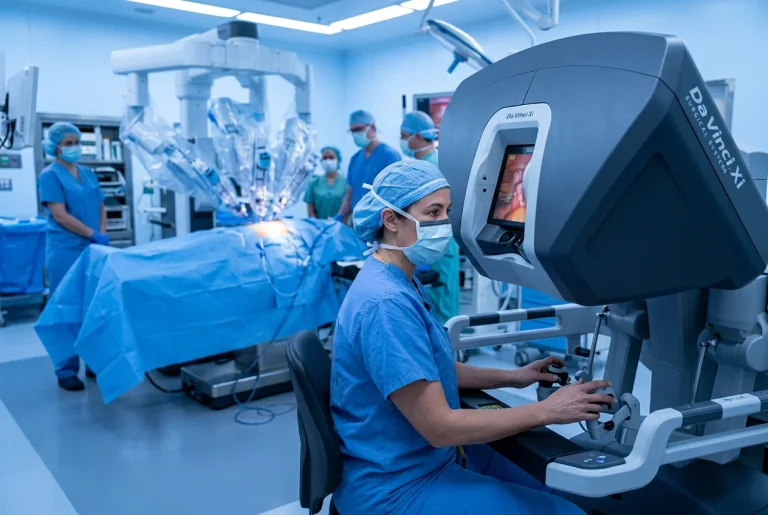
Dr. Brian Harkins is a nationally ranked, top-1% robotic surgeon based in Tomball, Texas, with over three decades of surgical practice, military training, and early Da Vinci adoption that places him among the most experienced robotic general surgeons in the Houston area. Patients choose him because the combination of technical expertise, personalized care, and proven outcomes is rare — and it's available in their own community.
There's no shortage of surgical options in the greater Houston market. What's harder to find is the specific combination of experience, technology, and the kind of physician you actually want to have your conversation with before surgery. Patients who come to Surgical Advanced Specialty Center at 455 School St. in Tomball frequently describe the same discovery: they came for Dr. Harkins' credentials and technical reputation, and stayed because of how the consultation actually went.
This page exists to answer the question patients are trying to answer when they research a surgeon: not just what the credentials are, but what they mean in practice — and why they translate into better surgical outcomes for you.
Dr. Harkins completed his surgical training at some of the most demanding institutions in American medicine, capped by residency at Dwight D. Eisenhower Army Medical Center — a military surgical training program where precision, composure under pressure, and high-stakes decision-making are requirements, not differentiators. He earned his MD from LSU School of Medicine in 1984 and has practiced in Tomball since 1997.
Military surgical training shapes a specific kind of surgeon. The volume is high, the cases are complex, the expectation of standard is different from civilian academic programs, and the culture is one of performance accountability. Dr. Harkins brings that background to every procedure — not as a brand claim, but as an actual foundation for his technical approach.
His surgical experience spans:
That breadth matters when a patient presents with a complex hernia history, prior abdominal surgeries, unusual anatomy, or a condition that doesn't fit neatly into a simple treatment algorithm. Experience at the edges of surgical complexity is what differentiates surgeons — and Dr. Harkins has spent three decades accumulating it in Tomball.
National robotic surgery volume rankings are based on total case counts reported to Intuitive Surgical — the manufacturer of the Da Vinci platform. Dr. Harkins' top-1% ranking reflects thousands of robotic procedures performed over years of practice, placing him well past the learning curve and into a range of case volume where technique is standardized, outcomes are predictable, and complications are rare.
The learning curve in robotic surgery is steep and well-documented. Outcomes — including conversion rates, complication rates, and operative times — improve substantially with accumulated case volume and then plateau at a level of consistent proficiency. Below that plateau, outcomes are variable and often worse than laparoscopic. Above it, robotic surgery delivers its full benefit.
Dr. Harkins operates above that plateau by a wide margin. What that means for patients:
The American Hernia Society recommends that patients evaluate their surgeon's specific experience with their hernia type — a standard that applies equally across all robotic procedures. Dr. Harkins encourages patients to ask directly about his case volume for their specific procedure.
| Credential | Detail |
| Medical Degree | LSU School of Medicine, 1984 |
| Residency | Dwight D. Eisenhower Army Medical Center |
| Tomball Practice Established | 1997 |
| Robotic Surgery Ranking | Top 1% nationally (Intuitive Surgical volume data) |
| Da Vinci System | Da Vinci Xi (current generation) |
| Hospital Affiliation | HCA Houston Healthcare Tomball |
| Procedures Performed Robotically | Hernia, cholecystectomy, colorectal, anti-reflux, appendix, spleen, stomach |
Two elements set Dr. Harkins' clinical approach apart from standard robotic surgery practice: his integration of ERAS (Enhanced Recovery After Surgery) protocols across all procedures, and his routine use of near-infrared fluorescence imaging with ICG dye for bile duct and vascular visualization. Both represent best-practice adoption that most general surgeons in community settings have been slower to implement.
ERAS is a multimodal, evidence-based approach to perioperative care developed by the ERAS Society that reduces surgical stress and accelerates recovery through coordinated interventions before, during, and after surgery. Elements include pre-operative carbohydrate loading, multi-modal pain management, early mobilization, and early oral nutrition — all of which reduce hospital length of stay and complication rates.
Dr. Harkins' patients experience ERAS benefits as practical outcomes: many go home the same day as laparoscopic or robotic hernia repair; robotic cholecystectomy patients routinely discharge the same day; colorectal patients are ambulatory and eating within 24 hours. These aren't aspirational goals — they're the standard result of ERAS-integrated robotic technique.
During cholecystectomy, NIR fluorescence with ICG dye illuminates the bile duct anatomy in real time, allowing Dr. Harkins to confirm duct identification before any clips are placed. Bile duct injury is the most feared complication of gallbladder surgery — a consequence that can require complex reconstructive surgery and cause long-term biliary problems. Fluorescence imaging reduces that risk with a technology unavailable in open surgery.
During colorectal resections, the same fluorescence technology assesses bowel perfusion at the anastomosis before the bowel is joined — providing real-time confirmation of tissue viability at the most critical point in the procedure.
Dr. Harkins uses low-pressure insufflation during robotic procedures — maintaining lower abdominal CO₂ pressure than standard technique. This reduces post-operative shoulder pain (a common complaint from laparoscopic surgery), decreases cardiac and respiratory stress during surgery, and improves patient comfort in recovery.

The physical practice at Surgical Advanced Specialty Center reflects the same philosophy as Dr. Harkins' clinical approach: unhurried, thorough, and oriented toward giving patients what they actually need to make a decision.
Consultations typically run longer than patients expect — not because they're inefficient, but because Dr. Harkins diagrams what he finds, explains the anatomy, and walks through the surgical plan in terms that make sense to a non-surgeon. That level of transparency is something patients consistently note in reviews as unusual and valuable.
The office staff contribute meaningfully to that experience. Vicki handles insurance verification and prior authorization — meaning patients understand their coverage before they're on the operating table. The clinical team, including medical assistants Chalsea and Jessica, coordinate the pre- and post-operative care that makes ERAS protocols actually work in practice.
Office hours are Monday–Thursday 9am–5pm and Friday 9am–2pm. Same-week consultations are typically available.
Dr. Brian Harkins is the answer to the question Tomball-area patients are asking when they search for a robotic surgeon: someone with the technical training and case volume to make minimally invasive surgery deliver its full benefit, the clinical protocols to optimize recovery, and a practice culture that treats patients as informed participants in their own care.
If you're evaluating surgeons for a hernia, gallbladder, colorectal, or other general surgery procedure, schedule a consultation and see for yourself what the combination of military precision, robotic expertise, and 30 years of Tomball practice actually looks like in a room.
Dr. Harkins is a board-certified general surgeon specializing in robotic and minimally invasive surgery. His primary procedure areas include hernia repair, gallbladder surgery, colorectal surgery, anti-reflux surgery, and other abdominal surgical conditions.
All surgical procedures are performed at HCA Houston Healthcare Tomball. Consultations and office visits take place at Surgical Advanced Specialty Center, 455 School St., Bldg. 1, Suite 10, Tomball, TX 77375.
It refers to Dr. Harkins' national ranking in robotic surgery case volume as reported to Intuitive Surgical, the manufacturer of the Da Vinci system. Surgeons in the top 1% by volume have performed thousands of robotic procedures, reflecting a level of experience that consistently produces better outcomes than lower-volume practitioners.
The practice accepts most major insurance plans including PPO plans. Insurance specialist Vicki verifies coverage before scheduling and handles prior authorization. Call 281-351-5409 to confirm your specific plan.
Since 1997. His nearly 30-year presence in the Tomball community means established relationships with referring physicians, deep familiarity with the local patient population, and a reputation built on consistent outcomes over decades.
ERAS — Enhanced Recovery After Surgery — is an evidence-based perioperative protocol that reduces surgical stress and accelerates recovery. Dr. Harkins integrates ERAS across all his surgical procedures, producing same-day or next-day discharge for most hernia and gallbladder cases.
Yes. Patients with acute conditions — acute cholecystitis, appendicitis, incarcerated hernia, or other emergencies — can be evaluated and often operated on urgently through HCA Houston Healthcare Tomball.
Absolutely. Dr. Harkins welcomes patients seeking second opinions, whether to confirm a diagnosis, evaluate a surgical recommendation from another surgeon, or understand whether a robotic approach is appropriate for their condition.
Bring any imaging (CT scans, ultrasounds, X-rays), prior surgical records, a list of current medications, and your insurance card. If you've seen another surgeon, bring their notes or operative reports if available.
Call 281-351-5409 during office hours (Monday–Thursday 9am–5pm, Friday 9am–2pm) or submit a request through the contact page at drbrianharkins.com. Same-week appointments are typically available.
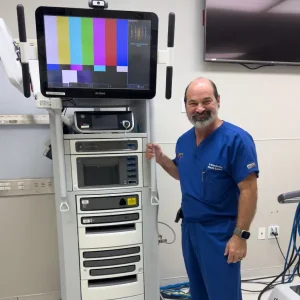

Dr. Brian Harkins is a renowned surgeon specializing in advanced, minimally invasive, and robotic surgical techniques. With a dedication to innovation and personalized patient care, he has transformed countless lives by delivering exceptional outcomes.
I want a website like this, where do i start?