455 School St. Bldg. 1, Suite 10 Tomball, Texas 77375
Mon-Thu: 9:00 am – 5:00 pm | Fri: 9:00 am – 2:00 pm

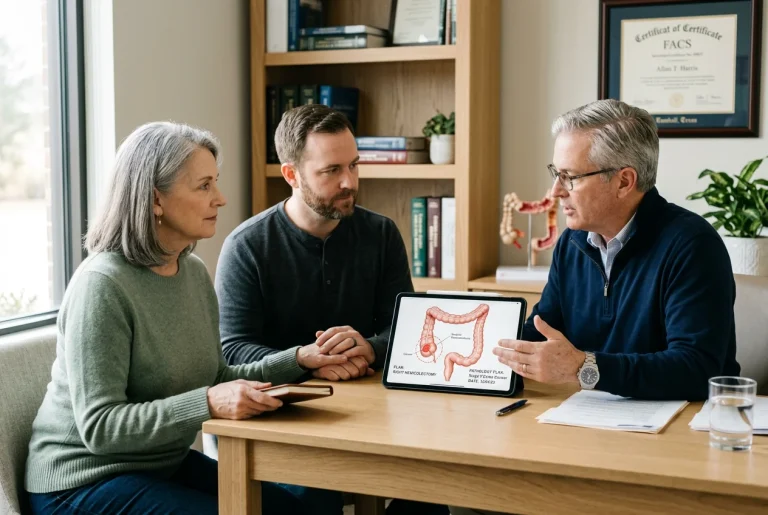
Robotic colectomy is the most common minimally invasive surgical approach for colon cancer in 2026, with similar oncologic outcomes (lymph node harvest, margin status, recurrence rates) to traditional laparoscopic and open surgery in published trials. Typical hospital stay is 3 to 5 days under ERAS protocols and recovery to full activity takes 4 to 6 weeks. Long term outcomes depend on cancer stage, lymph node status, and adjuvant therapy decided in coordination with medical oncology, not on the surgical platform alone.
A colorectal cancer diagnosis brings two questions to the front of most patients' minds: what does the surgery actually involve, and what does recovery look like. Surgery is the central treatment for most localized colon cancers (stages I through III), and increasingly that surgery is performed with the da Vinci robotic platform, an approach that has produced similar oncologic results to traditional laparoscopic and open surgery in randomized trials while offering the patient experience advantages of minimally invasive surgery.
This guide walks through what robotic colon cancer surgery involves, how surgeons choose between right, left, and sigmoid colectomy based on where the tumor sits, the oncologic principles that matter for long term outcomes (adequate lymph node harvest, clear margins, no tumor spillage), what hospital stay and recovery look like under Enhanced Recovery After Surgery protocols, and how surgery fits into the broader picture of multidisciplinary cancer care. Outcomes data is reported as published averages on aggregate populations. Your individual outlook depends on stage, pathology, comorbidities, and treatment decisions made in coordination with Dr. Brian Harkins and your medical oncology team.
Colorectal cancer is the third most common cancer in the United States and the second leading cause of cancer death when colon and rectal cancers are counted together. Most colon cancers develop slowly over years from precancerous polyps in the colon lining. When found early through colonoscopy screening, they can often be removed during the colonoscopy itself before they become invasive. When they have progressed to invasive cancer, treatment moves to the operating room.
Colon cancer is staged using the TNM system, which describes tumor depth (T), lymph node involvement (N), and distant metastasis (M). The American Joint Committee on Cancer combines these into stages I through IV:
Surgery is the central curative-intent treatment for stages I, II, and III. Most stage III patients also receive adjuvant chemotherapy after surgery, decided by medical oncology based on pathology findings. Stage IV management depends on the location and extent of metastases, performance status, and goals of care.
A colectomy is the surgical removal of a segment of the colon along with the regional lymph nodes that drain it. For colon cancer specifically, the operation is oncologic in design, meaning the resection is planned to remove not just the visible tumor but the lymphatic basin that drains the tumor's region, the surrounding mesentery, and the vascular supply. After the diseased segment and its lymph node basin are removed, the surgeon reconnects the remaining colon to restore intestinal continuity (an anastomosis).
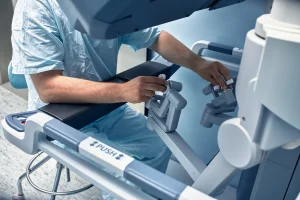
A robotic colectomy performs this same operation using the da Vinci Xi platform: small port incisions (typically 8 to 12 mm), magnified 3D vision at the surgeon's console, wristed instruments with seven degrees of freedom, and tremor filtration. The robot does not perform the surgery autonomously. The surgeon controls every instrument movement in real time from a console a few feet from the patient.

The colon is one organ but anatomically and surgically it is divided into segments. Different segments are removed for tumors in different locations because the blood supply, lymph drainage, and anatomic boundaries differ:
The right operation is the one that includes the tumor with appropriate proximal and distal margins, removes the regional lymph node basin in its entirety, and follows the principles of complete mesocolic excision when anatomically appropriate.
Whether a colon cancer operation is performed open, laparoscopically, or robotically, several oncologic principles drive long term outcome:
These principles are independent of the surgical approach. A high quality oncologic operation can be performed open, laparoscopically, or robotically. What matters is that the operation respects these principles, regardless of the platform.
Two major randomized trials have shaped how colorectal surgeons think about minimally invasive cancer surgery:
For colon cancer (as distinct from rectal cancer), large registry and cohort analyses, including data from the American College of Surgeons National Surgical Quality Improvement Program (NSQIP), consistently show:
The choice between robotic and laparoscopic for an elective colon cancer operation often comes down to surgeon experience and case complexity. Dr. Harkins is high volume in both approaches at HCA Houston Healthcare Tomball's Center of Excellence in Robotic Surgery.
Elective robotic colectomy for colon cancer follows a fairly predictable pattern at a center using Enhanced Recovery After Surgery (ERAS) protocols:
ERAS protocols have been shown in multiple published studies to reduce length of stay, complication rates, and 30 day readmission rates after colorectal cancer surgery. They are now standard at high volume centers.
| Phase | Duration | Key details |
| Pre-op bowel prep | 1 day before | Laxative regimen, oral antibiotics, clear liquids |
| Surgery | 2 to 4 hours | General anesthesia, robotic ports, oncologic resection, anastomosis |
| Hospital stay | 3 to 5 nights | ERAS protocol, early mobilization, advancing diet, pain control |
| First post op visit | 7 to 14 days | Incision check, pathology review, recovery assessment |
| Pathology and oncology coordination | 7 to 21 days | Full pathology report, tumor board, oncology consult if indicated |
| Adjuvant therapy decision | 4 to 6 weeks | Decided by medical oncology if stage III or high risk stage II |
| Full activity | 4 to 6 weeks | Surgeon clearance based on healing |

Recovery from colon cancer surgery follows a similar curve to other colectomy procedures, with the addition of pathology review and adjuvant therapy decisions in the first 4 to 6 weeks.
Within 7 to 14 days of surgery, the pathologist completes a detailed analysis of the removed specimen and reports several key findings:
These findings guide whether adjuvant chemotherapy is recommended:
Adjuvant chemotherapy decisions are made by medical oncology in coordination with the surgeon and the patient. The surgeon's role at this stage is to ensure the surgical recovery is complete, the pathology is fully reviewed, and the patient is well enough to begin systemic therapy.
Long term outcomes after colon cancer surgery depend strongly on the stage at the time of surgery. The American Cancer Society reports the following 5 year relative survival rates for colon cancer based on Surveillance, Epidemiology, and End Results (SEER) data:
These are population averages. Individual outcomes depend on many factors beyond stage, including overall health, response to adjuvant therapy, tumor biology, and recurrence patterns. Patients should discuss their specific prognosis with their oncology team based on their pathology, not on aggregate statistics.
What the surgical approach (robotic vs laparoscopic vs open) does not appear to change significantly in published data is long term survival itself. What it does change is the short term experience, recovery, and likelihood of complications that could delay adjuvant therapy. For patients who need chemotherapy after surgery, a faster surgical recovery often means starting chemotherapy on schedule, which matters for outcomes.
Colon cancer is not treated by one specialist alone. A well coordinated care team includes:
At HCA Houston Healthcare Tomball, this team works in close coordination, and tumor board reviews ensure that complex cases benefit from multidisciplinary input.
A robotic colectomy is a minimally invasive operation that removes the colon segment containing the cancer along with its regional lymph node basin, performed through small incisions using the da Vinci robotic platform. The surgeon controls every movement from a console; the robot translates those movements into precise instrument actions inside the abdomen. The procedure follows the same oncologic principles as open or laparoscopic surgery: clear margins, adequate lymph node harvest, complete mesocolic excision when appropriate, and no tumor spillage.
Large randomized trials and registry data show robotic, laparoscopic, and open colectomy produce comparable oncologic outcomes for colon cancer in terms of lymph node yield, margin status, and recurrence rates. The advantage of robotic and laparoscopic over open is in shorter hospital stay, lower complication rates, and faster recovery. The advantage of robotic over laparoscopic appears most in complex cases such as obese patients and difficult pelvic dissection, where robotic surgery has shown lower conversion to open rates.
Hospital stay after elective robotic colectomy is typically 3 to 5 nights under ERAS protocols. Most patients return to desk work in 2 to 3 weeks and reach full activity at 4 to 6 weeks. Recovery for patients receiving adjuvant chemotherapy continues during chemotherapy, which typically starts 4 to 6 weeks after surgery if indicated.
It depends on the final pathology stage. Stage I cancers typically do not require chemotherapy after a clean resection. Stage II cancers may receive chemotherapy when high risk features are present. Stage III cancers (lymph node positive) typically receive adjuvant chemotherapy unless contraindicated. Stage IV management follows a different algorithm. The decision is made by medical oncology in coordination with the surgical team and the patient.
Surgery is the central treatment for stages I, II, and III colon cancer. Some early stage cancers and large polyps may be removed during colonoscopy without formal colectomy. Stage IV (metastatic) management is individualized: surgery may be performed for palliation, obstruction, or in selected patients with limited metastases when curative resection is feasible.
The number depends on tumor location, anatomy, and the extent of mesenteric resection. Current National Comprehensive Cancer Network guidelines recommend examining at least 12 lymph nodes in the resection specimen for accurate staging. Surgeons aim to remove the entire regional lymph node basin in continuity with the tumor.
In most elective colectomy for colon cancer, a permanent colostomy is not needed. The bowel is reconnected during the same operation. A temporary stoma may be used in selected high risk cases or in emergency surgery for an obstructing or perforating tumor. Permanent colostomy is more often needed for very low rectal cancers, which are a different operation from colon cancer surgery.
According to American Cancer Society data based on SEER registries, approximate 5 year relative survival is 91 percent for localized disease, 73 percent for regional disease, and 13 percent for distant disease. These are population averages; individual prognosis depends on stage, pathology, treatment response, and overall health, and should be discussed with your oncology team.
For elective robotic or laparoscopic colectomy under ERAS protocols, the typical hospital stay is 3 to 5 nights. Patients are discharged when they tolerate a soft diet, control pain with oral medication, walk independently, and demonstrate return of bowel function. Emergency surgery for obstructing or perforating tumors typically requires a longer stay.
Outpatient (same day discharge) colectomy is rare. Same day discharge is occasionally reported in highly selected patients at specialized centers, but most colon cancer operations involve a multi day hospital stay even under aggressive ERAS protocols. This is different from gallbladder or hernia surgery, where same day discharge is standard.
A colon cancer diagnosis is heavy. The surgical part of the treatment, while major, is also one of the most well studied and standardized parts of modern cancer care. A robotic colectomy performed by an experienced surgeon at a high volume center can offer the precision and recovery advantages of minimally invasive surgery while delivering the same oncologic quality as open surgery. If you would like to discuss robotic surgery for colon cancer, schedule a consultation with Dr. Brian Harkins at our Tomball office by calling 281-351-5409 or request an appointment online. We see patients from across the greater Houston area, with robotic colorectal surgeries performed at HCA Houston Healthcare Tomball's Center of Excellence in Robotic Surgery.

Dr. Brian Harkins is a renowned surgeon specializing in advanced, minimally invasive, and robotic surgical techniques. With a dedication to innovation and personalized patient care, he has transformed countless lives by delivering exceptional outcomes.
I want a website like this, where do i start?