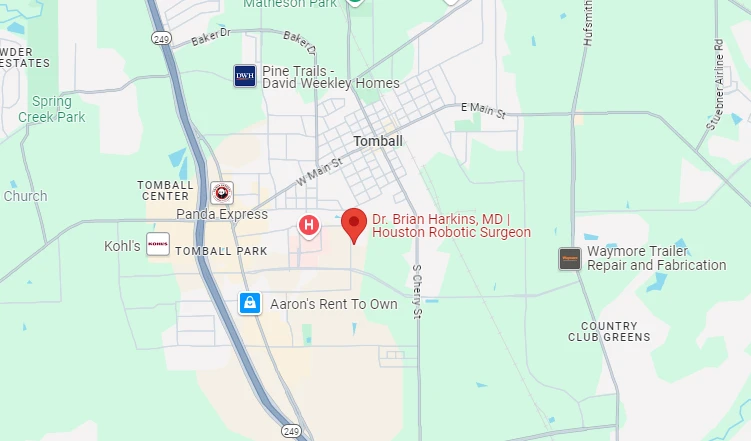
455 School St. Bldg. 1, Suite 10 Tomball, Texas 77375
Mon-Thu: 9:00 am – 5:00 pm | Fri: 9:00 am – 2:00 pm

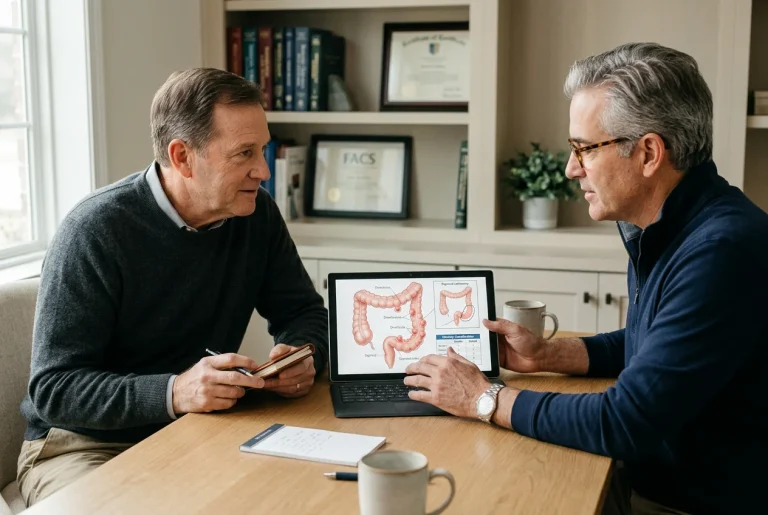
Most diverticulitis attacks resolve with antibiotics, bowel rest, and dietary changes. Surgery is needed when complications develop (perforation, abscess, fistula, obstruction, or stricture), when attacks recur and significantly affect quality of life, when medical management fails, or when colon cancer cannot be ruled out. Robotic sigmoid colectomy is the most common elective approach in 2026, with a 2 to 4 day hospital stay and 4 to 6 week recovery under ERAS protocols at HCA Houston Healthcare Tomball.
Diverticulitis is one of the most common reasons adults over 50 land in an emergency room with abdominal pain. About half of Americans over age 60 have diverticulosis, the small pouches in the colon wall, and roughly 10 to 25 percent of them will eventually have an episode of diverticulitis, the inflammation or infection of those pouches. The good news: most attacks resolve with antibiotics and a few days of bowel rest. The harder question, and the one that brings patients into a surgical consultation, is what to do when attacks recur or complications develop.
Surgical guidelines for diverticulitis have changed substantially in the last decade. The old "rule" of two attacks meaning automatic surgery has been retired by the American Society of Colon and Rectal Surgeons (ASCRS) and the American Gastroenterological Association (AGA). The current recommendation is individualized: surgery is considered based on attack frequency, severity, complications, comorbidities, and how much diverticulitis affects daily life. This guide walks through what those criteria actually look like, what a colectomy involves, how robotic surgery has changed the patient experience, and what recovery in the Tomball area looks like.

Diverticula are small pouches that develop in weak spots of the colon wall, most often in the sigmoid colon, the lowest portion of the large intestine in the left lower abdomen. Having these pouches is called diverticulosis, and by age 60 about half of Americans have them. Diverticulosis itself is usually silent. Most people never know they have it unless it is found incidentally on a colonoscopy or imaging study.
Diverticulitis is what happens when one of those pouches becomes inflamed or infected. It typically presents with left lower quadrant abdominal pain, fever, change in bowel habits, and sometimes nausea or vomiting. Mild cases are treated with antibiotics; some uncomplicated cases in selected patients are now managed without antibiotics under updated AGA guidance. A short course of bowel rest (clear liquids, then gradual advance) usually resolves the inflammation within several days.
When the attack does not respond, when complications appear, or when attacks keep returning, the conversation shifts toward surgery.
There are two categories of diverticulitis surgery: emergency (when something is going seriously wrong right now) and elective (planned surgery to prevent future problems).
Emergency surgery is needed when diverticulitis has caused a complication that cannot wait. Specific indications:
Emergency cases are typically classified using the Hinchey system:
| Hinchey grade | What it describes | Typical management |
| Stage I | Small confined pericolic abscess | Antibiotics; percutaneous drainage if larger |
| Stage II | Larger walled-off pelvic, retroperitoneal, or distant abscess | Percutaneous drainage and antibiotics; elective surgery often follows |
| Stage III | Generalized purulent peritonitis (pus throughout abdomen) | Emergency surgery, typically Hartmann's procedure or resection with primary anastomosis |
| Stage IV | Generalized fecal peritonitis (stool spilled into abdomen) | Emergency surgery, typically Hartmann's procedure with temporary colostomy |
Elective surgery is planned ahead of time, after the active attack has settled. Indications now favor an individualized approach rather than a fixed attack-count threshold. Patients should consider elective sigmoid colectomy when:
The ASCRS 2020 practice parameter explicitly states the decision should be based on "the number, severity, and pattern of attacks; the presence of persistent symptoms; the patient's comorbidities and immune status; and the patient's preferences," not a single threshold number.
A colectomy is the surgical removal of part or all of the colon. For diverticulitis, the procedure is almost always a sigmoid colectomy, the removal of the sigmoid colon, which is the segment where diverticulitis most commonly occurs. After the diseased segment is removed, the surgeon reconnects the remaining colon to the upper rectum (called an anastomosis), and bowel function continues normally.
In most elective cases, no stoma (colostomy bag) is needed. The bowel is reconnected during the same operation. A temporary diverting stoma is occasionally used when the anastomosis needs time to heal in higher-risk patients. Permanent colostomy is uncommon in elective diverticulitis surgery. It is more often used in emergency cases (Hinchey III and IV) where the abdomen is too inflamed for a safe reconnection. In those situations, surgeons may use the Hartmann's procedure (remove the diseased segment, close the rectal stump, and bring the upper colon out as a temporary colostomy), with the colostomy typically reversed 3 to 6 months later.
A sigmoid colectomy for diverticulitis can be performed three ways:
The sigmoid colon sits deep in the pelvis, in a tight space surrounded by the ureter, iliac vessels, and other structures. The robotic platform's stable visualization and wrist articulation are often most useful exactly where colorectal surgery is most demanding: the pelvic dissection. Published comparisons (including analyses from the American College of Surgeons NSQIP database and randomized trials such as the ROLARR study) show similar overall complication rates between robotic and laparoscopic colectomy in straightforward cases, with lower conversion-to-open rates for robotic surgery in obese patients and in cases with significant adhesions or inflammation from prior diverticulitis attacks.
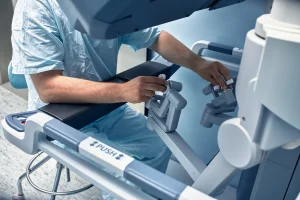
For most patients in the Tomball area considering elective sigmoid colectomy for diverticulitis, the choice between robotic and laparoscopic comes down to surgeon experience with each approach. Dr. Harkins is high-volume in both, with the da Vinci Xi system available at HCA Houston Healthcare Tomball's Center of Excellence in Robotic Surgery.
Elective robotic sigmoid colectomy follows a fairly consistent pattern:
ERAS protocols at HCA Houston Healthcare Tomball include preoperative carbohydrate loading, opioid-sparing pain control, early feeding, early ambulation, and structured discharge criteria, all of which together have been shown in multiple published studies to reduce hospital length of stay and complication rates after colectomy.

Recovery from sigmoid colectomy is slower than from gallbladder or hernia surgery. The colon needs time to wake up, the anastomosis needs time to heal, and bowel function takes weeks to fully normalize.
| Time after surgery | What to expect | Activity |
| Hospital days 1 to 4 | IV pain control transitioning to oral; clear liquids advancing to soft diet; walking 4+ times daily; first bowel movement around day 2 to 4 | Walking, sitting up, light activity in hospital |
| Week 1 home | Tired easily; soft low-residue diet; bowel function irregular; mild incision pain | Short walks, no lifting over 10 lb, no driving while on opioids |
| Week 2 | Energy returning; transitioning to normal diet gradually; bowel function still adjusting | Return to desk work for many patients; light activity |
| Weeks 3 to 4 | Most patients near baseline; bowel function more predictable | Most jobs (with surgeon clearance); resume gentle exercise |
| Weeks 5 to 6+ | Full clearance for most activity; core strength rebuilding | Resume normal exercise, lifting, full physical work |
The first post-operative visit is typically 2 weeks after discharge at the Tomball office. A second visit 4 to 6 weeks out is common for final clearance.
After elective sigmoid colectomy for diverticulitis, most patients have a significant reduction in recurrent attacks, though not zero. Roughly 5 to 15 percent of patients will have at least one additional episode of diverticulitis in the remaining colon over the following decade, depending on how much diverticulosis exists in the rest of the colon and individual risk factors. Recurrence rates are lower when the entire diseased sigmoid segment is removed down to the rectosigmoid junction.
Long-term bowel habits typically return to baseline within 3 to 6 months. Some patients have slightly looser or more frequent stools for the first several months as the colon adapts. A high-fiber diet, adequate hydration, and regular exercise are the most evidence-supported strategies for reducing the risk of recurrent diverticulitis and other colon-related issues over time.
Colorectal surgery outcomes are tightly tied to surgeon volume and judgment. Research consistently shows that high-volume colorectal surgeons have lower complication rates, lower conversion-to-open rates, and lower readmission rates than lower-volume surgeons. If you are evaluating surgeons for an elective colectomy, ask about annual case volume, specific experience with robotic sigmoid resection, conversion rates, and complication data.
Surgery is needed for diverticulitis in three situations: (1) emergency complications like perforation, large abscess, peritonitis, obstruction, or uncontrolled hemorrhage; (2) elective situations where attacks recur and significantly affect quality of life, fistulas or strictures develop, medical management has failed, or the patient is immunosuppressed; (3) when imaging cannot rule out colon cancer. Current ASCRS guidelines no longer recommend automatic surgery after two attacks; the decision is individualized.
Elective robotic sigmoid colectomy in a healthy patient is a major operation but generally well-tolerated, with overall complication rates around 10 to 20 percent (most of which are minor) and serious complications under 5 percent at experienced centers. Emergency surgery for perforation or peritonitis is significantly higher risk because the patient is often acutely ill at the time of surgery. The seriousness depends heavily on whether the operation is elective or emergent.
Hospital stay after elective robotic sigmoid colectomy is typically 2 to 4 days under ERAS protocols. Most patients return to desk work in 2 to 3 weeks and reach full activity at 4 to 6 weeks. Emergency surgery often involves a longer hospital stay (5 to 10 days or more) and proportionally longer recovery.
Yes, in roughly 5 to 15 percent of patients over the following decade, though recurrence is significantly less common than without surgery. Recurrence happens because diverticulosis can exist in colon segments above the removed sigmoid. Lifestyle factors (high-fiber diet, hydration, exercise) reduce risk.
In elective sigmoid colectomy, a permanent colostomy is uncommon. The colon is typically reconnected during the same operation. A temporary diverting stoma may be used in higher-risk patients. Permanent colostomy is more often needed in emergency surgery for severe perforation or peritonitis (Hinchey III and IV), and in some of those cases (such as a Hartmann's procedure) the stoma can be reversed 3 to 6 months later.
Elective surgery is planned after the active attack has resolved. Patients are well-nourished, optimized medically, and the operation is performed under controlled conditions, usually robotically through small incisions with a 2 to 4 day stay. Emergency surgery is performed while the patient is acutely ill with perforation, peritonitis, obstruction, or sepsis. These operations carry higher complication risk, longer hospital stays, and more often involve a temporary or permanent stoma.
Diverticulosis is the presence of small pouches in the colon wall. Most adults over 60 have them, and they usually cause no symptoms. Diverticulitis is the inflammation or infection of those pouches, which causes pain, fever, and change in bowel habits. Diverticulosis is a condition; diverticulitis is an active illness.
The Hinchey classification is a four-stage grading system surgeons use to describe how severe an episode of complicated diverticulitis is. Stage I is a small contained pericolic abscess. Stage II is a larger walled-off pelvic or distant abscess. Stage III is generalized purulent peritonitis (pus throughout the abdomen). Stage IV is generalized fecal peritonitis (stool spilled into the abdomen). The stage guides whether the case can be managed with antibiotics and drainage, requires elective surgery, or needs emergency surgery.
For elective robotic sigmoid colectomy under ERAS protocols, the typical hospital stay is 2 to 4 nights. Patients are discharged when they tolerate a soft diet, control pain with oral medication, walk independently, and demonstrate return of bowel function. Emergency surgery for complicated diverticulitis typically requires 5 to 10 nights or longer, depending on severity and recovery.
For straightforward elective sigmoid colectomy, robotic and laparoscopic approaches produce comparable overall complication rates in published research. The robotic platform shows evidence of meaningful advantage in complex cases: obese patients, patients with significant adhesions from prior diverticulitis attacks, and cases where the pelvic dissection is technically difficult, where robotic surgery has consistently shown lower conversion-to-open rates. Surgeon experience and case volume influence outcomes more than the platform itself.
The right time for diverticulitis surgery is the question worth asking carefully. Most patients do not need it, some clearly do, and a meaningful number sit in the middle where the answer depends on attack patterns, complications, individual health, and personal tolerance for the disease. A good surgical consultation walks through your specific history, your imaging, your overall health, and your goals before recommending anything. If you would like to discuss whether colectomy is the right step for your diverticulitis, schedule a consultation with Dr. Brian Harkins at our Tomball office by calling 281-351-5409 or request an appointment online.

Dr. Brian Harkins is a renowned surgeon specializing in advanced, minimally invasive, and robotic surgical techniques. With a dedication to innovation and personalized patient care, he has transformed countless lives by delivering exceptional outcomes.
I want a website like this, where do i start?