455 School St. Bldg. 1, Suite 10 Tomball, Texas 77375
Mon-Thu: 9:00 am – 5:00 pm | Fri: 9:00 am – 2:00 pm

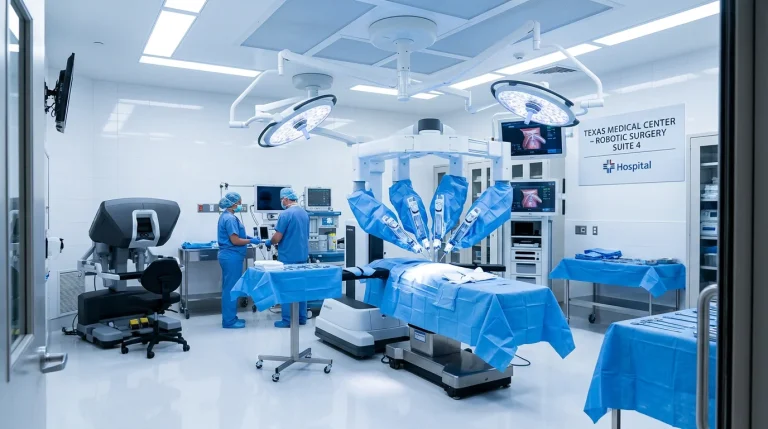
Robotic colorectal surgery uses the Da Vinci Xi system to treat conditions of the colon, rectum, and anus through small incisions, delivering shorter hospital stays, reduced complications, and faster recovery than traditional open surgery. Dr. Brian Harkins performs robotic colorectal procedures at HCA Houston Healthcare Tomball and brings decades of advanced surgical experience to every case.
Colorectal surgery encompasses a wide range of procedures — from removing a cancerous segment of colon to repairing a prolapsed rectum to managing chronic diverticulitis that has stopped responding to conservative treatment. What these procedures share is that they involve some of the most technically demanding anatomy in abdominal surgery: the pelvis, the mesorectal plane, the proximity of critical blood vessels and nerves that govern bladder and sexual function.
The robotic platform changes what's achievable in this space. The Da Vinci Xi's wristed instruments and 3D magnified visualization give Dr. Brian Harkins access and precision in the pelvis and lower abdomen that open and standard laparoscopic approaches cannot consistently match. For patients in Tomball and northwest Houston, that technical capability translates directly into better outcomes — smaller incisions, preserved nerve function, and a recovery measured in days rather than weeks.

Robotic colorectal surgery addresses both malignant and benign conditions of the large intestine, rectum, and related structures. The robotic approach is particularly valuable for conditions requiring precise dissection in the narrow confines of the pelvis, or wherever protecting adjacent nerve and vessel structures is critical to preserving quality of life after surgery.
The most common reason patients are referred for colorectal surgery. Robotic resection — whether a right colectomy, left colectomy, sigmoid resection, or low anterior resection for rectal cancer — allows for precise, oncologically sound removal of the involved segment with minimal disruption of surrounding tissue. For rectal cancer specifically, robotic total mesorectal excision (TME) is the current standard of care at high-volume centers, enabling nerve-sparing dissection in the pelvis that protects urinary and sexual function.
Recurrent diverticulitis — multiple attacks or a severe complicated episode — is among the most common reasons patients ultimately require sigmoid colectomy. Robotic resection removes the involved segment cleanly while preserving healthy colon, and ERAS recovery protocols typically allow discharge within one to two days.
Full-thickness rectal prolapse — where the rectum protrudes through the anus — is repaired robotically via a transabdominal approach (rectopexy), with or without bowel resection. The robotic platform gives excellent visualization of the presacral space and allows precise fixation with minimal trauma.
Crohn's disease and ulcerative colitis both occasionally require surgical intervention — either for acute complications or failed medical management. Robotic technique reduces surgical trauma in patients whose tissue quality may already be compromised by chronic inflammation.
Large or anatomically unfavorable polyps that can't be safely removed endoscopically sometimes require surgical resection. Robotic segmental colectomy removes the affected bowel segment while preserving the surrounding colon.
For low rectal cancers where the goal is to avoid a permanent colostomy, robotic low anterior resection with coloanal anastomosis can achieve oncologically complete resection while maintaining continence — a technically demanding procedure where robotic visualization and instrument precision are most consequential.
| Condition | Robotic Procedure | Key Technical Advantage |
| Colon cancer | Right or left colectomy, sigmoid resection | Precise lymph node dissection, minimal blood loss |
| Rectal cancer | Low anterior resection, TME | Nerve-sparing pelvic dissection |
| Diverticulitis | Sigmoid colectomy | Clean resection of inflamed segment |
| Rectal prolapse | Robotic rectopexy | Precise presacral fixation |
| Ulcerative colitis | Total proctocolectomy, J-pouch | Complex reconstruction in confined space |
| Large polyps | Segmental colectomy | Tissue-sparing removal of affected segment |

The colorectal surgeon's most demanding work happens in the pelvis — a narrow anatomical corridor where the rectum is surrounded by structures governing urinary control, sexual function, and defecation. The Da Vinci Xi's 3D visualization and wristed instrument articulation give robotic colorectal surgeons capabilities in this space that open and laparoscopic approaches cannot consistently replicate.
Three specific technical advantages define robotic colorectal surgery:
For rectal cancer, total mesorectal excision — removing the rectum completely within its fascial envelope — is the gold standard that reduces local recurrence. The robotic platform makes it possible to complete this dissection while identifying and sparing the autonomic nerve bundles (hypogastric nerves, pelvic splanchnic nerves) responsible for bladder and sexual function. In open surgery, these structures are at greater risk because direct visibility in the narrow pelvis is limited. Robotics changes that equation.
Dr. Harkins uses near-infrared (NIR) fluorescence with indocyanine green (ICG) dye during colorectal procedures to assess bowel vascularity at the anastomosis — the site where two bowel ends are joined after resection. Anastomotic leak is the most feared complication in colorectal surgery. Confirming blood flow to the anastomosis before closing significantly reduces that risk.
One of the most meaningful outcome metrics in minimally invasive colorectal surgery is conversion rate — the percentage of laparoscopic cases that have to be converted to open surgery due to technical difficulty. Robotic colorectal surgery consistently shows lower conversion rates than laparoscopic in high-volume series, particularly in obese patients and cases with extensive adhesions. A conversion to open surgery dramatically changes the recovery trajectory.
| Metric | Open Surgery | Laparoscopic | Robotic (High-Volume Surgeon) |
| Incision size | 6–10 inches | 0.5–1 cm ports | 0.5–1 cm ports |
| Hospital stay | 5–7 days | 3–4 days | 1–3 days |
| Conversion to open | N/A | 10–20% | 2–5% |
| Pelvic nerve preservation | Variable | Difficult in narrow pelvis | Superior visualization |
| Anastomotic leak risk | Baseline | Baseline | Reduced with fluorescence imaging |
| Return to activity | 4–6 weeks | 2–3 weeks | 1–2 weeks |
All robotic colorectal procedures performed by Dr. Harkins take place at HCA Houston Healthcare Tomball, a full-service acute care hospital with dedicated robotic surgery capabilities and a staff experienced in colorectal perioperative care. The combination of Dr. Harkins' robotic technique and ERAS (Enhanced Recovery After Surgery) protocols produces significantly shorter hospital stays and faster returns to full activity than traditional colorectal surgery.
The ERAS Society describes Enhanced Recovery After Surgery as a multimodal perioperative pathway that reduces surgical stress and accelerates recovery through evidence-based interventions before, during, and after an operation. Dr. Harkins integrates these protocols across all colorectal cases.
Patients receive detailed pre-operative instructions that include: carbohydrate loading the night before rather than prolonged fasting, pre-operative medications to reduce pain and nausea, and a specific bowel preparation protocol tailored to the procedure type. Patients scheduled for elective colorectal resection meet with the team in advance to set recovery expectations and understand their active role in the process.
Under general anesthesia, Dr. Harkins positions the Da Vinci Xi robotic arms through small abdominal ports and performs the resection with full 3D visualization. Depending on the procedure, operative time ranges from 90 minutes to 3 hours. For resections requiring an anastomosis, NIR fluorescence confirms tissue perfusion before the bowel is joined.
ERAS protocols enable most colorectal patients to:
Dr. Harkins has performed robotic general surgery in Tomball since the Da Vinci platform became viable for advanced colorectal cases. His experience includes the full spectrum of colorectal conditions — from straightforward sigmoid resections for diverticulitis to low anterior resections for rectal cancer requiring meticulous pelvic dissection. Patients referred from across northwest Houston and beyond choose his practice for the combination of technical expertise, ERAS-integrated care, and a consultation style that gives patients clear information rather than vague reassurances.
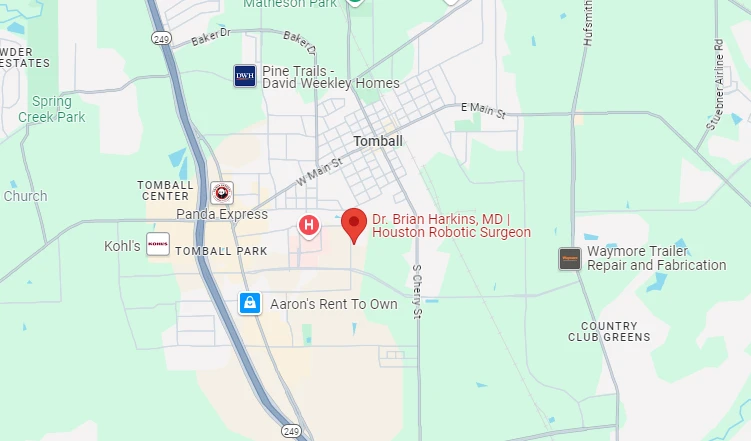
The practice at Surgical Advanced Specialty Center (455 School St., Bldg. 1, Suite 10, Tomball) sees colorectal consultations Monday through Thursday 9am–5pm and Friday 9am–2pm. Contact the office at 281-351-5409 or submit a consultation request online.
Robotic colorectal surgery represents the convergence of the most demanding surgical anatomy with the most capable minimally invasive tools available. For patients facing colon cancer, recurrent diverticulitis, rectal prolapse, or other colorectal conditions, the difference between a robotic approach in experienced hands and a traditional open operation is measured in incision size, hospital days, complication risk, and return to the activities that define normal life.
Dr. Brian Harkins brings all of that to Tomball. To discuss your colorectal condition and understand whether a robotic approach is right for your specific case, schedule a consultation today.
Common surgical indications include colorectal cancer, recurrent or complicated diverticulitis, rectal prolapse, ulcerative colitis or Crohn's disease failing medical management, and large polyps not removable by colonoscopy. Dr. Harkins will advise whether surgery is indicated and which approach is optimal for your case.
Yes. Robotic colorectal surgery has an established safety record across large patient series and consistently shows complication rates comparable to or lower than open surgery when performed by experienced surgeons. Dr. Harkins' high case volume and technique standardization contribute to predictable outcomes.
Most patients undergoing uncomplicated robotic colectomy with ERAS protocols are discharged in 1–3 days. This compares to 5–7 days typical for open colectomy. Complex rectal procedures may require slightly longer stays depending on the extent of reconstruction.
Not necessarily, and often not. The goal of modern rectal surgery is to preserve bowel continuity wherever oncologically and technically safe. Robotic technique expands the ability to perform sphincter-preserving resection for low rectal cancers. Some patients may have a temporary diverting ostomy to protect an anastomosis, which is typically reversed in a second procedure after healing.
Preparation depends on the procedure. Most colorectal resections require bowel preparation the day before, specific dietary restrictions, and pre-operative medications to manage pain and nausea. Dr. Harkins' team provides detailed written instructions at the pre-operative appointment.
Total mesorectal excision is the surgical standard for rectal cancer — complete removal of the rectum within its mesorectal fascial envelope, which contains the draining lymph nodes. Proper TME technique dramatically reduces local recurrence rates. The robotic platform enhances the precision of TME in the narrow pelvis.
Yes. Sigmoid colectomy — removal of the sigmoid colon, where diverticulitis most commonly occurs — is one of the most common robotic colorectal procedures. It's recommended for patients with recurrent diverticulitis, complicated disease (abscess, fistula, perforation), or persistent symptoms between episodes.
An anastomotic leak occurs when the junction between two bowel ends fails to heal properly after resection, allowing bowel contents to escape into the abdominal cavity. It's the most serious complication of colorectal resection. Dr. Harkins uses NIR fluorescence imaging to confirm adequate blood supply to the anastomosis before closing, reducing this risk.
Most major insurance plans cover robotic colorectal surgery when medically indicated. The practice's insurance specialist, Vicki, verifies coverage and handles prior authorization before the procedure is scheduled.
Most patients with desk or light-duty work return in 1–2 weeks. Physical labor or jobs requiring heavy lifting typically require 3–4 weeks. Dr. Harkins provides individualized return-to-work guidance based on your procedure and occupation.

Dr. Brian Harkins is a renowned surgeon specializing in advanced, minimally invasive, and robotic surgical techniques. With a dedication to innovation and personalized patient care, he has transformed countless lives by delivering exceptional outcomes.
I want a website like this, where do i start?