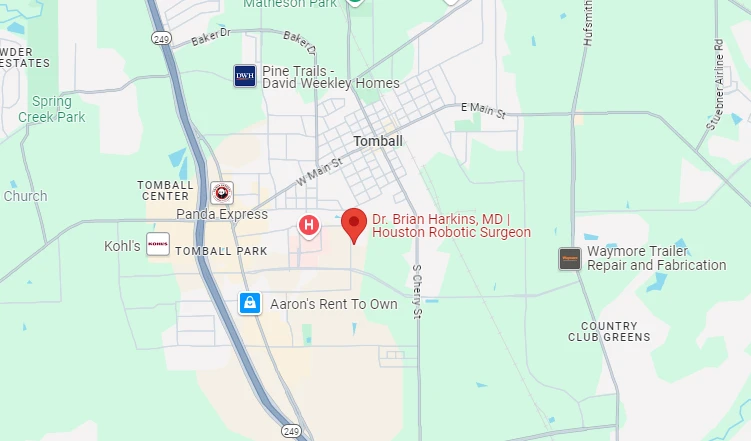
455 School St. Bldg. 1, Suite 10 Tomball, Texas 77375
Mon-Thu: 9:00 am – 5:00 pm | Fri: 9:00 am – 2:00 pm

For most uncomplicated gallbladder removals, robotic and laparoscopic cholecystectomy produce comparably excellent outcomes. Large cohort studies show similar complication rates, similar length of stay, and similar recovery times between the two approaches. The robotic platform shows evidence of meaningful advantage in complex cases such as acute cholecystitis, severe adhesions, obese patients, and biliary anatomic variants. Surgeon experience and case volume influence outcomes more than the platform itself.
Cholecystectomy, the surgical removal of the gallbladder, is one of the most common abdominal operations in the United States, with more than 700,000 performed annually. For more than three decades, laparoscopic cholecystectomy has been the worldwide standard of care, and in the last ten to fifteen years, the da Vinci robotic platform has joined it as a widely available alternative for robotic gallbladder surgery. Patients considering gallbladder removal often find themselves comparing the two approaches, and the answer they're looking for is narrower and more interesting than marketing materials on either side would suggest.
Both procedures are minimally invasive, both use small incisions, and both send most patients home the same day. The differences between them are real for certain patient groups and marginal for most others. This guide walks through what the evidence actually shows, where each approach has measurable advantages, and how a thoughtful surgeon makes the decision based on your specific case rather than a preference for one tool over the other.
A cholecystectomy removes the gallbladder, most often because gallstones are causing biliary colic, cholecystitis, or biliary obstruction. Whether performed laparoscopically or robotically, the underlying surgery is the same: identify and divide the cystic duct and cystic artery, separate the gallbladder from the liver bed, and remove it through a small port. The difference lies in how the surgeon controls the instruments, not in the operation itself.
Both approaches share the core elements of minimally invasive cholecystectomy. The surgeon makes three to four small port incisions, inserts a camera through one port, and works with long instruments through the others under general anesthesia, with operative time typically running 45 to 90 minutes. Same-day discharge is the expectation in uncomplicated cases. Both approaches carry strong safety profiles, with overall complication rates between 2% and 5% and major complications occurring in well under 1% of cases at experienced centers.
Table 1: Robotic vs laparoscopic cholecystectomy at a glance
| Factor | Laparoscopic cholecystectomy | Robotic cholecystectomy |
| Number of incisions | 3 to 4 small ports (5 to 12 mm) | 3 to 4 small ports (8 to 12 mm) |
| Anesthesia | General | General |
| Typical operative time | 45 to 75 minutes | 60 to 90 minutes |
| Hospital stay (uncomplicated) | Same-day discharge (most patients) | Same-day discharge (most patients) |
| Conversion to open surgery (complex cases) | 5 to 12% | 2 to 6% |
| Return to light activity | 5 to 7 days | 5 to 7 days |
| Return to full activity | About 2 weeks | About 2 weeks |
| Overall complication rate | 2 to 5% | 2 to 5% |
| Major bile duct injury rate | Under 0.5% | Under 0.5% |
| Scar appearance at 6 months | Small, well-healed | Small, well-healed |
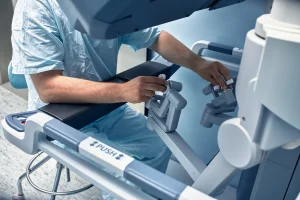
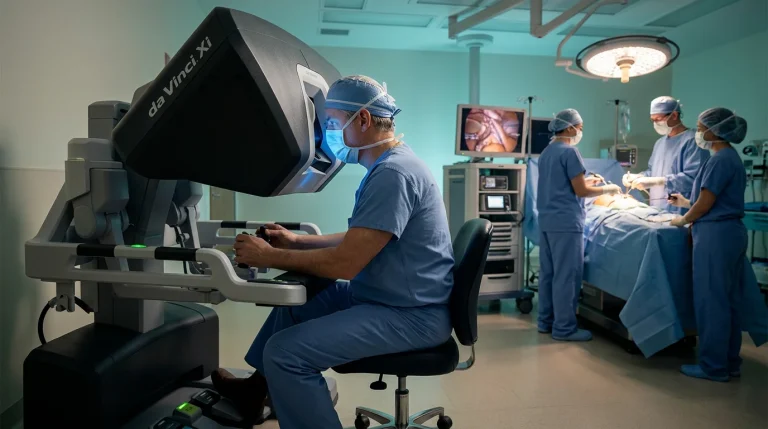
The da Vinci robotic platform is not a different surgery. It is a different way for the surgeon to perform the same surgery. The surgeon sits at a console a few feet from the patient, looking at a magnified three-dimensional view of the surgical field while their hands rest on controls that translate every motion into movements of the robot's arms inside the patient. The robot does not operate autonomously or make decisions; the surgeon does. Every cut, clip, and suture is the result of direct hand input.
What separates the robotic platform from a standard laparoscopic setup is a set of capabilities that change how the surgeon experiences the operation. The 3D vision provides up to 10x magnification, the EndoWrist instruments offer seven degrees of freedom that articulate more like a human wrist, tremor filtration removes small involuntary hand movements, and motion scaling converts larger hand movements at the console into smaller, more precise instrument movements. For a textbook cholecystectomy with clean anatomy, these advantages often do not change the outcome in any measurable way. For complicated cases involving severe inflammation, scarring from prior abdominal surgery, an unusually positioned gallbladder, or a high BMI, the enhanced visualization and precision matter, since clearer visualization of the cystic duct, cystic artery, and surrounding biliary anatomy makes the dissection safer.
Table 2: Da Vinci platform capabilities versus standard laparoscopy
| Capability | Standard laparoscopy | Da Vinci robotic platform |
| Visualization | 2D high-definition monitor | 3D stereoscopic console at up to 10x magnification |
| Instrument articulation | Rigid straight instruments, 4 degrees of freedom | Wristed EndoWrist instruments, 7 degrees of freedom |
| Tremor filtration | None | Real-time digital tremor filtering |
| Motion scaling | Direct 1:1 hand-to-instrument | Adjustable scaling for finer movements |
| Surgeon position | Standing at the patient's side | Seated at console adjacent to the patient |
| Tactile feedback | Direct through instruments | Substituted by visual cues ("visual haptics") |
| Camera control | Held by an assistant | Controlled directly by the operating surgeon |
Research comparing robotic and laparoscopic cholecystectomy has grown substantially over the last decade. Most published comparisons fall into two categories: large retrospective cohort studies using national databases, and smaller randomized controlled trials. Together they paint a consistent picture of comparable safety in routine cases and meaningful differences in complex ones.
A 2024 retrospective cohort analysis in the Annals of Surgery examined over 14,000 patients after propensity-score matching. The study reported similar overall complication rates in elective cases, with a significant reduction in conversion to open surgery in the robotic group for patients with acute cholecystitis, elevated BMI, or prior abdominal surgery. The odds ratio for conversion in complex cases favored robotic surgery at approximately 0.55 (95% CI 0.41 to 0.73). The BMJ Trauma Surgery & Acute Care Open journal has published similar findings for robotic cholecystectomy in acute cholecystitis. A separate randomized controlled trial in elective cases found no significant difference in operative time, length of stay, or 30-day complications, though it did find slightly higher patient-reported satisfaction with cosmetic outcomes in the robotic group.
What the evidence does not consistently show is a reduction in bile duct injury with robotic cholecystectomy. Bile duct injury is the most serious complication of gallbladder surgery, occurring in under 0.5% of cases at experienced centers, and large datasets have not yet demonstrated a statistically significant reduction with robotic approaches.
Table 3: Summary of major comparative findings
| Outcome measure | Finding in published studies | Clinical interpretation |
| Overall complication rate (uncomplicated cases) | No significant difference | Both approaches equally safe |
| Conversion to open surgery (complex cases) | Lower with robotic (OR ~0.55) | Robotic reduces open-conversion in difficult anatomy |
| Bile duct injury rate | No significant reduction with robotic | Theoretical advantage not yet confirmed in data |
| Operative time | 10 to 20 minutes longer with robotic | Modest tradeoff, not clinically significant |
| Length of stay | Similar (most same-day discharge) | No advantage either way |
| 30-day readmission | Similar | No advantage either way |
| Patient-reported cosmetic satisfaction | Slightly higher with robotic | Marginal difference in selected cohorts |
| Surgeon learning curve | Steeper for robotic | Outcomes improve substantially after 20 to 30 cases |
The data starts to favor robotic surgery in specific clinical presentations where dissection becomes more difficult and visualization more critical. The advantages translate into measurable reductions in conversion to open surgery and shorter hospital stays for the patients who need the most surgical precision.
Acute cholecystitis with severe inflammation is one of the clearest indications. When the gallbladder is inflamed and obscured by edematous tissue, the magnified 3D view and wristed instruments help the surgeon identify critical structures more confidently in a field where landmarks are blurred. This matters because bile duct injury usually happens when anatomy is misidentified during a difficult dissection. Obese patients also benefit because access and visualization are harder at elevated BMI.
Prior abdominal surgery with significant adhesions creates a different difficulty, where scar tissue can make every plane of dissection unpredictable. The robotic wrist often allows finer movements in tight adhesive planes than rigid laparoscopic instruments can achieve. Biliary anomalies represent another scenario where robotic surgery shows an edge, since roughly 10 to 15% of patients have some variation in biliary or vascular anatomy and the magnified 3D view helps surgeons recognize and adapt earlier in the case.
For most uncomplicated symptomatic gallstone disease in otherwise healthy patients, traditional laparoscopic cholecystectomy remains an excellent and often preferable choice. The procedure is well-studied across decades of literature, universally available, and performed by essentially every general surgeon. When the anatomy is straightforward and the case is elective, the theoretical advantages of robotic surgery do not translate into measurable benefits, and the additional operative time and facility cost are not justified by outcomes.
Practical situations also favor laparoscopic cholecystectomy. The surgeon may have higher laparoscopic volume, the facility's robotic platform may not be available on the date your surgery needs to happen, or insurance and facility logistics may favor laparoscopic. The single most important factor is the surgeon, not the instruments. A high-volume laparoscopic surgeon with excellent judgment will usually produce better outcomes than a lower-volume robotic surgeon, even when the robotic platform has theoretical advantages on paper.
Recovery timelines between the two approaches are effectively the same. Both approaches benefit from Enhanced Recovery After Surgery (ERAS) protocols, which include multimodal pain control, early mobilization, and structured hydration and nutrition strategies. These protocols contribute to same-day discharge in most uncomplicated cases and faster return to normal activity than older perioperative care models allowed.
The first 48 hours after either procedure typically involve some abdominal discomfort at the port sites and possible right shoulder pain from residual carbon dioxide. Patients are encouraged to walk frequently starting the day of surgery, eat lightly as tolerated, and take prescribed pain medication on a scheduled basis for the first day or two. By day five to seven, most patients have returned to light activity including driving and desk work, and most return to full activity by the two-week mark. Both approaches produce small, similar-sized scars: laparoscopic ports typically measure 5 to 12 mm and robotic ports typically measure 8 to 12 mm. After six months of healing, scars from either approach are usually difficult to see, and they continue to fade over the first full year.
Robotic surgery generally involves higher facility costs because of the equipment, disposables, and per-case licensing fees the technology requires. Whether that translates to higher out-of-pocket cost for the patient depends entirely on insurance coverage and the structure of the plan. Most major commercial plans, Medicare, and Medicaid cover robotic cholecystectomy at the same rate as laparoscopic when medically indicated, meaning copays and deductibles are typically identical for the patient.
For patients with high-deductible plans or those paying out of pocket, asking for specific cost estimates for both procedures makes sense. Ask the facility for the chargemaster price of each approach, the typical insurer-negotiated rate, and the expected patient responsibility based on year-to-date deductible status. Patients on Medicare should also confirm that the surgeon and facility are in-network for their specific Medicare Advantage plan, since out-of-network charges for robotic cases can be substantially higher than the patient anticipates.
A thoughtful pre-operative evaluation determines which approach is best suited to the case before surgery is scheduled. The surgeon will review the right upper quadrant ultrasound to assess gallbladder wall thickness and stone burden, may order a HIDA scan to evaluate ejection fraction in suspected biliary dyskinesia, and may request an MRCP when cystic duct anatomy is unclear or there is concern for stones in the common bile duct. These imaging studies inform whether the case is likely to be straightforward or whether complicating factors are likely to be encountered.
Several questions should be discussed during the consultation. Ask about the surgeon's case volume in both robotic and laparoscopic cholecystectomy, since high volume in either approach is more important than platform choice. Ask about conversion rates to open surgery and bile duct injury rates at the facility. Discuss any prior abdominal surgeries you have had, since adhesions may influence the recommended approach.
A thoughtful surgeon does not default to one platform for every case. The decision is matched to the patient based on imaging findings, history, body habitus, and the specific surgical challenges the case is likely to present. The conversation should cover imaging including ultrasound and any HIDA or MRCP results; signs of acute inflammation; prior abdominal surgeries and likely adhesions; BMI; suspected anatomic variations; and patient preferences after a clear discussion of tradeoffs.
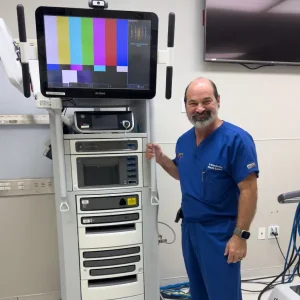
Dr. Brian Harkins is trained in both laparoscopic and robotic cholecystectomy and performs high volumes of each annually at HCA Houston Healthcare Tomball's Center of Excellence in Robotic Surgery. For patients in Tomball, Magnolia, Spring, Cypress, The Woodlands, and greater Houston, that dual expertise means the platform decision is driven by the case rather than by the tool the surgeon prefers.
Do not pick the technology. Pick the surgeon who is honest about when each approach helps, when it does not, and who performs high volumes of the platform they recommend for your case. The right answer for one patient is not always the right answer for another.
If you would like to discuss whether robotic or laparoscopic cholecystectomy makes sense for your situation, schedule a consultation with Dr. Brian Harkins at our Tomball office by calling 281-351-5409 or request an appointment online. We see patients from across greater Houston and perform surgeries at HCA Houston Healthcare Tomball, where both platforms are available and the choice between them is based on what your case actually needs.
For uncomplicated cholecystectomy, cohort studies and randomized trials show similar complication rates, recovery times, and outcomes. In complex cases involving acute cholecystitis, severe adhesions, or obesity, the robotic platform may reduce conversion to open surgery. Surgeon experience is the strongest predictor of outcome.
Safety profiles are comparable in uncomplicated elective surgery. In complex cases, robotic surgery appears to reduce conversion to open surgery and may aid in identifying critical biliary structures. Bile duct injury, the most serious complication, remains below 0.5% at experienced centers regardless of platform.
Robotic cholecystectomy has slightly longer operative times, by roughly 10 to 20 minutes on average, plus higher facility costs and no haptic feedback for the surgeon. For straightforward gallstone disease, published evidence does not show a meaningful outcome advantage that offsets these tradeoffs.
Yes, in many cases. Published analyses suggest lower conversion rates to open surgery in acute cholecystitis with robotic compared to laparoscopic approaches. The decision depends on surgeon experience, facility availability, and individual patient factors. Acute cases often benefit from intervention within 72 hours of symptom onset.
Most patients are discharged the same day under ERAS protocols. Length of stay extends beyond same-day discharge when patients have acute cholecystitis, significant comorbidities, intraoperative complications, or trouble controlling post-operative pain and nausea.
Scars from both approaches are small, comparable in size, and usually fade substantially within the first year. Laparoscopic ports range from 5 to 12 mm and robotic ports range from 8 to 12 mm. Individual healing influences final scar appearance more than the platform choice.
Facility costs for robotic surgery are typically higher because of equipment, disposables, and licensing fees. For insured patients, however, copays and deductibles are usually identical because most commercial plans, Medicare, and Medicaid cover both at the same rate when medically indicated. Verify benefits with the billing team before scheduling.
Recovery is similar to laparoscopic surgery. Most patients return to light activity such as driving and desk work within five to seven days and to full activity within about two weeks. The first 48 hours involve some port-site discomfort and possible right-shoulder referred pain that resolves quickly with movement.
Ask about annual case volume in both approaches, conversion rates to open surgery, bile duct injury rates at the facility, and whether intraoperative cholangiography is used routinely. Discuss any prior abdominal surgeries, since adhesions may influence the recommendation.
Most major commercial insurance plans, Medicare, and Medicaid cover robotic cholecystectomy at the same rate as laparoscopic when medically indicated. Copays and deductibles are typically identical to laparoscopic surgery. Always verify coverage in writing before scheduling, particularly for Medicare Advantage plans.

Dr. Brian Harkins is a renowned surgeon specializing in advanced, minimally invasive, and robotic surgical techniques. With a dedication to innovation and personalized patient care, he has transformed countless lives by delivering exceptional outcomes.
I want a website like this, where do i start?