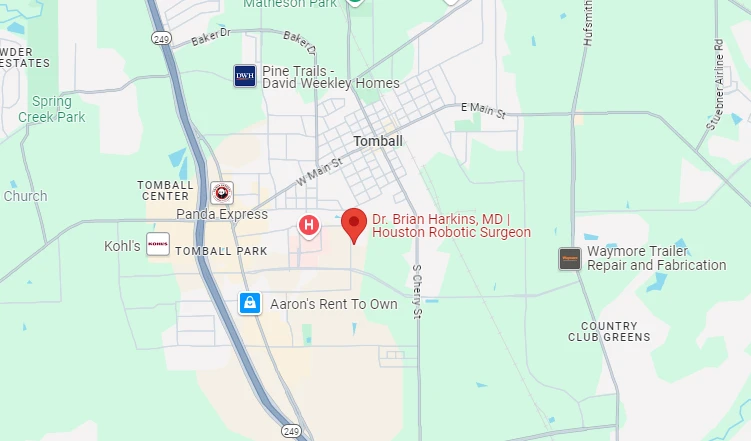
455 School St. Bldg. 1, Suite 10 Tomball, Texas 77375
Mon-Thu: 9:00 am – 5:00 pm | Fri: 9:00 am – 2:00 pm

For most small to mid sized ventral hernias (under 10 cm), robotic ventral hernia repair offers smaller incisions, lower surgical site infection rates, and faster recovery than open repair, with comparable recurrence rates in published series. For very large or complex ventral hernias, particularly those requiring component separation or significant abdominal wall reconstruction, open repair remains the standard. Hospital stay is typically 1 to 3 nights for robotic and 3 to 7 nights for open, with full recovery at 4 to 6 weeks for both.
A ventral hernia is a defect in the front of the abdominal wall through which abdominal contents (fat, intestine) push outward. Most ventral hernias fall into one of four types: umbilical hernias (at the navel), epigastric hernias (above the navel, below the rib cage), spigelian hernias (lateral abdominal wall), and incisional hernias (at the site of a previous abdominal surgical incision). Incisional hernias are by far the most common, occurring in roughly 10 to 30 percent of patients who have had open abdominal surgery, with higher rates in patients who develop wound complications or who have risk factors such as obesity, diabetes, smoking, or chronic steroid use.
For decades, open ventral hernia repair was the only option, especially for large or complex defects. Over the last 10 to 15 years, robotic ventral hernia repair using the da Vinci Xi platform has joined laparoscopic and open repair as a mainstream option. The result is that patients today have real choices, and the decision between robotic and open repair depends more on hernia size, complexity, anatomy, and surgeon experience than on a universal "better" answer. This guide walks through both approaches, the tradeoffs that matter, and how the choice is typically made for patients in the Tomball area.
A ventral hernia is a fascial defect in the anterior abdominal wall. The fascia is the strong connective tissue layer that holds the abdominal muscles together. When that layer weakens or separates, the contents inside the abdomen (omentum, fat, intestine) can push through the defect, creating a visible or palpable bulge under the skin.
Ventral hernias share several features in common:
The risk of progression varies. Small asymptomatic umbilical hernias in low risk patients may simply be watched. Symptomatic, enlarging, or complicated ventral hernias usually need elective surgical repair to prevent emergent complications and to relieve symptoms.
Surgical guidelines for ventral hernia have evolved similarly to other hernia repairs. Small, asymptomatic umbilical hernias in low risk patients can often be observed safely. Other ventral hernias usually merit surgical evaluation when:
The decision to operate is individualized. Hernias that are very small and asymptomatic may be safely watched. Hernias that are growing, symptomatic, or threaten complications usually move to elective repair before they become emergent.
The European Hernia Society (EHS) classification is widely used. It describes ventral hernias by location (midline vs lateral), width of the defect, and whether the hernia is primary (no previous abdominal surgery) or incisional. The width categories are:
Hernia width matters because it influences surgical approach. Small W1 hernias are often well suited to minimally invasive (laparoscopic or robotic) repair. Mid sized W2 hernias are increasingly approached robotically with techniques such as extended totally extraperitoneal repair (eTEP) or robotic transabdominis release. Large W3 hernias often require component separation and may be approached open, robotically with robotic transversus abdominis release (rTAR), or in some cases a hybrid approach.
In open ventral hernia repair, the surgeon makes a single incision over the hernia (or a midline incision for incisional hernias) to access the defect directly. The hernia sac is reduced, the defect is closed primarily, and mesh is typically placed to reinforce the repair. Mesh placement can be:
For large or complex ventral hernias, component separation techniques are often added. These release the lateral abdominal wall muscle layers (transversus abdominis or external oblique) to allow the fascia to be brought together in the midline without excessive tension. Component separation is what allows surgeons to close large defects that otherwise could not be closed primarily.
Open repair remains the standard for very large, complex, or recurrent ventral hernias because:
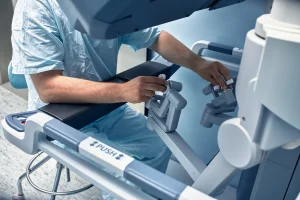
Robotic ventral hernia repair uses the da Vinci Xi platform to perform the same fundamental operation through small port incisions. Several techniques have emerged:
The robotic platform's magnified 3D vision and wristed instruments are particularly useful for the precise dissection required in the retromuscular plane, where laparoscopic instruments can be challenging. Multiple published series and registry analyses (including data from the Americas Hernia Society Quality Collaborative) suggest:

The table below summarizes how the two approaches compare on the metrics most patients ask about.
| Factor | Open ventral hernia repair | Robotic ventral hernia repair |
| Incision pattern | 1 longer midline or transverse incision (10 to 20+ cm) | 3 to 5 small ports (5 to 12 mm) |
| Typical operative time | 1.5 to 3 hours (longer for component separation) | 2.5 to 5 hours (longer for rTAR) |
| Hospital stay | 3 to 7 nights | 1 to 3 nights |
| Pain (early post op) | Moderate to severe, typically requires IV opioids 24 to 48 hours | Mild to moderate, often controlled with oral medication |
| Surgical site infection rate | 8 to 15 percent | 2 to 6 percent |
| Return to light activity | 3 to 4 weeks | 1 to 2 weeks |
| Return to full activity | 6 to 8 weeks | 4 to 6 weeks |
| Recurrence rate (1 to 2 year) | 5 to 15 percent (varies by size, technique, risk factors) | 5 to 12 percent (comparable in series) |
| Scar appearance at 1 year | Single longer scar | Multiple small scars, often hard to see |
| Best suited for | Very large (W3+) defects, complex multi-defect hernias, recurrent hernias after prior MIS repair, severely scarred abdomens | Small to mid sized (W1, W2) defects, primary umbilical and epigastric hernias, many incisional hernias without extensive prior dissection |
| Hospital cost | Lower facility cost | Higher facility cost (insurance coverage typically similar to patient) |
The evidence and clinical judgment favor robotic ventral hernia repair when:
Open repair often remains the better option when:

Recovery varies meaningfully between robotic and open approaches and also based on hernia complexity. The general patterns are:
Recovery is meaningfully affected by individual factors: age, overall health, pre-operative conditioning, BMI, and whether mesh was placed in a complex multi-layer reconstruction or a more straightforward repair.
Mesh is used in the large majority of modern ventral hernia repairs (robotic and open) because primary tissue-only closure has historically had high recurrence rates, often above 30 to 50 percent for incisional hernias. Mesh reduces recurrence substantially. The trade-off is that mesh introduces a small risk of mesh-related complications (chronic pain, infection, migration), which makes mesh choice and placement strategy important. Ask your surgeon what mesh they plan to use, where it will sit, and what the published recurrence and complication data look like for that specific product.
A ventral hernia is a defect in the fascia of the anterior abdominal wall that allows internal contents (omentum, fat, intestine) to push outward, creating a bulge under the skin. Common types include umbilical hernias (at the navel), epigastric hernias (between navel and breastbone), spigelian hernias (lateral abdominal wall), incisional hernias (at the site of a previous surgical scar), and parastomal hernias (around a stoma). Incisional hernias are the most common in surgical practice.
For small to mid sized ventral hernias (typically under 10 cm), robotic repair generally offers smaller incisions, lower surgical site infection rates, shorter hospital stay, and faster recovery in published series, with comparable recurrence rates. For very large or complex hernias requiring extensive component separation, open repair remains the standard. "Better" depends on hernia size, complexity, patient anatomy, surgeon experience, and individual priorities.
After robotic repair, most patients return to desk work in 1 to 2 weeks and reach full activity at 4 to 6 weeks. After open repair, recovery is longer: desk work at 3 to 4 weeks, full activity at 6 to 8 weeks. Larger and more complex hernias requiring component separation take longer to recover from regardless of approach.
In the large majority of modern ventral hernia repairs, yes. Tissue-only repairs have historically had high recurrence rates, often above 30 to 50 percent for incisional hernias. Mesh substantially reduces recurrence. Mesh choice (synthetic, biologic, absorbable), weight, and placement (onlay, sublay, intraperitoneal) are individualized to the hernia and patient.
Published 1 to 2 year recurrence rates for modern ventral hernia repair with mesh range from approximately 5 to 15 percent, depending on hernia size, technique, mesh choice, and patient risk factors. Recurrence rates are higher for very large hernias, recurrent hernias, patients with obesity, diabetes, smoking, and chronic steroid use. Recurrence rates for tissue-only (no mesh) repair are substantially higher and are rarely recommended today for ventral hernias above about 2 cm.
Increasingly, yes. Robotic transversus abdominis release (rTAR) and extended totally extraperitoneal (eTEP) techniques have expanded the size and complexity of ventral hernias that can be approached robotically. However, very large hernias (above 10 to 15 cm) with loss of domain, severe scarring from multiple prior operations, or other complex features may still be better suited to open repair. The decision is individualized at consultation.
All three are types of ventral hernia, but they differ in location. Umbilical hernias occur at the navel. Epigastric hernias occur in the upper midline between the navel and the breastbone. Incisional hernias occur at the site of a previous abdominal surgical scar. Treatment principles are similar (mesh-reinforced repair when surgery is indicated), but the approach depends on size, location, and the specifics of the defect.
For robotic ventral hernia repair, typical hospital stay is 1 to 3 nights, depending on hernia size and whether component separation was needed. For open repair, typical hospital stay is 3 to 7 nights. Complex large hernia reconstructions can extend either of these stays. Same day discharge is uncommon for ventral hernia repair, in contrast to inguinal hernia repair where same day discharge is standard.
Component separation is a surgical technique that releases the lateral abdominal wall muscle layers (transversus abdominis or external oblique) to allow the fascia to be brought together in the midline without excessive tension. It is used for medium to large ventral hernias where the defect cannot be closed primarily without releasing the lateral muscles. Component separation can be performed open (traditional) or robotically (robotic transversus abdominis release).
Consider consultation when the hernia causes pain or discomfort affecting daily activity, when the hernia is enlarging, when symptoms suggest intermittent obstruction or incarceration, when cosmetic concern is significant, or when risk factors for progression are present. Hernias that become acutely incarcerated or strangulated (severe pain, color change, bowel obstruction) are emergencies and need immediate evaluation. Small asymptomatic hernias in low risk patients can often be safely observed.
For a ventral hernia, the best surgical approach depends on the hernia and the patient, not on a universal "best" answer. Small to mid sized hernias often do well with robotic repair, where the smaller incisions, lower infection risk, and faster recovery are meaningful. Very large or complex hernias, especially those needing significant abdominal wall reconstruction, often still call for open repair or a robotic technique combined with component separation.If you would like to discuss whether robotic or open repair is the right approach for your ventral hernia, schedule a consultation with Dr. Brian Harkins at our Tomball office by calling 281-351-5409 or request an appointment online. We see patients from across the greater Houston area, with ventral hernia repairs performed at HCA Houston Healthcare Tomball's Center of Excellence in Robotic Surgery.

Dr. Brian Harkins is a renowned surgeon specializing in advanced, minimally invasive, and robotic surgical techniques. With a dedication to innovation and personalized patient care, he has transformed countless lives by delivering exceptional outcomes.
I want a website like this, where do i start?