455 School St. Suite 10 Tomball, Texas 77375
Mon-Thu: 9:00 am – 5:00 pm | Fri: 9:00 am – 2:00 pm


Passing a gallstone usually feels like steady or cramping pain in the upper right or middle of the abdomen that lasts at least 30 minutes and sometimes several hours, often after a heavy meal or at night. The pain usually eases once the stone moves out of the blocked duct and into the small intestine.
Many patients in Tomball and the greater Houston area describe the first episode the same way: a pain in the upper right belly that builds after dinner, keeps them awake for an hour or more, and then fades as suddenly as it arrived. Because the pain often leaves on its own, it is easy to wonder whether a gallstone simply passed and the problem is over.
This guide comes from the practice of a Tomball da Vinci robotic surgeon, and it explains what the government health sources describe when a stone moves through the bile ducts.
In this guide, you'll learn what gallstone pain usually feels like and how long it lasts, what happens as a stone moves and then passes, which warning signs mean you should get care right away, how doctors confirm that gallstones caused the pain, and what usually happens after an episode ends.
Gallstone pain usually feels like a cramping or constant ache in the middle to right upper abdomen, and MedlinePlus notes that it can feel sharp or dull depending on the person and the episode.
Doctors call this pain biliary colic, which is the medical name for the pain caused when a gallstone blocks one of the ducts that drain the gallbladder. The gallbladder is a small pouch under the liver that stores bile, a digestive fluid that helps the body break down fat. When a stone lodges in the opening of the gallbladder or in a bile duct, bile backs up behind it, and the pressure produces the pain that people describe as an attack.
The description patients give varies, which is part of what makes gallstones confusing, because some people feel a steady pressure while others notice waves of cramping across the upper belly. Nausea and vomiting can come with the pain, and the National Institute of Diabetes and Digestive and Kidney Diseases (NIDDK) notes that an attack can last for several hours.
| Feature | What the government sources describe | Source |
|---|---|---|
| Location | Middle to right upper abdomen | MedlinePlus |
| Quality | Constant or cramping, and it can feel sharp or dull | MedlinePlus |
| Duration | At least 30 minutes, sometimes several hours | MedlinePlus; NIDDK |
| Timing | Often after heavy meals, usually in the evening or at night | NIDDK |
| Other symptoms | Nausea and vomiting can occur with the pain | MedlinePlus; NIDDK |
| Pattern | One attack is likely to be followed by more | NIDDK |
When a gallstone moves, it travels from the gallbladder into the narrow ducts that carry bile toward the small intestine, and the pain usually lasts as long as the stone blocks the flow of bile.

Gallstones range in size from a grain of sand to a golf ball, according to MedlinePlus. MedlinePlus describes the classic pain as starting when a stone blocks one of the ducts that drain the gallbladder. Many people with gallstones never have symptoms at all, and NIDDK notes that gallstones which do not block the bile ducts do not cause symptoms.
The sequence below follows a stone from the gallbladder to the intestine, using the stages the government sources describe, although not every episode follows every step.
| Stage | What is happening | What you may notice |
|---|---|---|
| Stone sits in the gallbladder | The stone is not blocking anything | Usually nothing at all |
| Stone blocks the gallbladder outlet or a bile duct | Bile builds up behind the stone | Cramping or constant upper right or middle abdominal pain |
| Blockage continues | Pressure persists while the stone stays in place | Pain that lasts at least 30 minutes and may last several hours, sometimes with nausea |
| Stone moves into the small intestine | Bile can flow again | The pain usually goes away |
| Blockage lasts more than a few hours | Complications can begin | Pain that does not ease, fever, chills, or yellowing of the skin |
The relief at the end of an episode is the closest thing to a feeling of passing that the sources describe. MedlinePlus explains that the pain goes away if the stone passes into the first part of the small intestine, and NIDDK says attacks usually stop when stones move and no longer block the bile ducts. Neither source describes a separate sensation when a stone leaves the body, so a sudden easing of pain is the usual sign that a blockage has cleared.
A gallstone that stays stuck usually causes pain lasting several hours, and it may bring fever, chills, yellowing of the skin or eyes, tea-colored urine, or light-colored stools, which NIDDK says call for a doctor right away.
When a bile duct stays blocked for more than a few hours, NIDDK says complications can develop. MedlinePlus explains that a blockage can cause swelling or infection in the gallbladder, called cholecystitis, in the bile duct, called cholangitis, or in the pancreas, called pancreatitis. NIDDK also warns that blockages of the bile ducts or the pancreatic duct can be fatal if they are left untreated, which is why these signs are not worth waiting out at home.
| Warning sign | What it may point to | What NIDDK advises |
|---|---|---|
| Abdominal pain lasting several hours | A stone that has not moved out of the duct | See a doctor right away |
| Nausea and vomiting | A blockage that is not clearing | See a doctor right away |
| Fever, even a low grade fever, or chills | Possible infection of the gallbladder or bile ducts | See a doctor right away |
| Yellowish skin or whites of the eyes, called jaundice | A bile duct that may be blocked | See a doctor right away |
| Tea-colored urine and light-colored stools | A bile duct that remains blocked | See a doctor right away |
A stone that passes usually leaves you feeling better as the pain fades, while a stone that stays lodged tends to make the pain persist and can add fever or jaundice. If you cannot tell which situation you are in, that uncertainty is itself a reason to be examined by a doctor.
Doctors usually confirm gallstones with an abdominal ultrasound and blood tests, and they add other imaging when they need to see whether a stone is sitting in a bile duct.

Confirmation matters because gallstone symptoms overlap with several other conditions. NIDDK lists appendicitis, ulcers, pancreatitis, and gastroesophageal reflux disease (GERD) as conditions that can look like gallstones, and each of them needs prompt care from a doctor. A clear diagnosis also tells the care team whether a stone is still in the gallbladder, sitting in the common bile duct, or causing inflammation in a nearby organ.
| Test | What it shows | Notes from the government sources |
|---|---|---|
| Abdominal ultrasound | Stones in the gallbladder | NIDDK calls it the best imaging test for finding gallstones |
| Blood tests | Signs of infection, inflammation, or a blocked duct, including bilirubin, liver function, and pancreatic enzymes | Listed by MedlinePlus and NIDDK |
| Computed tomography (CT) scan | Stones or complications | NIDDK notes it can also miss gallstones |
| Magnetic resonance cholangiopancreatography (MRCP) | Stones in the bile ducts | A specialized magnetic resonance imaging (MRI) study of the bile ducts |
| Cholescintigraphy, also called a HIDA scan | Abnormal gallbladder emptying or a duct blockage | Uses a small amount of radioactive tracer |
| Endoscopic retrograde cholangiopancreatography (ERCP) | A stone stuck in the common bile duct | More invasive, and used selectively, usually to remove the stone |
Many people learn they have gallstones only by accident. The MedlinePlus gallstones overview notes that many people with stones have no symptoms and that stones are often found on imaging done for another reason. Your history of symptoms is what helps a surgeon tell a silent stone from one that has already caused an attack.
After a gallstone passes, the pain usually goes away, but NIDDK says that one gallbladder attack is likely to be followed by more, so doctors typically discuss treatment once symptoms have started.
The stone that caused the episode may be gone, but the gallbladder that formed it is still in place, and NIDDK notes that symptoms may go away and then appear again. Many patients find that the same pattern of pain after heavy meals returns. For that reason, the usual treatment for gallstones that cause symptoms is surgery to remove the gallbladder, called cholecystectomy, while silent gallstones that cause no symptoms usually need no treatment.
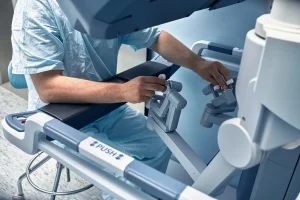
Surgeons remove the gallbladder through a few small incisions in most cases, using either laparoscopy or robotic gallbladder removal surgery, in which the surgeon operates the da Vinci system from a console. MedlinePlus reports that nearly all people who have their gallbladder removed do not have their symptoms return. For an uncomplicated case in an otherwise healthy patient, robotic and laparoscopic cholecystectomy are both sound options, and the surgeon recommends one after reviewing your history and imaging.
Your imaging report may use the word cholelithiasis, which is simply the medical term for having gallstones in the gallbladder, and the decision about surgery is made with a surgeon who has reviewed your imaging, symptoms, and general health.
Northwest Houston surgeon Dr. Brian Harkins is a board-certified general surgeon in Tomball who evaluates gallstone pain and performs robotic gallbladder surgery when removal is the right choice.
Credentials and experience: Dr. Harkins holds MD and FACS credentials and is certified by the American Board of Surgery. He has practiced in the Northwest Houston area since 1997, chairs the Robotics Committee at HCA Houston Healthcare Tomball, a Center of Excellence in Robotic Surgery, and sees patients who travel from across the United States and abroad.
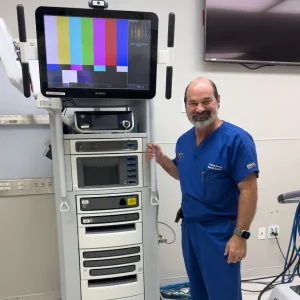
Robotic gallbladder surgery: Dr. Harkins operates the da Vinci Xi system from a console, where he works with a magnified 3D view and wristed instruments that filter hand tremor and move with seven degrees of freedom. The system never operates on its own. Robotic surgery uses smaller incisions than open surgery, which typically means less tissue trauma and a faster recovery, and most patients return to light activity within 2 to 3 weeks compared with 6 to 8 weeks after open surgery, although full recovery takes longer.
An honest look at fit: Robotic surgery is not the right choice for every patient or every condition, and some operations need to be converted to open surgery during the operation for safety. Every surgery carries real risks, and the consultation is where the surgeon reviews your symptoms and imaging and explains whether an operation makes sense for you.
The pain of a gallstone attack lasts at least 30 minutes and sometimes several hours, according to the government sources. Pain that continues for several hours suggests the stone may be stuck, and that calls for a doctor right away.
Most people feel it in the middle to right upper abdomen, according to MedlinePlus. The location and timing help doctors separate gallstone pain from other causes of belly discomfort.
The sources describe no separate sensation when a stone leaves the body. What most people notice is that the pain eases once the stone moves out of the duct and into the small intestine.
A stone that moves into the intestine usually causes no further harm, but a stone that stays lodged can lead to infection or inflammation. Fever, jaundice, or pain lasting hours needs care right away.
NIDDK says attacks often follow heavy meals and usually occur in the evening or during the night. Noting when each episode starts gives your doctor useful information at your visit.
Gallstone pain is usually a cramping or constant ache in the upper right abdomen that lasts at least 30 minutes. GERD and ulcers can feel similar, so a doctor confirms the cause with an examination and tests.
Yes, a stone can lodge in the common bile duct and block the flow of bile. Signs include jaundice, tea-colored urine, and light-colored stools, and doctors may use ERCP to remove the stone.
It often does, because NIDDK says one gallbladder attack is likely to be followed by more. The gallbladder that formed the stone is still in place, so doctors typically discuss treatment after the first episode.
An abdominal ultrasound is the imaging test NIDDK describes as best for finding gallstones. Blood tests, MRCP, HIDA scans, and CT may be added to check the ducts and nearby organs.
MedlinePlus reports that nearly all people who have their gallbladder removed do not have their symptoms return. The surgeon reviews whether surgery makes sense for you after looking at your history and imaging.
Passing a gallstone usually feels like cramping or constant pain in the upper right or middle abdomen that lasts from about 30 minutes to several hours and then eases once the stone clears the duct. Pain that lingers for hours, or that comes with fever, chills, jaundice, dark urine, or pale stools, points to a stone that has stuck and needs care right away.
Because one attack is often followed by more, an episode that ends on its own is still worth a conversation with a surgeon. You can schedule a consultation about recurring gallstone pain so a board-certified surgeon can review your symptoms and imaging and explain the options that fit your health and goals.
Ask about recurring gallstone pain today.
Call (281) 351-5409 to schedule your consultation.
This information is educational and is not a substitute for professional medical advice. Every patient is different. Dr. Brian Harkins will discuss whether robotic-assisted surgery is right for your specific situation based on your anatomy, health, and goals.

Dr. Brian Harkins is a renowned surgeon specializing in advanced, minimally invasive, and robotic surgical techniques. With a dedication to innovation and personalized patient care, he has transformed countless lives by delivering exceptional outcomes.
I want a website like this, where do i start?