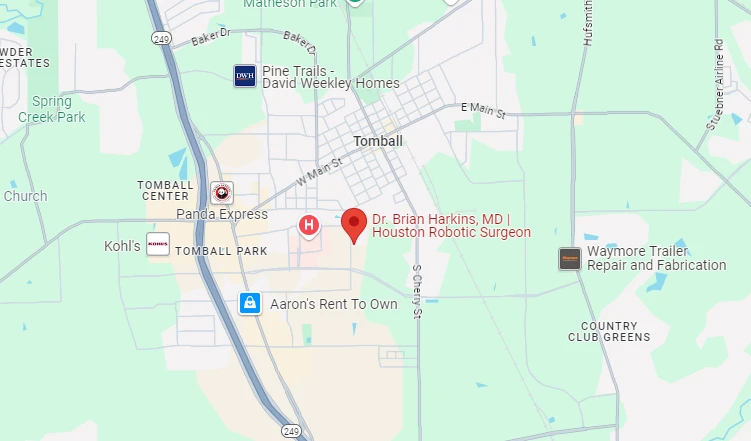
455 School St. Suite 10 Tomball, Texas 77375
Mon-Thu: 9:00 am – 5:00 pm | Fri: 9:00 am – 2:00 pm

Most colon polyps are not serious on their own, because most are benign growths that cause no symptoms. Some types, especially adenomas and serrated polyps, can turn into colorectal cancer over many years, and the risk usually rises with a larger polyp, a higher number of polyps, and abnormal cells called dysplasia.
Many adults in Tomball and the greater Houston area first hear the word polyp after a routine screening colonoscopy, often while they are still waking up from sedation and before the lab results are back. The word sounds alarming, so it is natural to wonder how serious colon polyps are and whether the finding means cancer is already present or on its way.
The honest answer sits between the two extremes, because most polyps never become cancer, yet a small share carry real cancer potential that depends on their type, their size, and how their cells look under a microscope.
In this guide, you'll learn how common colon polyps are, which types are more serious than others, what makes a polyp more likely to contain cancer, which symptoms deserve a prompt call to a doctor, and how screening and follow-up keep the risk low for most patients.
For most adults, colon polyps are a common and usually harmless finding, and the main concern is that some types can slowly become cancer if they are left in place.
According to the National Institute of Diabetes and Digestive and Kidney Diseases (NIDDK), colon polyps are growths on the lining of the colon and rectum, and a person can have more than one. The same source reports that anywhere between 15 and 40 percent of adults may have colon polyps, that they are more common in men and in older adults, and that most polyps are not cancerous, although some may turn into cancer over time.
That last point is why doctors take polyps seriously even when they cause no trouble. NIDDK notes that colorectal cancer most often begins as polyps and is the third leading cause of cancer death in the United States, and the American Cancer Society adds that the change from polyp to cancer usually takes many years, which gives screening a long window to find and remove the polyps that matter.
NIDDK lists several risk factors that raise the chance of developing a colorectal polyp, and they help explain why screening advice is not the same for everyone. Family history gets close attention because rare inherited conditions, such as familial adenomatous polyposis, which causes very large numbers of polyps, change the colon cancer risk for a whole family.
| Risk factor | What NIDDK says | Why it matters for seriousness |
|---|---|---|
| Age 45 or older | Polyps become more likely with age | Screening usually begins at 45 for people at average risk |
| Family history | A relative who has had polyps or colorectal cancer raises the chance | Doctors may suggest earlier or more frequent testing |
| Inflammatory bowel disease | Ulcerative colitis or Crohn's disease raises the chance | Long-term inflammation calls for closer follow-up |
| Obesity | Linked with a greater chance of polyps | A risk factor that can be discussed with your doctor |
| Smoking cigarettes | Linked with a greater chance of polyps | Another factor your doctor weighs when planning tests |
The type of polyp matters more than anything else, because adenomas and serrated polyps can become cancer, while hyperplastic and inflammatory polyps are generally not precancerous.

After a polyp is removed, a pathologist names its type in a pathology report, and the American Cancer Society explains that the chance of a polyp turning into cancer depends on that type, so the report is the most useful guide to how serious your own polyp was.
Adenomas sometimes change into cancer, which is why the American Cancer Society calls them a precancerous condition. There are three kinds of adenoma: tubular adenomas are the most common, villous adenomas are the least common but more likely to change into cancer, and tubulovillous adenomas share features of both.
Sessile serrated polyps and traditional serrated adenomas are named for the saw-tooth look of their cells under the microscope. The American Cancer Society notes that these polyps are often treated like adenomas because they have a higher risk of changing into cancer, so they usually call for the same careful follow-up.
Hyperplastic and inflammatory polyps are more common than adenomas, and in general they are not precancerous. The American Cancer Society adds one qualification, which is that some people with large hyperplastic polyps, more than 1 centimeter across, might need screening colonoscopy more often.
| Polyp type | How common it is | Cancer potential, per the American Cancer Society |
|---|---|---|
| Tubular adenoma | The most common adenoma | Precancerous, so it is removed and followed |
| Villous adenoma | The least common adenoma | More likely than other adenomas to change into cancer |
| Tubulovillous adenoma | Mixed features of tubular and villous | Precancerous, so it is removed and followed |
| Sessile serrated polyp | Less common than hyperplastic polyps | Often treated like an adenoma because of higher risk |
| Traditional serrated adenoma | Uncommon | Often treated like an adenoma because of higher risk |
| Hyperplastic polyp | Common | Generally not precancerous, though large ones may change screening timing |
| Inflammatory polyp | Common | Generally not precancerous |
Beyond the type, three findings make a polyp more serious: a size larger than 1 centimeter, more than three polyps found at once, and dysplasia, which means abnormal cells that have not yet become cancer.
The American Cancer Society lists these three factors as signs that a polyp is more likely to contain cancer or that a person's overall risk of colorectal cancer is higher, which is why a pathology report usually describes size, number, and cell changes along with the type.
| Factor | Threshold named by the American Cancer Society | What it means in plain terms |
|---|---|---|
| Size | Larger than 1 centimeter | Bigger polyps have had more time and room to change |
| Number | More than 3 polyps found | Several polyps suggest the colon lining forms them readily |
| Histology | Dysplasia seen in the polyp | The cells look abnormal, although they are not yet cancer |
| Cancer in the polyp | Cancer cells found on review | Cancer can grow into the wall of the colon or rectum over time |
When cancer does form inside a polyp, the American Cancer Society explains that it can grow into the wall of the colon or rectum over time, and that is the point at which a polyp stops being a screening finding and becomes a cancer that needs its own treatment plan. None of these thresholds can tell you whether your own polyp was dangerous, because the report has to be read together with the full colonoscopy findings and your medical history.
Most colon polyps cause no symptoms at all, but rectal bleeding, blood in the stool, or tiredness from anemia can occur and are reasons to contact a doctor right away.
NIDDK explains that most people with colon polyps feel well and cannot tell that the polyps are there, which is why screening is done in people without symptoms. When polyps do cause symptoms, NIDDK names the ones below and notes that many other health problems can cause them too.
| Symptom | What you might notice | What NIDDK advises |
|---|---|---|
| Rectal bleeding | Blood on underwear or toilet paper after a bowel movement | Contact your doctor right away |
| Blood in the stool | Stool that looks black or has red streaks | Contact your doctor right away |
| Tiredness from anemia | Fatigue linked with a lack of iron caused by slow bleeding | Have it checked so the cause can be found |
Because these signs overlap with common problems such as hemorrhoids, only an evaluation by a doctor can show what is behind them.
Serious colon polyps are usually found through colorectal cancer screening, removed when they are found, and then followed with repeat colonoscopy on a schedule set by the findings.
NIDDK states that doctors recommend colorectal cancer screening starting at age 45 for people who do not have health problems or other factors that raise their risk, and that people at higher risk may be advised to start younger and be tested more often. For adults older than 75, NIDDK suggests talking with a doctor about whether screening should continue, and it points readers to the current guidelines from the U.S. Preventive Services Task Force (USPSTF), the national panel that reviews screening evidence.

Most polyps are removed during the colonoscopy itself, and the pathology report then guides how soon the next colonoscopy should be, with shorter intervals for higher risk findings. Follow-up matters because new polyps can form in the years after a clean removal, so a single screening test is the start of a plan rather than the end of one. A small number of polyps are too large or too flat to remove safely through the scope, or turn out to contain cancer, and those cases may lead to a referral for colorectal surgery in Houston to remove the affected section of bowel, an operation that can often be done through small incisions with colon and rectal surgery using a robotic approach.
| Situation after colonoscopy | What usually happens next |
|---|---|
| Hyperplastic or inflammatory polyps only | Routine screening schedule in most cases |
| Adenomas or serrated polyps removed | A shorter interval before the next colonoscopy |
| Large polyps, many polyps, or dysplasia | Closer follow-up and sometimes a recheck of the site |
| Polyp that cannot be removed through the scope | Referral to a surgeon to discuss removing that section of colon |
| Cancer found in a polyp | Further tests and a treatment plan, which may include colon cancer surgery |
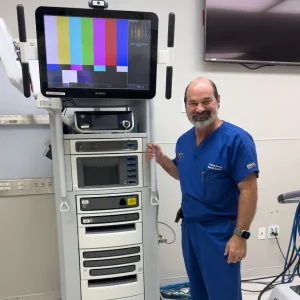
Board-certified Tomball surgeon Dr. Brian Harkins performs robotic and minimally invasive surgery for colon and rectal conditions, including the polyps that cannot be removed through a colonoscopy.
Credentials and experience: Dr. Harkins is a board-certified general surgeon with MD and FACS credentials, certified by the American Board of Surgery, and he has practiced in the Northwest Houston area since 1997. He chairs the Robotics Committee at HCA Houston Healthcare Tomball, a Center of Excellence in Robotic Surgery, and patients travel from across the United States and abroad to see him.
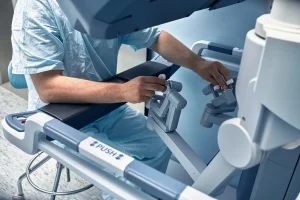
Robotic colon and rectal surgery: The practice treats colon and rectal cancer, diverticulitis, polyps, and colitis, using the da Vinci Xi surgical system as the standard platform. The surgeon operates the system from a console with a magnified 3D view, tremor filtration, and wristed instruments, and the system never operates on its own.
Recovery and honest limits: Robotic surgery uses smaller incisions than open surgery, typically with less tissue trauma and a faster recovery, and most patients return to light activity within 2 to 3 weeks, compared with 6 to 8 weeks after open surgery. Full recovery takes longer, robotic surgery is not right for every patient, and some operations need to be converted to open surgery for safety.
No. NIDDK states that most colon polyps are not cancerous, although some may turn into cancer over time. That is why polyps found during screening are usually removed and examined.
NIDDK reports that anywhere between 15 and 40 percent of adults may have colon polyps. They are more common in men and in older adults.
Among adenomas, villous adenomas are the most likely to change into cancer, according to the American Cancer Society. Sessile serrated polyps and traditional serrated adenomas also carry higher risk.
The American Cancer Society lists a size larger than 1 centimeter as a factor that makes a polyp more likely to contain cancer. Your doctor weighs size together with type and cell changes.
Dysplasia means the cells in the polyp look abnormal but have not yet become cancer. It is one reason a doctor may recommend closer follow-up.
The American Cancer Society says polyps that change into cancer usually do so over many years. That long timeline gives screening the chance to find and remove them first.
Usually not. NIDDK explains that most people with colon polyps have no symptoms and feel well, which is why screening is done before symptoms appear.
Usually not, because most polyps are removed during colonoscopy. Surgery is considered when a polyp cannot be removed safely through the scope or contains cancer.
In general they are not precancerous. The American Cancer Society notes that some people with large hyperplastic polyps might need screening colonoscopy more often.
NIDDK says screening usually starts at age 45 for people at average risk. People with a family history or other risk factors may be advised to start earlier.
Colon polyps are common, and most are not serious, but adenomas and serrated polyps can slowly become colorectal cancer, especially when a polyp is large, when several are found, or when dysplasia appears on the pathology report. Knowing the type, size, and number of your polyps turns a frightening word into a clear picture of your own risk.
Screening finds most serious polyps early enough to remove them during colonoscopy, and surgery is reserved for the few that cannot be removed that way or that contain cancer. If your report raised questions, you can schedule a consultation about your colon polyp findings and bring the pathology report with you. Patients across the area who need surgery after a polyp finding often look for a Northwest Houston robotic surgeon who can explain every option in plain language.
Ask about your colon polyp results.
Call (281) 351-5409 to schedule your consultation.
This information is educational and is not a substitute for professional medical advice. Every patient is different. Dr. Brian Harkins will discuss whether robotic-assisted surgery is right for your specific situation based on your anatomy, health, and goals.

Dr. Brian Harkins is a renowned surgeon specializing in advanced, minimally invasive, and robotic surgical techniques. With a dedication to innovation and personalized patient care, he has transformed countless lives by delivering exceptional outcomes.
I want a website like this, where do i start?