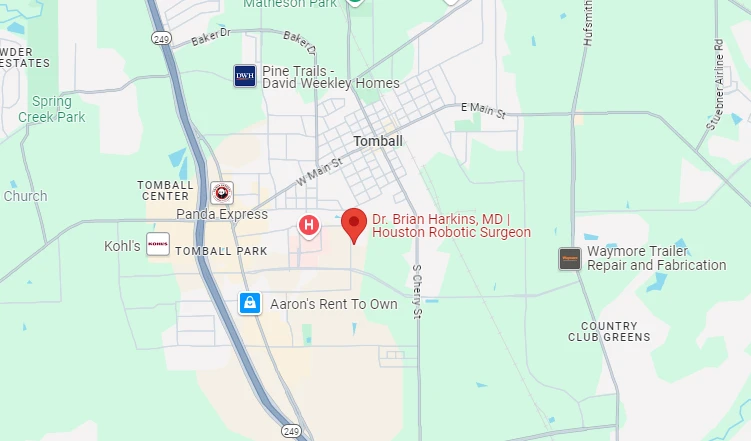
455 School St. Bldg. 1, Suite 10 Tomball, Texas 77375
Mon-Thu: 9:00 am – 5:00 pm | Fri: 9:00 am – 2:00 pm

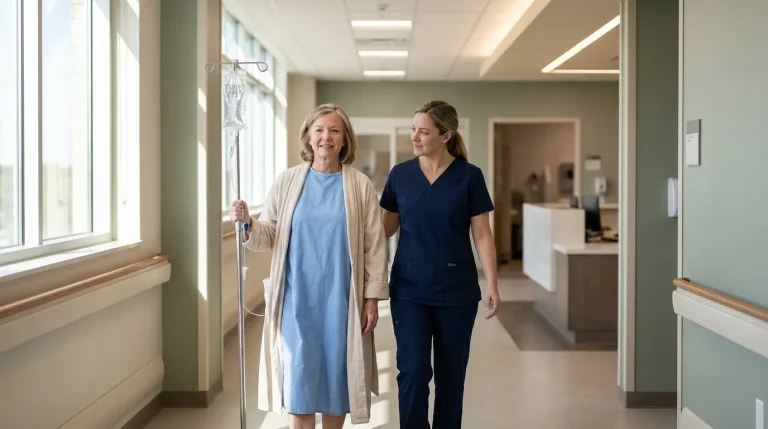
Recovery from robotic or laparoscopic colorectal surgery under an Enhanced Recovery After Surgery (ERAS) protocol typically involves a 2 to 4 night hospital stay, return to desk work in 2 to 3 weeks, and full activity at 4 to 6 weeks. The colon needs time to wake up, the anastomosis (bowel reconnection) needs time to heal, and bowel function takes several weeks to fully normalize. Walking on the day of surgery, early feeding, and multimodal non-opioid pain control are the ERAS practices that make this faster recovery possible.
Colorectal surgery takes longer to recover from than gallbladder or hernia surgery, and patients understandably want to know the timeline. After a segment of colon is removed and the healthy ends are reconnected, the body needs time for that reconnection to heal and for normal bowel function to return. The good news is that recovery from colorectal surgery in 2026 is meaningfully faster than it was a generation ago, thanks to Enhanced Recovery After Surgery (ERAS) protocols and minimally invasive robotic technique.
This guide walks through the recovery timeline week by week, what ERAS does to speed healing, what to expect with diet and bowel function, and the warning signs that warrant a call. For patients in the Tomball area, this reflects the pathway Dr. Brian Harkins uses at HCA Houston Healthcare Tomball, part of his broader robotic surgery practice. Our overview of robotic colorectal surgery covers the operations themselves in detail.
Colorectal surgery refers to operations on the colon and rectum. The most common elective procedures include:
Most elective colorectal surgery today is performed minimally invasively, either robotically or laparoscopically, through small port incisions. Minimally invasive surgery produces less tissue trauma, less pain, and faster return of bowel function than open surgery. The timeline in this guide reflects a typical elective minimally invasive resection with a primary anastomosis (the bowel reconnected during the same operation) under an ERAS protocol.
Enhanced Recovery After Surgery is a coordinated set of evidence-based practices originally developed for colorectal surgery, which is where it has the strongest evidence and the biggest impact. The traditional pathway of prolonged fasting, IV opioids, and bed rest actively worked against recovery. ERAS reverses those defaults, and published trials show it reduces hospital stay by an average of 2 to 3 days, lowers complications, and reduces readmissions without compromising safety.
The core ERAS practices that speed colorectal recovery are:

Recovery follows a fairly predictable arc, though it varies with age, overall health, the specific operation, and how closely the plan is followed. The table below summarizes the typical milestones.
| Time after surgery | What to expect | Activity and diet |
| Hospital days 1 to 4 | Walking several times daily; first bowel movement around day 2 to 4; IV to oral pain control | Clear liquids advancing to soft diet |
| Week 1 home | Low energy, frequent rest, mild incision discomfort, irregular bowel function | Short walks, low-residue diet, no lifting over 10 lb |
| Week 2 | Energy returning; first post-op visit; bowel function still adjusting | Desk work for many; diet broadening |
| Weeks 3 to 4 | Near baseline for daily activity; bowel function more regular | Gentle exercise; most jobs with clearance |
| Weeks 5 to 6 | Full activity clearance for most patients | Lifting and strenuous exercise resume |
| Beyond 6 weeks | Stable new normal; some dietary adaptation continues | Normal activity and diet |
The hospital stay, typically 2 to 4 nights, is focused on getting the bowel working again and controlling pain with oral medication. Discharge happens once a patient tolerates a soft diet, controls pain orally, walks independently, and shows return of bowel function. The first week home is the most fatiguing stretch, and most patients need frequent rest.

Immediately after surgery, the diet starts with clear liquids and advances to a low-residue diet, which limits high-fiber foods, raw vegetables, nuts, seeds, and tough meats that are harder for a healing colon to process. Over the first few weeks, fiber and variety are gradually reintroduced as tolerated, and most patients return to a normal diet by four to six weeks.
Bowel function takes time to normalize after any colon resection. Irregular habits, ranging from looser or more frequent stools to occasional constipation, are common and expected as the shortened colon adapts. Patients who had a segment of the left colon or rectum removed often have more frequent or urgent bowel movements early on that improve substantially over the first few months. Staying hydrated, eating small frequent meals, and reintroducing fiber gradually all help the colon settle into a stable pattern, usually within a few months.
In most elective colorectal operations, the bowel is reconnected during the same surgery and no stoma is needed. In some cases, particularly low rectal resections or higher-risk reconnections, a surgeon may create a temporary diverting ileostomy or colostomy to protect the healing anastomosis while it seals, then reverse it in a second, smaller operation several weeks to a few months later. The hospital's ostomy nurses teach stoma care thoroughly before discharge, and most patients adapt well. Whether a temporary stoma is likely is discussed before surgery so patients can prepare.
Most recoveries proceed smoothly, but certain symptoms warrant a prompt call to the surgical team at 281-351-5409:
The most serious early complication is an anastomotic leak, in which the bowel reconnection does not seal properly. It is uncommon (roughly 3 to 8 percent of colorectal anastomoses depending on the operation and patient factors) and typically appears in the first several days to two weeks with worsening pain, fever, and feeling unwell. This is why patients should never hesitate to call with concerning early symptoms.
For patients in Tomball, Magnolia, Cypress, Spring, and The Woodlands, recovering close to the surgical team is a real advantage during the first few weeks, when follow-up visits matter most and driving may still be restricted. Surgeries are performed at HCA Houston Healthcare Tomball, a Center of Excellence in Robotic Surgery minutes from the office. The first post-operative visit typically happens around 2 weeks after discharge, with a second at 4 to 6 weeks for final clearance. Telemedicine follow-up is available for patients traveling from farther parts of greater Houston.
Recovery from elective minimally invasive colorectal surgery under an ERAS protocol typically involves a 2 to 4 night hospital stay, return to desk work in 2 to 3 weeks, and full activity at 4 to 6 weeks. Bowel function continues to normalize over several weeks to months. Open and emergency operations involve longer recovery.
ERAS (Enhanced Recovery After Surgery) is a coordinated set of evidence-based practices developed for colorectal surgery: carbohydrate loading, minimally invasive technique, opioid-sparing pain control, goal-directed fluid management, early feeding, and early mobilization. Published trials show it reduces hospital stay by 2 to 3 days, lowers complications, and reduces readmissions.
The first bowel movement typically occurs around day two to four in the hospital and is a key discharge milestone. Bowel habits are often irregular for the first few weeks and normalize over several weeks to months. Left colon and rectal resections tend to cause more frequent or urgent movements early on that improve over the first few months.
Diet starts with clear liquids and advances to a low-residue diet, limiting high-fiber foods, raw vegetables, nuts, seeds, and tough meats while the colon heals. Fiber and variety are reintroduced gradually over the first few weeks, with most patients returning to a normal diet by four to six weeks. Small frequent meals and good hydration help.
In most elective operations, the bowel is reconnected during the same surgery and no stoma is needed. For low rectal resections or higher-risk reconnections, a surgeon may create a temporary diverting ileostomy or colostomy to protect the healing anastomosis, typically reversed several weeks to a few months later. Whether a temporary stoma is likely is discussed before surgery.
An anastomotic leak is a complication in which the bowel reconnection does not seal properly, allowing intestinal contents to leak. It is uncommon, occurring in roughly 3 to 8 percent of colorectal anastomoses depending on the operation and patient factors, and typically presents in the first several days to two weeks with worsening pain, fever, and feeling unwell. Prompt evaluation is important.
Most patients can drive once they are off prescription opioid pain medication and can move and react comfortably, typically around 1 to 2 weeks after minimally invasive colorectal surgery. Your surgeon will give specific guidance based on your operation and recovery.
Minimally invasive surgery (robotic or laparoscopic) produces less tissue trauma, less pain, faster return of bowel function, and shorter hospital stays than open surgery, with similar recovery between robotic and laparoscopic. Open surgery, used for some complex or emergency cases, involves a longer stay and recovery.
Call 281-351-5409 for fever above 101 degrees Fahrenheit, worsening abdominal pain, persistent vomiting, inability to pass gas or stool, expanding incision redness or drainage, calf pain or swelling, or shortness of breath. These can signal an ileus, infection, blood clot, or anastomotic leak.
Most patients feel close to baseline by three to four weeks and reach full activity clearance at four to six weeks. Bowel function and dietary tolerance continue to settle over the following months, with a stable new normal typical within a few months.
Recovery from colorectal surgery is a real process, but a well-understood and increasingly comfortable one. ERAS protocols and minimally invasive robotic technique have shortened hospital stays, reduced pain, and sped the return of normal function. Knowing the timeline, understanding what is normal, and staying in close contact with the surgical team are the keys to a smooth recovery.
If you would like to discuss robotic colorectal surgery or recovery for your situation, schedule a consultation with Dr. Brian Harkins, a robotic surgeon in Tomball, by calling 281-351-5409 or contact us online. We see patients from across the greater Houston area, with robotic colorectal surgeries performed at HCA Houston Healthcare Tomball's Center of Excellence in Robotic Surgery.
Sarah Chen is a healthcare communications specialist with 12+ years of experience in clinical environments. She writes about robotic and minimally invasive surgery for patients and families navigating surgical decisions. Her work is clinically reviewed by Dr. Brian Harkins, MD, FACS, ensuring medical accuracy and evidence-based information.
Based in: Tomball, TX | Serves: Greater Houston Area
This information is educational and is not a substitute for professional medical advice. Recovery timelines vary based on the specific operation, reason for surgery, overall health, age, and individual factors. The guidance above reflects typical courses for elective minimally invasive colorectal surgery under an ERAS protocol. Dr. Brian Harkins and his clinical team provide personalized post-operative instructions for each patient; follow their guidance over any general information here. Statistics cited reflect published research on aggregate patient populations, and individual outcomes vary. This content has been reviewed for medical accuracy by Dr. Brian Harkins, MD, FACS.

Dr. Brian Harkins is a renowned surgeon specializing in advanced, minimally invasive, and robotic surgical techniques. With a dedication to innovation and personalized patient care, he has transformed countless lives by delivering exceptional outcomes.
I want a website like this, where do i start?