455 School St. Suite 10 Tomball, Texas 77375
Mon-Thu: 9:00 am – 5:00 pm | Fri: 9:00 am – 2:00 pm


Gallstones that cause symptoms are usually treated by surgery to remove the gallbladder, according to the National Institute of Diabetes and Digestive and Kidney Diseases. Medicines can dissolve some small cholesterol stones, but only in special situations, and the stones can return. Gallstones that cause no symptoms usually need no treatment.
If you have been told you have gallstones, or you are having pain after meals and suspect them, the first question is usually how to make them go away. Patients in Tomball and the greater Houston area ask this often, and the honest answer depends on whether the stones are causing symptoms, what kind of stones they are, and whether another medical condition affects the choice of treatment.
This guide comes from the practice of a Tomball robotic gallbladder surgeon, and it lays out the treatment options in the order patients tend to ask about them. It explains what the National Institutes of Health describes as standard care, where the nonsurgical options fall short, and how a surgeon thinks about the decision.
In this guide, you'll learn when gallstones need treatment, which nonsurgical options exist and where they have limits, why gallbladder removal is the usual answer, and which symptoms mean you should get care right away.
No, gallstones that cause no symptoms, known as silent gallstones, usually do not need treatment, while stones that cause gallbladder attacks usually do.
Most people with gallstones never notice them. Silent gallstones do not stop the gallbladder, liver, or pancreas from working, so a doctor typically has no reason to treat them. The situation changes when a stone blocks a bile duct, the small tube that carries bile out of the gallbladder, because bile then builds up and causes a gallbladder attack.
A gallbladder attack usually causes pain in the upper right abdomen that can last several hours. Attacks often follow heavy meals and tend to happen in the evening or during the night. The National Institute of Diabetes and Digestive and Kidney Diseases (NIDDK) notes in its symptoms and causes guidance that one attack is likely to be followed by more, so a first attack is worth raising with a doctor.
| Situation | What NIDDK describes | Usual approach |
|---|---|---|
| Silent gallstones | No symptoms, and the gallbladder, liver, and pancreas keep working | Usually no treatment |
| One gallbladder attack | Upper right abdominal pain, often after a heavy meal, lasting up to several hours | Contact your doctor, because more attacks will likely follow |
| Repeated attacks | Symptoms may go away and then return | Treatment is usually discussed, most often surgery |
| A bile duct blocked for more than a few hours | Gallstone complications become possible | See a doctor right away |
A surgeon or gastroenterologist, a doctor who treats digestive conditions, decides which row you fit after reviewing your history and imaging. That review is why no article can tell you whether your own stones need treatment.
Doctors use nonsurgical treatments only in special situations, most often for cholesterol stones in people whose medical conditions prevent surgery, and even then stones can return.

Gallstones come in two main kinds. Cholesterol stones form when bile contains too much cholesterol, and pigment stones form from too much bilirubin, a yellow substance the liver produces when it breaks down old red blood cells. NIDDK says doctors can sometimes treat cholesterol stones without surgery, while pigment stones usually require an operation.
Three nonsurgical treatments are described, and each has a narrow use.
| Option | What it does | Limits |
|---|---|---|
| Endoscopic retrograde cholangiopancreatography (ERCP) | A doctor removes a stone that is stuck in the common bile duct | Sometimes used for a stuck stone in the duct |
| Oral dissolution therapy with ursodiol or chenodiol | Bile acid medicines that can break up gallstones | Works best on small cholesterol stones, and treatment may take months or years |
| Shock wave lithotripsy | Shock waves blast gallstones into small pieces | Doctors use it only rarely, sometimes along with ursodiol |
The most important limit applies to all three. Even after treatment, gallstones can return, so a person may need to be treated regularly for a very long time, or even for the rest of their life. That is the main reason surgeons usually recommend removing the gallbladder for people who have symptoms and can safely have surgery.
No home remedy, drink, or cleanse appears among the gallstone treatments that NIDDK lists, and every treatment on that list is carried out by a doctor.
Many patients search for a drink or a simple habit that might dissolve stones, including whether drinking water can remove them. The government source does not list any of these approaches as a treatment. What it does describe is prevention, and prevention is a different goal from removing stones that already exist.
The prevention advice is practical and specific. NIDDK suggests an eating plan with more fiber and healthy fats, fewer refined carbohydrates, and less sugar, along with losing weight safely if you are overweight and keeping a healthy weight through regular physical activity. Those habits may lower the chance of forming new stones, and they belong in a conversation with your doctor rather than in place of one, especially if you are having pain.
Gallbladder removal, called cholecystectomy, is the usual treatment because it takes out the organ where the stones form, and the gallbladder is not essential for living normally.

NIDDK describes cholecystectomy as one of the most common operations performed on adults in the United States. Patients usually receive general anesthesia, which means they are asleep during the operation. After the gallbladder is removed, bile flows from the liver through the ducts directly into the small intestine instead of being stored first.
Surgeons remove the gallbladder in two main ways, and a third option builds on the first.
| Approach | How it is done | When surgeons use it |
|---|---|---|
| Laparoscopic cholecystectomy | A camera and instruments pass through small incisions | NIDDK says almost all surgeons perform gallbladder removal this way |
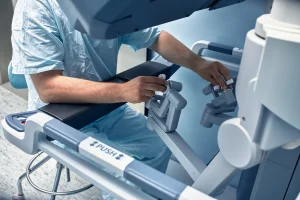
| Robotic-assisted cholecystectomy | The surgeon operates the da Vinci system from a console, using small incisions | Suitable for many patients, though not every patient or condition |
| Open cholecystectomy | One larger incision | When the gallbladder is severely inflamed, infected, or scarred from earlier operations, or when problems occur during a laparoscopic operation |
The surgeon, not the robot, performs every step of robotic gallbladder surgery, and the system simply extends what the surgeon can see and control. For an uncomplicated case in an otherwise healthy patient, robotic and laparoscopic surgery are both sound options, and the surgeon recommends one based on the individual situation.
The operation carries real risks, although NIDDK says complications are very rare. The most common complication is injury to the bile ducts, which can cause infection and may require additional operations to repair. A small number of people also have softer and more frequent stools after removal because bile now reaches the intestine more often, and this change is usually temporary.
Contact your doctor if you are having a gallbladder attack, and see a doctor right away if the pain lasts several hours or comes with fever, jaundice, or vomiting.
NIDDK lists specific symptoms that need immediate attention during or after an attack. They may signal a serious infection or inflammation of the gallbladder, liver, or pancreas, and the source warns that blocked bile ducts left untreated can be fatal.
| Warning sign | Where you notice it | What NIDDK advises |
|---|---|---|
| Pain lasting several hours | Abdomen | See a doctor right away |
| Nausea and vomiting | Digestive system | See a doctor right away |
| Fever, even a low grade fever, or chills | Whole body | See a doctor right away |
| Yellowish skin or whites of the eyes, called jaundice | Skin and eyes | See a doctor right away |
| Tea-colored urine and light-colored stools | Urine and stools | See a doctor right away |
Gallstone symptoms can look like other conditions, including appendicitis, ulcers, pancreatitis, and gastroesophageal reflux disease, and each of those also needs prompt care from a doctor. If you cannot tell the difference, that uncertainty is itself a reason to be examined instead of waiting it out.
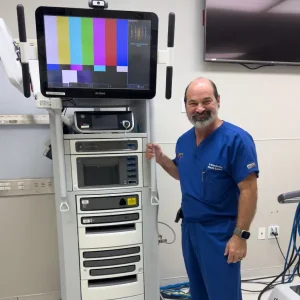
Dr. Brian Harkins is a board-certified general surgeon in Tomball who performs robotic gallbladder surgery for gallstones and related gallbladder disease.
Credentials and experience: Dr. Harkins holds MD and FACS credentials and is certified by the American Board of Surgery. He has practiced in the Northwest Houston area since 1997, chairs the Robotics Committee at HCA Houston Healthcare Tomball, a Center of Excellence in Robotic Surgery, and sees patients who travel from across the United States and abroad.
Robotic gallbladder surgery: Dr. Harkins operates the da Vinci Xi system from a console, where he works with a magnified 3D view and instruments that filter hand tremor and bend with seven degrees of freedom. The system never operates on its own. Robotic surgery uses smaller incisions than open surgery, which typically means less tissue trauma and a faster recovery, and most patients return to light activity within 2 to 3 weeks compared with 6 to 8 weeks after open surgery, although full recovery takes longer.
An honest look at fit: Robotic surgery is not the right choice for every patient or every condition, and some operations need to be converted to open surgery during the procedure for safety. Surgery of any kind carries real risks, and the consultation is where the surgeon reviews your history and imaging and explains whether an operation makes sense for you.
Nothing on NIDDK's list of treatments involves a home remedy. Doctors treat gallstones with surgery to remove the gallbladder or, in special situations, with medicines, ERCP, or shock wave lithotripsy. Symptoms may fade when a stone moves, but they can return.
A gallbladder attack usually stops when a stone moves and no longer blocks a bile duct. NIDDK notes that symptoms may go away and then appear again, so a person may still need treatment later.
NIDDK says pigment stones usually require surgery, while cholesterol stones can sometimes be treated without it. Your doctor can tell you which kind you have from your imaging and history.
NIDDK suggests an eating plan with more fiber and healthy fats, fewer refined carbohydrates, and less sugar. Losing weight safely and keeping a healthy weight also help. These habits address prevention, not stones you already have.
NIDDK says complications are very rare, and the most common is injury to the bile ducts. That injury can cause infection and may require more operations to repair. Your surgeon reviews these risks with you before surgery.
Yes, because the gallbladder is not an essential organ. After removal, bile flows from the liver directly into the small intestine instead of being stored first. Most people live normally without it.
A small number of people have softer and more frequent stools after removal, because bile reaches the intestine more often. NIDDK says the change is usually temporary, but you should mention it to your doctor.
After nonsurgical treatment, NIDDK says gallstones can return, and a person may need regular treatment for a very long time. That is one reason surgeons usually recommend removing the gallbladder when symptoms keep happening.
Contact your doctor if you are having a gallbladder attack or other symptoms. Your doctor may refer you to a gastroenterologist or a surgeon for treatment, and severe warning signs call for care right away.
Robotic-assisted surgery is one minimally invasive way to remove the gallbladder, with the surgeon operating the da Vinci system from a console. It is not right for every patient, and laparoscopy does equally well in many uncomplicated cases.
Getting rid of gallstones usually means removing the gallbladder when stones cause symptoms, and leaving them alone when they do not. Medicines, ERCP, and shock wave lithotripsy have narrow roles, home remedies are not listed as treatments, and the warning signs described above call for care right away.
If gallstones or repeated gallbladder attacks are affecting your life, you can schedule a consultation about gallstone treatment options so a board-certified surgeon can review your history and imaging. The right answer for you depends on your stones, your health, and your goals, and that conversation is where it gets settled.
Ask about your gallstone treatment options.
Call (281) 351-5409 to schedule your consultation.
This information is educational and is not a substitute for professional medical advice. Every patient is different. Dr. Brian Harkins will discuss whether robotic-assisted surgery is right for your specific situation based on your anatomy, health, and goals.

Dr. Brian Harkins is a renowned surgeon specializing in advanced, minimally invasive, and robotic surgical techniques. With a dedication to innovation and personalized patient care, he has transformed countless lives by delivering exceptional outcomes.
I want a website like this, where do i start?