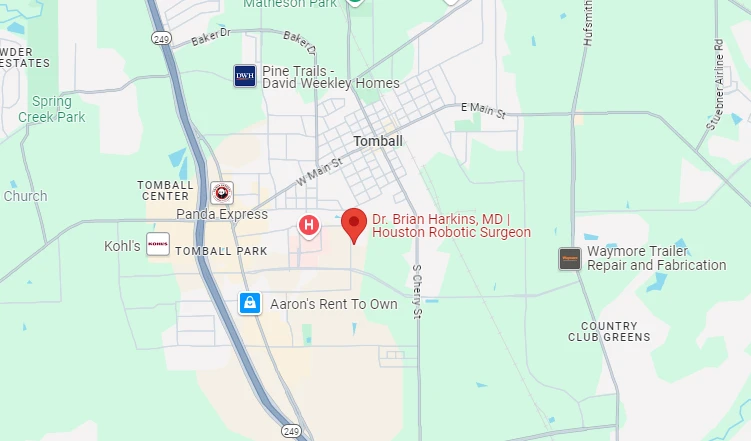
455 School St. Bldg. 1, Suite 10 Tomball, Texas 77375
Mon-Thu: 9:00 am – 5:00 pm | Fri: 9:00 am – 2:00 pm


Robotic surgery is not automatically better than traditional surgery. The right approach depends on your specific procedure, anatomy, and your surgeon's experience with the technology. For complex operations like prostate cancer removal or endometrial hysterectomy, robotic surgery offers clear advantages. For straightforward procedures like gallbladder removal, laparoscopic surgery often delivers equivalent results at lower cost.
If you're facing surgery in Tomball, TX, you've likely wondered whether robotic-assisted surgery is really better than traditional methods. Many patients want to know if robotic surgery will help them recover faster, whether it's safer, and why it might cost more if insurance doesn't cover the difference. This guide breaks down the real differences between robotic surgery and traditional approaches so you can have an informed conversation with your surgeon about what's right for your specific situation.
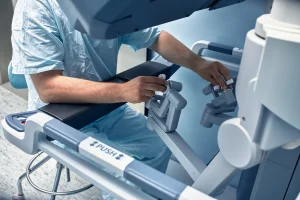
Robotic surgery uses advanced computer-assisted systems, most commonly the da Vinci surgical system, to perform minimally invasive procedures with enhanced precision. The surgeon sits at a console and controls robotic arms that hold tiny instruments and a high-definition 3D camera.
Unlike traditional open surgery, which requires large incisions, robotic-assisted surgery uses several small cuts, typically 0.5 to 1 cm. The system translates the surgeon's hand movements into smaller, more precise movements inside the body. It also filters out hand tremors and allows rotation beyond what the human wrist can achieve naturally.
Traditional laparoscopic surgery also uses small incisions but relies on long, rigid instruments. The da Vinci system offers greater range of motion and better visualization, which is especially valuable in tight spaces like the pelvis. The table below summarizes the key differences across all three surgical approaches.
| Feature | Open Surgery | Laparoscopic | Robotic |
| Incision size | 6 to 12 inches | 0.5 to 1 cm | 0.5 to 1 cm |
| 3D visualization | No | No (2D) | Yes (10x magnified) |
| Instrument range of motion | Full | Limited (rigid) | 7 degrees of freedom |
| Tremor filtering | No | No | Yes |
| Operative time | Shortest | Moderate | Longest (setup adds 20 to 40 min) |
| Typical hospital stay | 3 to 5 days | 1 to 2 days | Same day to 24 hours |
Robotic surgery delivers the clearest advantages in procedures requiring precision in confined anatomical spaces or delicate nerve preservation. Not all procedures benefit equally from the technology.
For men with localized prostate cancer, robotic radical prostatectomy shows clear advantages over open surgery. Patients typically experience improved urinary continence and sexual function recovery, along with shorter hospital stays, often going home the next day. The enhanced 3D visualization helps surgeons preserve delicate nerves responsible for these functions. This procedure has become one of the most common applications of robotic technology in urology.
Women undergoing hysterectomy for endometrial cancer benefit from robotic surgery's lower conversion rates compared to traditional laparoscopic approaches. Robotic systems also help surgeons navigate complex anatomy in patients who have had previous abdominal surgeries, where scar tissue makes laparoscopic instruments difficult to maneuver.
Patients undergoing robotic colorectal procedures typically recover faster and experience lower rates of ileus, which is a temporary paralysis of the bowel that delays eating and discharge. The wristed instruments make it easier to operate in the narrow pelvis, particularly for rectal cancer surgery.
For straightforward procedures like simple gallbladder removal or basic hernia repair, robotic and laparoscopic techniques produce roughly equivalent outcomes. In these cases, surgeons often choose laparoscopic surgery because it's faster and less expensive with no meaningful difference in patient results.
Open surgery remains necessary for emergency cases, extremely complex situations, or when anatomical factors make minimally invasive approaches unsafe. No surgical technology replaces the judgment required to select the right approach for each patient.
One of the most significant advantages of robotic surgery is faster recovery. Most patients go home the same day or the next day depending on the procedure and can typically return to light activities within 2 to 3 weeks. The small incisions mean less tissue trauma, reduced blood loss, and lower infection risk.
| Outcome | Open Surgery | Laparoscopic | Robotic |
| Return to light activity | 6 to 8 weeks | 2 to 4 weeks | 2 to 3 weeks |
| Blood loss | Higher | Reduced | Reduced |
| Infection risk | Higher | Lower | Lower |
| Conversion-to-open rate | N/A | 5 to 10% | 1 to 5% |
| Patient satisfaction | Moderate | High | Above 85% |
Recent surveys show patient satisfaction rates above 85% for robotic procedures. The key is setting realistic expectations. Complex cases may still require longer recovery than anticipated, and complications can occur with any surgical approach.
Robotic surgical systems cost hospitals between $1 million and $2.5 million to purchase. Each procedure incurs additional costs of $3,000 to $3,600 for disposable instruments and equipment maintenance, compared to under $1,000 for laparoscopic surgery.
Despite higher operating room expenses, robotic surgery often reduces total hospitalization costs. Patients typically stay 1 to 3 fewer days in the hospital, and lower conversion-to-open rates mean fewer complications and readmissions.
Private insurance companies do not pay hospitals more for robotic procedures than for laparoscopic ones. Hospitals absorb the cost difference, motivated by competitive positioning and improved outcomes data. Before scheduling surgery, verify with your insurance company whether they cover robotic surgery for your specific procedure. Coverage policies vary, and confirming in advance avoids unexpected bills.
The surgeon's skill level matters more than the technology itself. According to research on robotic surgery proficiency, robotic proficiency typically requires 20 to 50 supervised cases before a surgeon achieves independent competency. An experienced laparoscopic surgeon may deliver better results than an inexperienced robotic surgeon using the same system.
When controlled for surgeon experience, overall complication rates are comparable between robotic, laparoscopic, and open approaches. However, robotic surgery significantly reduces the conversion-to-open rate, meaning fewer cases where the surgeon must abandon the minimally invasive approach mid-procedure.
Before agreeing to any surgical approach, ask your surgeon these questions directly:
Robotic surgery is safe when performed by experienced surgeons at well-equipped facilities. Complication rates are similar across surgical approaches when you account for surgeon skill and patient complexity.
Robotic system malfunction is extremely rare, occurring in less than 1% of cases. When technical issues arise, surgeons can immediately switch to laparoscopic or open techniques. Operative times run 20 to 40 minutes longer for robotic procedures due to system setup and docking. This extra time under anesthesia is generally safe but should be considered for patients with significant heart or lung conditions.
Conversion to open surgery occurs in roughly 5 to 7% of minimally invasive cases overall, though robotic approaches have lower rates. Your surgical team prepares for this possibility with every procedure. As explained by Intuitive Surgical, conversion is a planned safety option, not a complication.
Most patients can safely undergo robotic surgery, but several factors determine candidacy. Your surgeon will assess both patient-specific and procedure-specific factors before making a recommendation. The table below outlines which patient profiles are well-suited and which may require a different approach.
| Factor | Favorable for Robotic | May Require Open or Lap |
| BMI | Up to 40+ (robotic is feasible) | Severe obesity with comorbidities |
| Prior abdominal surgery | Manageable with robotic precision | Extensive adhesions (case-by-case) |
| Age | Any age including 85+ | Not a disqualifying factor alone |
| Anesthesia tolerance | Normal tolerance | Severe cardiac or pulmonary disease |
| Procedure type | Elective, complex, pelvic | Emergency, severe anatomical distortion |
Research demonstrates that robotic surgery is safe and feasible in elderly patients, even those 85 and older, and those with multiple medical conditions. Age alone should not disqualify a candidate. Certain contraindications may make other approaches safer, including severe heart or lung disease that limits anesthesia tolerance or extensive adhesions that make pneumoperitoneum dangerous.
A 65-year-old Tomball man with localized prostate cancer chooses robotic radical prostatectomy at a high-volume center. His surgeon has performed over 100 robotic prostatectomies. He goes home the next day and returns to light activity within three weeks. Compared to open surgery, he experiences better urinary continence and sexual function recovery. His insurance covers the procedure at the same rate as open or laparoscopic surgery.
A 72-year-old woman needs a hysterectomy but has extensive scar tissue from previous abdominal surgeries. Her gynecologist recommends robotic surgery because it has a lower conversion-to-open rate than laparoscopic approaches. The robotic system successfully navigates her adhesions, and she avoids a large incision and the extended recovery that would come with it.
A 45-year-old patient with a BMI of 32 needs gallbladder removal for symptomatic gallstones. Her surgeon recommends standard laparoscopic cholecystectomy rather than robotic surgery. For this straightforward procedure, robotic technology offers no clear advantage. Laparoscopic surgery delivers the same outcomes with shorter operating time and lower cost. She recovers quickly and returns to work within a week.
Tomball residents have strong access to robotic surgical care through several nearby accredited facilities. As a robotic surgeon in Tomball, Dr. Brian Harkins offers consultations to help patients determine which approach is best suited for their specific condition.
HCA Houston Healthcare Tomball operates an accredited Center of Excellence in Robotic Surgery, meeting rigorous standards for procedure volume, outcomes, and patient care. Houston Methodist provides robotic surgery at multiple locations near Tomball, including Methodist Willowbrook Hospital, and operates the MITIE training center ensuring surgeons maintain current skills. North Cypress Medical Center and other nearby HCA facilities also offer robotic surgical services with experienced teams.
When selecting a facility and surgeon, prioritize experience with your specific procedure over proximity. A surgeon who performs your operation weekly will typically deliver better outcomes than one who does it monthly.
No. Robotic surgery offers clear advantages for complex procedures like prostate removal, endometrial hysterectomy, and rectal cancer surgery. For straightforward procedures like gallbladder removal or basic hernia repair, laparoscopic surgery typically delivers equivalent results with shorter operative time and lower cost.
Most robotic surgery patients return home the same day or the next day and resume light activity within 2 to 3 weeks. Open surgery typically requires 6 to 8 weeks before returning to normal activity. Laparoscopic recovery falls between the two, usually 2 to 4 weeks.
Most major insurance plans cover robotic surgery when it is the standard of care for the specific procedure. However, coverage policies vary by plan and diagnosis. Verify directly with your insurance provider before scheduling to confirm your specific procedure is covered under your plan.
Robotic surgery uses incisions of 0.5 to 1 cm, which typically leave minimal visible scarring. Most patients describe the marks as small dots rather than noticeable scars. This is a meaningful difference from open surgery, which requires incisions of 6 to 12 inches.
Robotic malfunctions are extremely rare, occurring in less than 1% of cases. If a technical issue arises, the surgeon immediately transitions to laparoscopic or open surgery. The ability to convert quickly is a built-in safety protocol trained for and prepared during every procedure.
Ask directly how many times they have performed your specific procedure robotically. Look for at least 20 to 50 completed cases as a baseline, with outcomes improving significantly after 50 cases. Also ask about their proctorship history and whether they participate in ongoing simulation training.
Robotic surgery requires additional time to set up and dock the robotic system, which adds 20 to 40 minutes compared to laparoscopic surgery. This setup time is offset for patients by the precision benefits and reduced conversion risk the technology provides, particularly in complex procedures.
Yes. Research shows robotic surgery is safe and feasible in patients 85 and older, as well as those with multiple medical conditions. Age alone is not a disqualifying factor. Your surgeon and anesthesiologist will assess your overall health and tolerance for anesthesia before recommending an approach.
A Center of Excellence designation, awarded by the Surgical Review Corporation, indicates a facility meets rigorous national standards for robotic procedure volume, surgeon credentialing, equipment quality, clinical pathways, and outcomes tracking. It is one of the most objective quality benchmarks available when choosing where to have surgery.
Conversion to open surgery means the surgeon transitions from a minimally invasive robotic or laparoscopic approach to a traditional open incision during the procedure. This happens in 1 to 5% of robotic cases due to unexpected anatomy, bleeding, or equipment issues. It is a safety protocol, not a complication or failure.
Choosing between robotic and traditional surgery comes down to your specific procedure, your anatomy, and your surgeon's experience with both approaches. Robotic surgery delivers measurable advantages in complex operations, particularly around nerve preservation, conversion rates, and recovery speed. For simpler procedures, the technology adds cost without improving outcomes.
The most important step you can take is asking the right questions before consenting to any approach. Your surgeon should be able to explain why they recommend a specific technique, what their personal outcomes look like, and what happens if conversion becomes necessary.
If you're weighing your surgical options in Tomball, TX, Dr. Brian Harkins can walk you through the right approach for your condition. Call 281-247-0503 or visit the contact page to schedule a consultation.
Schedule your surgical consultation in Tomball, TX today.
Contact Dr. Harkins to discuss the best approach for your procedure.


Dr. Brian Harkins is a renowned surgeon specializing in advanced, minimally invasive, and robotic surgical techniques. With a dedication to innovation and personalized patient care, he has transformed countless lives by delivering exceptional outcomes.
I want a website like this, where do i start?