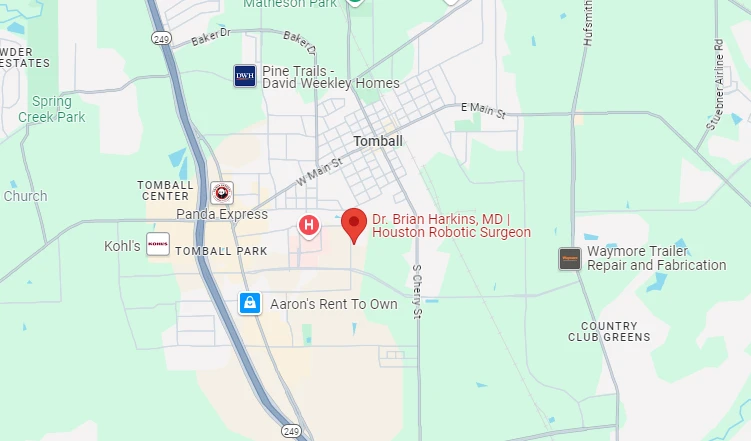
455 School St. Bldg. 1, Suite 10 Tomball, Texas 77375
Mon-Thu: 9:00 am – 5:00 pm | Fri: 9:00 am – 2:00 pm


Robotic colorectal surgery offers enhanced precision, lower blood loss, fewer readmissions, faster recovery, and a much lower rate of conversion to open surgery. The trade-offs are higher cost, longer operative times, a substantial surgeon learning curve, no haptic feedback, and mixed results for certain rectal procedures.
If you're facing colorectal cancer or another serious colon or rectal condition in Tomball, TX, you may be wondering whether robotic surgery is the right choice for you. This advanced minimally invasive approach offers benefits like shorter hospital stays and faster recovery, but it also comes with questions about cost, surgeon experience, and whether it truly improves cancer outcomes compared to traditional methods.
In this article, we'll walk through the key pros and cons of robotic colorectal surgery so you can make an informed decision about your care. The goal is a balanced picture rather than a sales pitch, because the honest answer is that robotic surgery is clearly better for some patients and procedures and roughly equivalent for others.
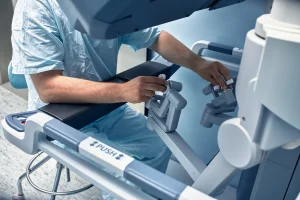
Robotic colorectal surgery uses advanced robotic systems, most commonly the da Vinci platform, to perform operations on the colon and rectum. The surgeon sits at a console and controls robotic arms that hold specialized instruments and a high-definition camera.
Unlike traditional open surgery, robotic procedures require only small incisions. National health resources such as MedlinePlus note that large bowel resection can be performed robotically through several small cuts rather than one large one. The robot translates the surgeon's hand movements into precise motions inside the body, offering three-dimensional high-definition visualization with a stable surgeon-controlled camera.
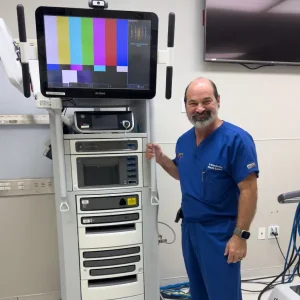
This technology is available locally in Tomball, where HCA Houston Healthcare Tomball operates as a Center of Excellence in robotic surgery and specialists like Dr. Brian Harkins use advanced minimally invasive and robotic techniques for colon cancer.
Before examining each factor in detail, the table below summarizes how the advantages and limitations balance against each other.
| Advantages | Limitations |
| Wristed instruments and 3D visualization improve precision | Higher acquisition, maintenance, and per-case costs |
| Lower blood loss (about 59 ml versus 132 ml) | Longer operative times, especially during early adoption |
| Fewer readmissions (2.1% versus 15%) | Substantial surgeon learning curve |
| Much lower conversion to open surgery (odds ratio 0.26) | No haptic feedback or tactile sensation |
| Greater lymph node harvest for cancer staging | Mixed results for certain rectal procedures |
| Better ergonomics with tremor filtration and motion scaling | Longer anesthesia may risk patients with heart or lung disease |
The robotic system provides several technical advantages that improve surgical precision. The wristed instruments offer multiple degrees of freedom for precise dissection, allowing surgeons to navigate tight spaces more easily than traditional laparoscopic tools.
This enhanced control leads to measurable benefits. Studies show finer marginal resections and greater lymph node harvest, which is critical for accurate cancer staging and treatment planning. For colon cancer patients specifically, a UT Southwestern Medical Center study found more comprehensive lymph node harvest with robotic surgery, helping doctors better understand the extent of disease. That matters well beyond the operating room, because staging accuracy shapes every treatment decision that follows.
Patients who undergo robotic procedures often experience smoother recoveries compared to traditional approaches. Research demonstrates earlier postoperative flatus and bowel function, meaning the digestive system returns to normal more quickly. Pain levels are also reduced, with studies reporting lower pain scores at days 1 and 7 postoperatively compared to laparoscopic surgery, which translates to less need for pain medication and greater comfort during recovery.
Other recovery advantages include:
For right-sided colon procedures, 71% of robotic cases achieved textbook outcomes versus 64% for laparoscopic. For left-sided procedures, the numbers were even better at 75% robotic versus 68% laparoscopic.
One of the most significant benefits is the reduced need to convert to traditional open surgery during the procedure. When surgeons encounter difficulty with laparoscopic techniques, they sometimes must make a larger incision to complete the operation safely, which erases much of the benefit of a minimally invasive approach.
Robotic surgery dramatically reduces this risk. A meta-analysis of 854 patients found a significantly lower conversion rate to open surgery, with an odds ratio of 0.26, meaning robotic procedures are much more likely to be completed as planned. This advantage is particularly beneficial for obese patients, those with a narrow pelvis, or patients with prior abdominal operations, cases where traditional laparoscopy often struggles.
The robotic console offers ergonomic benefits that may improve surgical performance. Surgeons work from a seated console position that reduces musculoskeletal strain, especially important during lengthy procedures where fatigue can affect precision.
The system also includes tremor filtration and motion scaling to maintain fine control. Even small hand movements are smoothed and scaled appropriately, resulting in steadier instrument motion inside the body than the unaided hand can achieve.
Patients in Tomball have access to cutting-edge approaches developed by nearby Houston specialists. Houston Methodist pioneered the NICE procedure, a natural-orifice robotic resection that eliminates visible abdominal incisions for certain cases. This innovative approach achieved an average hospital stay of 2.3 days versus 5 to 8 days nationally, zero surgical site infections involving skin incisions, halved readmission rates, and return to work in 2 to 3 weeks versus 6 to 12 weeks.
The most significant drawback of robotic surgery is cost. The technology requires millions of dollars for system acquisition and hundreds of thousands per year for maintenance, and each procedure also incurs higher per-case expenses for disposable instruments and drapes. One multicenter study found robotic rectal resection cost approximately 919.66 euros more per case.
However, the same study found these higher costs may be justified by better outcomes. The research showed an 84.38% probability of being more cost-effective at a 20,000 euro threshold when quality-adjusted life years were considered, which reframes the cost question as one of value rather than price alone.
Robotic procedures typically take longer than laparoscopic surgery. Setup tasks like docking the robot and positioning arms add time to the overall procedure, and operative times are often longer than laparoscopic benchmarks, especially during early adoption.
The good news is that times decrease with experience and may approach laparoscopic benchmarks as surgeons become more proficient. For patients with severe heart or lung conditions, however, longer anesthesia times may pose additional risks that need careful consideration before choosing this approach.
Robotic surgery requires specialized training and experience. There is a substantial learning curve influenced by prior experience and case mix, meaning surgeons need time to develop proficiency, and the technology requires robust training, simulation, and proctoring programs to ensure safe implementation.
Early cases often have more complications and longer operative times, which is why it's important to choose a surgeon with established experience. When considering robotic surgery, ask your surgeon about their experience level and how many robotic colorectal procedures they've performed. It is a fair question and an experienced surgeon will answer it directly.
Unlike traditional surgery, robotic systems don't provide tactile sensation. Surgeons cannot feel tissue resistance directly and must rely entirely on visual cues and instrument motion.
Experienced robotic surgeons learn to compensate for this limitation through visual feedback and careful technique. However, it remains a genuine consideration, especially in complex cases where tissue handling is critical and the feel of the tissue would normally inform the next move.
While robotic surgery excels for many colorectal procedures, results aren't uniformly superior across all operation types. Low anterior resection showed higher ileus, readmission, and morbidity rates in some datasets.
The technology is not universally superior for all rectal procedures, and outcomes can vary based on the specific operation, patient characteristics, and surgeon experience. This is the strongest argument for a procedure-specific conversation rather than a blanket preference for one platform.
Overall, robotic colorectal surgery demonstrates a reassuring safety record. A single-surgeon series of 129 robotic colon surgeries reported an overall complication rate of 14%, with most being minor issues. The breakdown of complications was encouraging:
Research shows robotic procedures demonstrate similar or reduced complication rates relative to laparoscopy for anastomotic leak, wound infection, and postoperative ileus, which places the platform on solid safety footing across the common failure modes.
Certain patients are particularly well-suited for robotic approaches, while others may be better served by an alternative. Understanding which colon and rectal conditions you are dealing with is the starting point for that decision.
| Strong Candidates | Consider Alternatives |
| Rectal cancer requiring precise mesorectal excision | Severe cardiopulmonary disease limiting tolerance of longer operative times |
| Obese patients or those with narrow pelvis | Extensive adhesions from multiple prior operations |
| Prior abdominal operations with complex anatomy | Emergent conditions requiring immediate access |
| Cases requiring nerve-sparing or sphincter preservation | Limited surgeon experience with robotic techniques |
For rectal cancer in particular, the robot's precision in the narrow pelvic space can be invaluable. The enhanced visualization and instrument articulation help surgeons preserve critical nerves and structures, which is precisely where the technology's advantages are most pronounced.
Your surgeon will evaluate your individual situation, including your overall health, the specifics of your condition, and their own experience, to recommend the most appropriate approach.
Tomball residents have access to robotic surgery for colorectal conditions without traveling to the medical center. The da Vinci surgical system is available locally, and the area benefits from proximity to Houston's world-class medical community.
Local resources include specialists trained in the latest techniques and hospitals with established robotic surgery programs. Additionally, the broader Houston area offers access to internationally recognized experts like Dr. Eric Haas and comprehensive programs at Baylor College of Medicine.
This combination of local availability and regional expertise means Tomball patients can receive advanced robotic surgery close to home while benefiting from the innovation happening in nearby Houston medical centers.
The main advantages are enhanced precision from wristed instruments and 3D visualization, lower blood loss at about 59 ml versus 132 ml, fewer readmissions at 2.1% versus 15%, greater lymph node harvest, and a much lower conversion rate to open surgery.
The main drawbacks are higher cost, longer operative times especially during early adoption, a substantial surgeon learning curve, absence of haptic feedback, and mixed results for certain procedures such as low anterior resection.
It depends on the procedure. Robotic surgery showed textbook outcomes of 71% versus 64% for right-sided and 75% versus 68% for left-sided colon procedures, but long-term cancer survival rates are similar across robotic, laparoscopic, and open approaches.
Yes, significantly. A meta-analysis of 854 patients found an odds ratio of 0.26 for conversion to open surgery, making robotic procedures much more likely to be completed as planned, especially in obese patients or those with a narrow pelvis.
A single-surgeon series of 129 robotic colon surgeries reported a 14% overall complication rate, with only 1% grade 4 events and 78% grade 1 events requiring no intervention. Complication rates are similar to or lower than laparoscopy.
The system requires millions of dollars to acquire and hundreds of thousands annually to maintain, plus higher per-case costs for disposable instruments. One study found robotic rectal resection cost about 919.66 euros more per case.
Research suggests it can be. One multicenter study found an 84.38% probability of robotic surgery being more cost-effective at a 20,000 euro threshold once quality-adjusted life years were factored into the analysis.
Strong candidates include patients with rectal cancer requiring precise mesorectal excision, obese patients or those with a narrow pelvis, patients with prior abdominal operations, and cases needing nerve-sparing or sphincter preservation.
Alternatives may be preferable for severe cardiopulmonary disease that limits tolerance of longer operative times, extensive adhesions from multiple prior operations, emergent conditions requiring immediate access, or when surgeon robotic experience is limited.
There is a substantial learning curve, and early cases often involve longer operative times and more complications. Asking how many robotic colorectal procedures a surgeon has performed is a reasonable way to gauge proficiency.
Robotic colorectal surgery earns its reputation in the areas where precision and access matter most: the narrow pelvis, the obese abdomen, the field scarred by prior operations. Lower blood loss, fewer readmissions, better lymph node harvest, and a far lower chance of converting to open surgery are real advantages backed by data rather than marketing.
The honest counterweight is that it costs more, takes longer, depends heavily on surgeon experience, and does not outperform laparoscopy on every procedure or on long-term cancer survival. That makes the right question narrower and more useful than pros versus cons in the abstract, namely whether this platform is the best fit for your specific procedure, your anatomy, and the experience of the surgeon holding the console.
Find out whether robotic surgery fits your procedure.
Schedule a consultation with a Tomball robotic surgery specialist.


Dr. Brian Harkins is a renowned surgeon specializing in advanced, minimally invasive, and robotic surgical techniques. With a dedication to innovation and personalized patient care, he has transformed countless lives by delivering exceptional outcomes.
I want a website like this, where do i start?