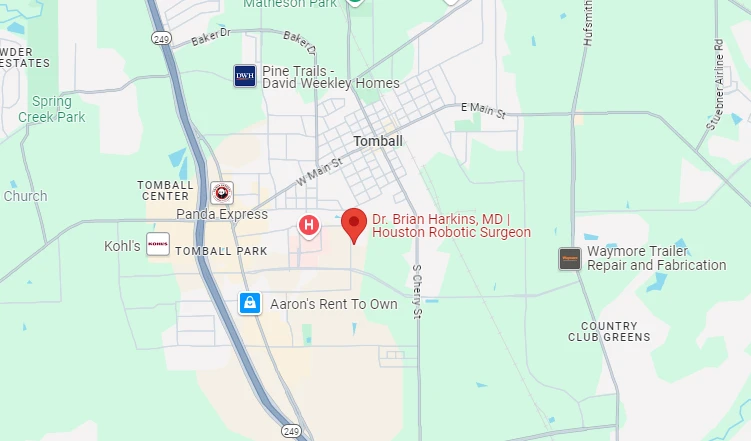
455 School St. Bldg. 1, Suite 10 Tomball, Texas 77375
Mon-Thu: 9:00 am – 5:00 pm | Fri: 9:00 am – 2:00 pm

Your stomach usually looks bigger after gallbladder surgery because of temporary causes: carbon dioxide gas left from the operation, swelling around the small incisions, and slowed bowels from anesthesia and pain medicine. Most of this settles within one to three weeks, while a change that lasts for months usually points to weight gain or, less often, an incision hernia.
You expected a few small bandages after gallbladder surgery, and a few days later your belly looks rounder, tighter and more swollen than before. That's one of the most common surprises after laparoscopic gallbladder removal or da Vinci robotic surgery in Houston, and for patients in Tomball it often shows up just as you're home and wondering whether something has gone wrong.
The reassuring part is that early swelling almost always has an ordinary explanation that fades as the gas clears and your bowels find their rhythm again. The useful part is knowing which changes follow that normal pattern and which ones need a surgeon's attention.
In this guide, you'll learn the specific causes of a bigger stomach after gallbladder surgery, how long each one usually lasts, why bloating can linger for weeks, what a change months later can mean, and which warning signs call for a phone call to your surgeon.
Most of the change you see in the first week comes from three things that happen during and right after surgery. None of them involves a problem with the repair, and they tend to fade in a fairly predictable order.
During a laparoscopic or robotic cholecystectomy, your surgeon inflates the abdomen with carbon dioxide gas, a step called pneumoperitoneum, so the instruments have room to work. Most of the gas is let out at the end, but some stays behind and is absorbed over the next few days, which can leave your belly full, tight and slightly distended.
That same gas explains the shoulder pain many patients feel, because it irritates the diaphragm. In a study that took upright chest X-rays after laparoscopic cholecystectomy, about half of patients still had visible gas on the day of surgery, and all but one of them had cleared it within the first week.
Every incision, however small, triggers a normal healing response that brings extra fluid into the skin and the muscle of the abdominal wall. Around the port sites, especially at the belly button where the gallbladder is often removed, you may notice firmness, puffiness or bruising that makes the area look fuller. This swelling usually peaks in the first few days and eases over one to two weeks.
Anesthesia and the handling of the abdomen during surgery slow your intestines for a short time, so gas and stool move through more slowly than usual. That trapped gas adds to the tight, rounded feeling even though nothing is wrong inside.
For most people the bowels wake up within a few days, and short walks around the house help them along. The table below puts the early causes side by side.
| Cause | When it shows up | How long it usually lasts | What usually helps |
|---|---|---|---|
| Leftover carbon dioxide gas | Day of surgery | Clears in most patients within the first week | Short, frequent walks and changing position |
| Swelling around the incisions | First two to three days | Eases over one to two weeks | Rest, loose clothing, clean and dry wounds |
| Slowed bowels after anesthesia | First few days | Usually a few days | Walking, fluids, easing back into food |
| Constipation from pain medicine | First one to two weeks | Improves once narcotic pain medicine stops | Water, fiber, walking, a stool softener if your surgeon advises one |
Once the gas and swelling have faded, some patients still feel bloated or notice their stomach sticking out after meals for a few more weeks. This stage has less to do with the operation and more to do with how your digestion adjusts to working without a gallbladder.
Narcotic pain medicine slows the gut, and combined with more sitting and less fiber, it makes constipation one of the most common causes of a firm belly in the first couple of weeks. MedlinePlus discharge guidance for laparoscopic gallbladder removal recommends a high-fiber diet and eight to ten glasses of water a day to ease bowel movements.
Your gallbladder used to store bile and release it in bursts when you ate, especially after fatty meals. Without it, bile trickles steadily into the small intestine, and while most people adapt well, the change can bring more gas and a sense of fullness after meals for a while. A review on the NCBI Bookshelf lists diarrhea and bloating among the effects of this altered bile flow.
Loose stools after eating are common after laparoscopic gallbladder removal, and MedlinePlus notes they may last four to eight weeks, sometimes longer. Large, rich meals tend to worsen both the loose stools and the bloating, so smaller portions and a slow return to fried food usually keep your stomach calmer.
The timeline below shows how these changes usually overlap, although every recovery moves at its own pace.
| Time after surgery | What most patients notice | Usual cause |
|---|---|---|
| Days 1 to 3 | Tight, rounded belly, shoulder pain, sore incisions | Leftover gas, incision swelling, slowed bowels |
| Days 4 to 7 | Gas pain easing, belly still puffy around the ports | Gas absorbing, swelling fading |
| Weeks 2 to 3 | Bloating after meals, possible constipation | Pain medicine, lower activity, diet changes |
| Weeks 4 to 8 | Occasional loose stools or fullness after rich meals | Digestion adjusting to steady bile flow |
| Beyond 2 months | A flat belly for most; a lasting change for some | Weight change, incision hernia or ongoing digestive symptoms |
If your stomach still looks bigger two or three months after surgery, the early causes are long gone. Three explanations account for most of these later cases, and each calls for a different response.
Some patients gain weight after gallbladder removal, often because foods that used to trigger attacks become comfortable again and portions quietly grow. The evidence is mixed: a UK study of 103 patients found significant weight gain six months after cholecystectomy, while other studies have not found the same pattern. Weight gain usually shows as a gradual, even change around the waist rather than a firm or lopsided swelling.
A bulge at one of the incisions, most often the belly button, can be a trocar site hernia, a weak spot where the abdominal wall hasn't closed fully. It typically looks like a soft lump that gets bigger when you cough or stand and flattens when you lie down.
Reported rates vary widely, and one prospective study that followed patients with exams and ultrasound for about four years found umbilical port hernias in roughly a quarter of them. The risk was higher after wound infection, an enlarged incision, diabetes or obesity, and because hernias don't close on their own, any new bulge is worth showing to a surgeon.
A smaller group of patients still has bloating, indigestion, diarrhea or abdominal pain months after surgery, a pattern called post-cholecystectomy syndrome. That same review reports it in 5 to 30 percent of patients, with causes ranging from bile-related diarrhea and a retained bile duct stone to unrelated conditions such as reflux or irritable bowel syndrome.
The review cites a study in which 75 percent of patients had good pain relief on long-term follow-up, so lasting symptoms deserve a proper workup rather than the assumption that this is simply life without a gallbladder.
Most swelling after gallbladder surgery is harmless, but a few signs can point to infection, a bile leak or a blockage. The MedlinePlus discharge instructions for this surgery list the signs below.
| Warning sign | Why it matters | What to do |
|---|---|---|
| Temperature above 101°F | Can signal infection | Call your surgeon's office the same day |
| Incisions that are red, warm, bleeding or draining | Can signal a wound infection | Call your surgeon's office |
| Pain that isn't helped by your pain medicine | Can signal a problem inside the abdomen | Call right away, or seek emergency care if severe |
| Yellowing of the skin or eyes, or gray stools | Can signal blocked bile flow | Call your surgeon promptly |
| Unable to eat or drink | Risk of dehydration or a blockage | Call your surgeon's office |
| Trouble breathing or a cough that won't go away | Needs medical assessment | Seek care promptly |
Whether you had surgery in Tomball or elsewhere in the greater Houston area, a belly that is swollen but soft and a little better each day is following the usual pattern. A belly that is getting bigger, harder or more painful is not, and that difference is the most useful thing to watch.
Dr. Brian Harkins performs gallbladder surgery for patients in Tomball, Northwest Houston and the greater Houston area, and he has practiced in the Northwest Houston area since 1997.
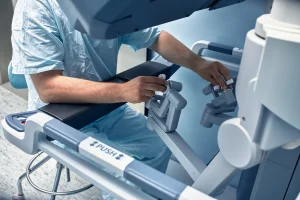
Robotic gallbladder surgery: Dr. Harkins performs robotic cholecystectomy through a few small incisions rather than one long one. He operates the da Vinci system from a console with a magnified 3D view and instruments that filter hand tremor, and the system never operates on its own. For an uncomplicated gallbladder in a healthy patient, robotic and laparoscopic surgery are both excellent options, and he reviews which fits your situation.
Care for gallbladder conditions: Gallstones and an inflamed gallbladder, called cholecystitis, are among the gallbladder conditions he treats. The evaluation starts with your history, imaging and symptoms rather than with the operation.
Hernia repair when an incision bulges: The practice also offers robotic hernia surgery, so a suspected port site hernia can be assessed by a surgeon who repairs them.
Hospital and credentials: As a board-certified general surgeon, Dr. Brian Harkins serves as Robotics Committee Chairman at HCA Houston Healthcare Tomball, a Center of Excellence in Robotic Surgery. Patients have sought him out from across the United States and abroad.
Yes. Some swelling is expected after laparoscopic or robotic gallbladder removal because of leftover gas, incision swelling and slowed bowels. It should ease a little each day and is usually much better within one to three weeks.
Most of the carbon dioxide absorbs within a few days. In one X-ray study, about half of patients had visible gas on the day of surgery, and nearly all of them had cleared it within the first week.
Leftover gas irritates the diaphragm, and that irritation is felt in one or both shoulders. Walking and changing position help the gas absorb, and MedlinePlus notes the pain should ease over several days to a week.
Yes. Narcotic pain medicine, less movement and a lower-fiber diet can all cause constipation, which leaves the belly firm and bloated. Fluids, gradual fiber and walking usually help, and your surgeon can advise on stool softeners.
Both approaches use carbon dioxide to inflate the abdomen, so either one can leave gas and bloating for the first several days. Your surgeon chooses the approach based on your anatomy and condition rather than on bloating.
No. Gradual weight gain is one cause, but a soft bulge at an incision may be a hernia, and ongoing bloating may be post-cholecystectomy syndrome. An even change around the waist points to weight; a lump or pain points elsewhere.
It usually appears as a soft bulge at a port site, often the belly button, that gets bigger when you cough, strain or stand. It can flatten when you lie down and should be examined by a surgeon.
Ongoing bloating can come from diet, bile-related diarrhea, a retained stone or a separate condition such as reflux or irritable bowel syndrome. This pattern is called post-cholecystectomy syndrome, and many of its causes can be treated once they're identified.
Call if your belly is getting bigger, harder or more painful, or if you have a fever above 101°F, red or draining incisions, yellow skin or eyes, gray stools, or you can't eat or drink.
Walk several times a day, drink plenty of water, add fiber slowly, eat smaller meals and ease back into fried or fatty foods. Loose clothing also makes a swollen belly more comfortable while it settles.
For patients in Tomball and across Northwest Houston, a bigger stomach after gallbladder surgery is one of the most common and least discussed parts of recovery, and in most cases it has nothing to do with a problem in the repair. Leftover gas, incision swelling and sluggish bowels explain the first week, while constipation and digestion adjusting to steady bile flow explain most of the bloating that follows.
What matters is the direction of change rather than the size of your belly on any one day. Swelling that slowly improves is healing, while a belly that keeps growing, hardens or hurts more, or a new bulge at an incision, is the signal to schedule a consultation about lasting bloating after gallbladder surgery.
Ask about swelling after your gallbladder surgery.
Call 281-247-0503 to schedule your consultation.
This information is educational and is not a substitute for professional medical advice. Every patient is different. Dr. Brian Harkins will discuss whether robotic-assisted surgery is right for your specific situation based on your anatomy, health, and goals.


Dr. Brian Harkins is a renowned surgeon specializing in advanced, minimally invasive, and robotic surgical techniques. With a dedication to innovation and personalized patient care, he has transformed countless lives by delivering exceptional outcomes.
I want a website like this, where do i start?