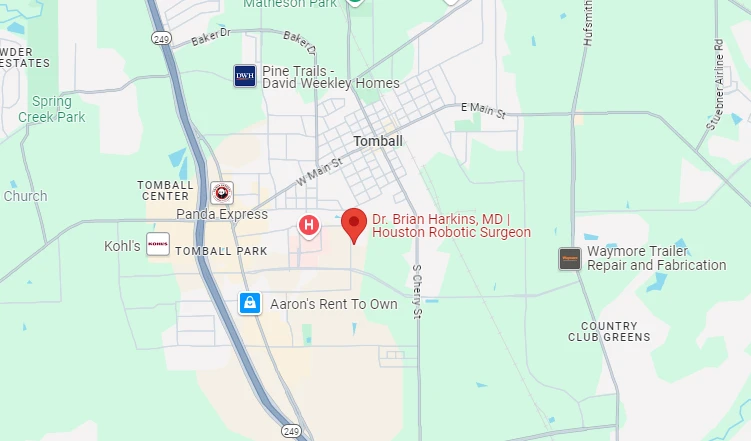
455 School St. Bldg. 1, Suite 10 Tomball, Texas 77375
Mon-Thu: 9:00 am – 5:00 pm | Fri: 9:00 am – 2:00 pm


A hernia is a hole in the abdominal wall that lets fat or intestine push through, while diastasis recti is a stretching and widening of the tissue between the two "six-pack" muscles with no hole at all. Diastasis recti often improves with targeted exercise and is rarely dangerous. A hernia does not heal on its own and can occasionally trap tissue, so it usually needs repair.
A new bulge in the middle of your belly is unsettling, especially when it pops out every time you sit up, cough, or lift a child. Many people assume it must be a hernia, while others are told online that it is "just diastasis" and nothing to worry about. Both can be true, and sometimes both are true at the same time, which is exactly why the difference is worth understanding.
The two conditions can look similar from the outside, but they are very different underneath. One is a stretch in the abdominal wall, and the other is a break in it. This guide explains what each condition is, how to tell them apart, why they so often show up together, which one carries real risk, and what treatment looks like for each.
Diastasis recti is a widening of the gap between the two long muscles at the front of the belly, with the tissue between them stretched and thinned but still intact.
The rectus abdominis muscles run vertically down each side of the abdomen and are joined in the middle by a strip of connective tissue called the linea alba. When the abdomen is under steady outward pressure for a long time, as it is during pregnancy, that strip stretches and the two muscles drift apart. Surgeons generally consider a gap of more than about 2 centimeters, or roughly two finger widths, to be a true diastasis.
Pregnancy is by far the most common cause, and the condition is extremely common after childbirth. A 2016 Norwegian study in the British Journal of Sports Medicine found diastasis recti in about 60 percent of women six weeks after delivery, and in roughly one in three at twelve months. It is not limited to mothers, though. Men can develop it as well, particularly with central weight gain, heavy lifting done with poor technique, or simply with age.
Because the connective tissue is stretched rather than torn, nothing can slip through it and become trapped. The National Library of Medicine's patient overview of diastasis recti notes that the main concern arises only when a hernia forms within the widened tissue. That is the key reason diastasis recti is usually a comfort, function, and appearance issue rather than a surgical emergency.
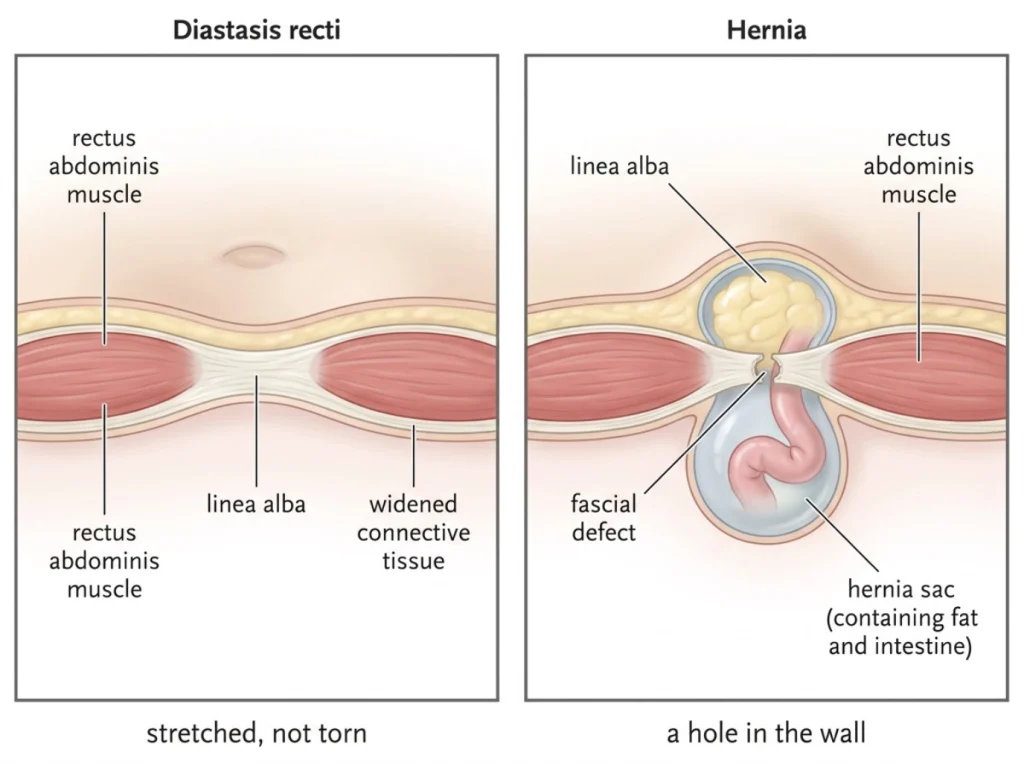
A hernia is a true hole or weak opening in the abdominal wall that allows fat or a loop of intestine to push through into a pouch under the skin.
Hernias form where the layer of tough fascia that holds the abdomen together develops a defect. That can happen at the belly button, above it along the midline, in the groin, or through the scar of a previous operation. Once the opening exists, the pressure of everyday life, from coughing to lifting to straining on the toilet, pushes abdominal contents into it.
The practical differences come down to that single fact: a hernia has a hole and diastasis recti does not.
| Feature | Diastasis recti | Hernia |
| What it is | Stretched, widened tissue between the rectus muscles | A hole or defect in the abdominal wall |
| Typical location | Along the midline, from the breastbone to below the belly button | Belly button, upper midline, groin, or an old incision |
| How it looks | A long ridge or "tenting" down the center when you sit up | A rounded, localized bulge that may come and go |
| How it feels | Soft gap you can press your fingers into | A distinct lump, sometimes tender, that may push back in when you lie down |
| Pain | Usually painless, sometimes linked to back or core discomfort | Can ache, burn, or cause pressure, especially with activity |
| Risk of trapping tissue | None, because there is no opening | Small but real risk of incarceration or strangulation |
| Heals on its own | Often improves, especially in the first year after pregnancy | No, the opening does not close by itself |
| Usual treatment | Core-focused physical therapy; surgery only in select cases | Surgical repair when symptomatic or growing |
If a hernia has already been diagnosed and you want to know what an operation involves, our guide to robotic umbilical hernia repair walks through the most common type found alongside diastasis recti.
A simple self-check can show whether you have a midline gap, but only an exam can confirm whether a hernia is also present.
Many physical therapists and surgeons teach a quick finger test for diastasis recti. It takes less than a minute and can help you describe what you are feeling when you see a doctor:
A soft gap of two or more finger widths that runs up and down the midline suggests diastasis recti. A firm, rounded lump in one spot, especially one that bulges when you cough or stand and shrinks when you lie down, is more typical of a hernia. You may also have heard of a "three finger test," which usually refers to the same midline check, not a way to rule out a hernia.
Home checks have real limits. A small umbilical or epigastric hernia can hide inside a diastasis, and a hernia in the groin will not show up on this test at all. If you feel a distinct lump, have pain, or are unsure, an exam is the right next step. Our overview of hernia symptoms and when surgery makes sense covers the signs that point toward a hernia.
Yes, and it is common. A widened, thinned midline is a known risk factor for small hernias at and above the belly button.
When the linea alba stretches, it also becomes weaker, and weak spots can eventually open into true hernias. The two conditions therefore travel together more often than most people realize. A classification paper from the German Hernia Society and the International Endohernia Society reported that among patients with even small umbilical and epigastric hernias, 45 percent also had a diastasis.
This overlap matters for three reasons:
Hernias that form in the scar of a previous operation behave differently again. If you have had abdominal surgery before, our article on ventral hernia repair explains how those are evaluated and treated.
Not sure whether your bulge is a hernia, diastasis recti, or both? A quick exam, and sometimes an ultrasound, can answer that clearly. Call 281-351-5409 or contact us to schedule an evaluation.
Both conditions come from pressure on the abdominal wall, but they tend to show up in slightly different groups of people.
The table below summarizes the most common risk factors. Many people have more than one, which is part of why the conditions so often overlap.
| Risk factor | Diastasis recti | Hernia |
| Pregnancy, especially more than one | Very common | Raises risk of umbilical hernia |
| Carrying twins or a large baby | Raises risk | Raises risk |
| Excess weight around the middle | Common in both men and women | Common, especially umbilical and ventral hernias |
| Heavy lifting or straining | Can widen the gap | Can open or enlarge a hernia |
| Chronic cough or constipation | Adds pressure | Adds pressure and raises risk |
| Previous abdominal surgery | Not a direct cause | Main cause of incisional hernias |
| Male sex | Less common | Groin hernias are far more common in men |
| Age | Tissue loses elasticity over time | Risk rises with age |
Most of the time, a careful physical exam is enough, with imaging added when the picture is unclear.
During an exam, the surgeon feels along the midline while you lie flat and then while you lift your head, measuring the gap and feeling for any separate lump or opening. You may be asked to cough or stand, because hernias often become more obvious under pressure.
When the exam leaves questions, imaging helps:

Diastasis recti is usually treated with targeted exercise first, while a hernia that causes symptoms or grows usually needs surgical repair.
For diastasis recti, the first line of treatment is a structured program with a physical therapist who specializes in the core and pelvic floor. The focus is on deep abdominal muscles, breathing, and posture rather than traditional sit-ups, which can make the bulge more noticeable. Many people see meaningful improvement over several months, particularly when they start within the first year after pregnancy.
Surgery for diastasis alone is uncommon and is usually reserved for large gaps that cause persistent symptoms despite therapy. It is often performed as part of a tummy tuck, and insurers frequently treat repair of diastasis on its own as cosmetic. When a true hernia is present alongside the diastasis, however, the hernia itself is the medical reason for surgery.
| Situation | Usual first step | When surgery is considered |
| Diastasis recti alone, mild to moderate | Core-focused physical therapy | Rarely needed |
| Diastasis recti alone, severe and symptomatic | Therapy for several months | If function or pain does not improve |
| Small umbilical or epigastric hernia, no diastasis | Evaluation and monitoring of symptoms | If painful, growing, or hard to push back in |
| Hernia with a significant diastasis | Evaluation of both conditions together | Repair of the hernia, with a plan that accounts for the widened midline |
| Hernia that is hard, very painful, or will not go back in | Urgent medical care | Often the same day |
Hernia repair today is usually done through small incisions, and most repairs of any size use mesh to reinforce the weak area. Our guide to hernia mesh surgery explains the types of mesh, how safe they are, and how they lower the chance of a hernia coming back.
Diastasis recti is almost never an emergency, but a hernia that becomes trapped can be.
Because a hernia has an opening, tissue can occasionally get stuck in it and lose its blood supply. This is uncommon, but it is the main reason hernias are taken more seriously than diastasis. Seek care the same day if a bulge:
These are signs of a trapped or strangulated hernia, not diastasis. Our article on the first signs of a strangulated hernia explains what happens and why fast treatment matters.
An accurate diagnosis is the most important step, because it decides whether you need therapy, surgery, or both.
A midline bulge after pregnancy, weight change, or years of heavy work deserves a clear answer rather than a guess. An in-person exam can usually tell within minutes whether you are dealing with a diastasis, a hernia, or both, and whether any repair is needed now or can safely wait.
Dr. Brian Harkins is a board-certified general surgeon and robotic surgeon who evaluates abdominal wall bulges and performs robotic hernia repair at HCA Houston Healthcare Tomball, including umbilical and ventral hernias that occur alongside a diastasis. With robot assisted surgery, many repairs can be done through a few small incisions. His practice treats the full range of hernia conditions for patients from Tomball, Magnolia, Spring, Cypress, The Woodlands, and across the greater Houston area.
Diastasis recti usually feels like a soft, long gap down the middle of your belly that you can press your fingers into when you lift your head. A hernia usually feels like a distinct, rounded lump in one spot that bulges when you cough or stand and may shrink when you lie down. Because the two can occur together, an exam is the most reliable way to know.
No. Diastasis recti is a stretching and widening of the connective tissue between the rectus muscles, and the tissue stays intact. A hernia is an actual hole or defect in the abdominal wall with a sac that tissue can push into. Diastasis recti can, however, weaken the midline and make small hernias more likely.
The finger test checks the gap between your abdominal muscles. Lie on your back with your knees bent, place your fingertips across your midline just above the belly button, and lift your head and shoulders slightly. If two or three fingers or more fit into a soft gap, you likely have diastasis recti. The test does not rule out a hernia.
It can make one more likely. When the linea alba stretches, it also thins and weakens, and those weak spots can eventually open into true umbilical or epigastric hernias. Research has found diastasis in close to half of patients with small midline hernias, which is why surgeons check for both conditions during an exam.
Yes, this is common. A widened, thinned midline often exists alongside a small hernia at or above the belly button. The diastasis can make the hernia harder to feel, so imaging such as an ultrasound is sometimes used. When both are present, the hernia usually drives the decision about surgery, and the repair plan takes the diastasis into account.
Surgery is usually considered only when the gap is large, symptoms such as back pain or core weakness persist after several months of dedicated physical therapy, or a hernia is also present. Many people improve without surgery. Repair of diastasis on its own is often treated by insurance as cosmetic, while repair of an associated hernia is considered medically necessary.
It often improves, especially in the first year after pregnancy. Studies show the condition is present in most women shortly after delivery but in roughly one in three at twelve months. Improvement is more likely with targeted core exercise guided by a physical therapist. Some gaps remain, and those are usually managed with continued exercise rather than surgery.
Common signs include a bulge that appears when you stand, cough, or strain, a feeling of pressure or heaviness, and aching or burning at the site. Urgent warning signs include a bulge that becomes hard and will not go back in, skin that turns red or dark, severe or worsening pain, nausea or vomiting, and being unable to pass gas.
Yes. Although it is best known as a pregnancy-related condition, men can develop diastasis recti, most often with excess weight around the middle, repeated heavy lifting with poor technique, or age-related loss of tissue elasticity. As in women, it may occur alongside umbilical or epigastric hernias, so a new midline bulge in a man is worth having examined.
A general surgeon who treats abdominal wall conditions is the right specialist to confirm whether a bulge is a hernia, diastasis recti, or both. For diastasis without a hernia, a physical therapist trained in core and pelvic floor rehabilitation often leads treatment. Your primary care doctor can also examine you first and refer you to the right specialist.
A hernia and diastasis recti can both show up as a bulge in the middle of your belly, but they are very different problems. Diastasis recti is a stretch in the abdominal wall that often improves with the right exercise and rarely causes harm, while a hernia is a hole that does not close by itself and occasionally traps tissue. Because the two so often appear together, the most useful step is getting a clear diagnosis rather than guessing from a home check alone.
If you have a new or changing bulge and want to know what it is, schedule a consultation with Dr. Brian Harkins by calling 281-351-5409, and mention any past pregnancies or abdominal surgeries so the exam can focus on your situation.
Get Your Belly Bulge Checked. Book an Exam.
Hernia or Diastasis? Get Answers From Dr. Harkins.
Sarah Chen is a healthcare communications specialist with 12+ years of experience in clinical environments. She writes about robotic and minimally invasive surgery for patients and families navigating surgical decisions. Her work is clinically reviewed by Dr. Brian Harkins, MD, FACS, ensuring medical accuracy and evidence-based information.
Based in: Tomball, TX | Serves: Greater Houston Area
This information is educational and is not a substitute for professional medical advice. Whether a bulge is a hernia, diastasis recti, or both, and whether it needs treatment, depends on an in-person examination and sometimes imaging.
Home self-checks can suggest diastasis recti but cannot rule out a hernia. The statistics in this article come from published research and typical patient groups, and individual results vary.
Dr. Brian Harkins and his clinical team provide personalized guidance for each patient, and their instructions take priority over any general information here. This content has been reviewed for medical accuracy by Dr. Brian Harkins, MD, FACS.

Dr. Brian Harkins is a renowned surgeon specializing in advanced, minimally invasive, and robotic surgical techniques. With a dedication to innovation and personalized patient care, he has transformed countless lives by delivering exceptional outcomes.
I want a website like this, where do i start?