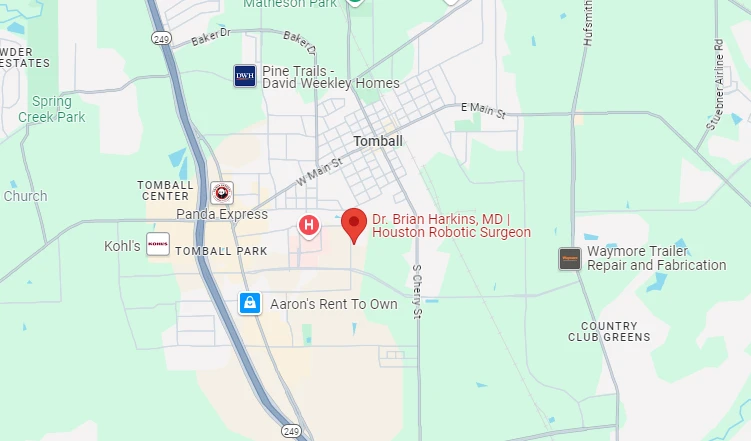
455 School St. Bldg. 1, Suite 10 Tomball, Texas 77375
Mon-Thu: 9:00 am – 5:00 pm | Fri: 9:00 am – 2:00 pm


The earliest and most reliable sign is a change in behavior: a hernia you could previously push back in becomes firm, exquisitely tender, and will not reduce. Pain follows quickly, arriving suddenly and escalating from localized to excruciating within minutes to hours. Skin changes and vomiting come later. Strangulation is a surgical emergency where tissue can die within hours, so the emergency room is the right destination.
A strangulated hernia occurs when trapped tissue loses its blood supply, and recognizing the earliest warning signs can be the difference between a straightforward repair and treatment for gangrene or sepsis.
The difficulty is that strangulation frequently begins suddenly. A hernia you have lived with comfortably for months can become painful, swollen, and impossible to push back within a few hours. This guide covers the first signs to watch for, why the timeline matters so much, and when to seek emergency care.
Not every hernia is an emergency, and understanding the progression helps identify when a familiar condition has become dangerous.
A reducible hernia is one whose contents can be returned into the abdominal cavity, either spontaneously or with gentle external pressure. Many people live with reducible hernias for months or years before pursuing treatment.
An incarcerated hernia occurs when the contents become trapped within the hernial sac and cannot be reduced. Blood supply may not yet be compromised at this stage, but incarceration creates conditions for progressive vascular compromise.
A strangulated hernia is the most serious stage, where blood flow to the trapped tissue has been cut off. This is a surgical emergency requiring immediate intervention to prevent tissue death and life-threatening complications.
The progression from incarcerated to strangulated can happen quickly, which is why incarceration itself warrants emergency evaluation rather than watchful waiting.
The earliest warning for most patients is a distinct change from the usual pattern. A hernia that reduced easily becomes firm, sharply tender, and nonreducible despite gentle sustained pressure.
Emergency medicine guidance identifies this specifically: a hernia becomes an emergency when you try to push it back in, something you should normally be able to do, and it will not go, particularly when the area is painful and firm.
This is the sign to act on. If you have been able to reduce your hernia previously and suddenly cannot, seek immediate medical attention rather than trying repeatedly or waiting to see whether it settles.
Pain is typically the most prominent early symptom. Strangulation pain has a sudden onset, is sharply localized at first, and intensifies rapidly over minutes to hours, becoming constant and severe.
Patients frequently describe it as excruciating, which distinguishes it from the dull ache many people experience with a reducible hernia. The character of the pain changes as much as its intensity.
It typically does not ease with rest or positional change, and it may worsen with attempts at reduction or with palpation. Pain that suddenly becomes far worse than your usual baseline should not be given time to improve on its own.
As venous congestion and inflammation progress, visible changes develop that signal an emergency:
Skin may first appear paler than usual before progressing to a reddish or darker hue and eventually to purple or dark discoloration. Any significant color change over a hernia warrants immediate evaluation, and darkening in particular indicates an advanced stage.
Because strangulated hernias frequently involve small bowel, they often produce mechanical obstruction:
These indicate the intestine may be obstructed or damaged. Combined with a painful, irreducible bulge, they establish the need for emergency care rather than an urgent appointment.
Early systemic signs can be subtle:
As the systemic inflammatory response intensifies, fever becomes more pronounced. In older adults, confusion or altered mental status may emerge as an early marker of sepsis, which is easily mistaken for something else and should be taken seriously in anyone with a known hernia.
The table below compares strangulation risk by hernia type.
| Hernia type | Strangulation risk | Typical guidance |
| Femoral | 22% at three months, 45% at 21 months | Repair recommended even when minimally symptomatic |
| Inguinal | Approximately 2.8% at three months, 4.5% at two years | Watchful waiting reasonable if reducible and minimally symptomatic |
Femoral hernias are particularly prone to strangulation because they protrude through the narrow femoral canal. That tight opening creates high risk that tissue becomes trapped and blood flow is cut off.
The epidemiologic data is striking. Cumulative strangulation probability reaches 22 percent at three months and 45 percent at 21 months, far exceeding inguinal risk. Those figures are why guidelines advise against watchful waiting for femoral hernias and recommend elective repair even in minimally symptomatic cases.
They present as a bulge in the upper inner thigh or lower groin, just below the inguinal ligament, and are more prevalent in women. A groin bulge in a woman warrants prompt surgical consultation on those grounds alone.
Inguinal hernias are the most common type, particularly in men, occurring where the abdominal wall is naturally weaker in the groin.
Annual strangulation risk is comparatively low, roughly 2.8 percent at three months and 4.5 percent at two years after presentation. Lower than femoral, but not zero, and cumulative over time.
Watchful waiting can be reasonable in men with minimally symptomatic, reducible inguinal hernias. It is discouraged for symptomatic hernias, where incarceration and strangulation risk is higher. A hernia causing regular discomfort or visibly growing should prompt surgical consultation.
On arrival at an emergency department with suspected strangulation, the surgeon looks for specific findings:
These findings frequently provide enough information for a surgeon to make the diagnosis and proceed directly to emergency repair.
In many straightforward cases, surgeons proceed to the operating room without imaging to minimize time to intervention. When tissue is dying, delay has a direct cost.
Ultrasonography is often first-line for groin hernias, with sensitivity between 33 and 86 percent and specificity between 77 and 90 percent for detecting occult hernias. It is quick, non-invasive, and widely available.
CT can depict the hernia sac, neck, and herniated bowel loops, with signs of strangulation including bowel wall thickening, reduced enhancement, mesenteric edema, and closed-loop configuration.
The governing principle is that imaging should support clinical judgment rather than replace it. Where symptoms and examination strongly suggest strangulation, surgery should not be delayed for an extensive imaging workup.
Emergent care focuses on rapid resuscitation alongside prompt surgical intervention: establishing intravenous access and administering fluids, providing analgesia, starting broad-spectrum antibiotics where sepsis or peritonitis is suspected, and nasogastric decompression for significant vomiting or distension.
These measures stabilize the patient and prepare them for surgery. None of them resolve the underlying problem, which remains tissue without blood supply.
Definitive treatment is surgical, typically via an open approach that allows direct assessment of bowel viability and resection of any necrotic segment. The surgeon releases the trapped tissue, evaluates whether it has been permanently damaged, and removes anything nonviable.
If the tissue remains viable, it returns to the abdominal cavity and the defect is repaired. If it has died, bowel resection becomes necessary, which complicates recovery and raises the risk of further complications considerably.
Elective hernia repair is typically a planned outpatient procedure with low complication rates and predictable recovery. Performed before an emergency develops, it can often be done minimally invasively with limited downtime.
Most patients having laparoscopic repair resume physical activity within three to five days. Compare that with the weeks or months following emergency surgery for strangulation, and the value of acting early becomes concrete rather than theoretical.
Delaying elective repair significantly increases the risks of strangulation and of needing complex emergency surgery, with worse long-term outcomes. Emergency operations carry higher rates of infection, bowel resection, extended hospitalization, and slower recovery.
Anyone with a known hernia in the Tomball area can discuss options with an experienced Tomball surgeon before an emergency forces the decision, and patients noticing new or worsening symptoms should arrange an urgent evaluation rather than waiting for a routine appointment slot.
The interval between recognizing the signs and reaching a surgeon matters, and a few things help while others make the situation worse.
Repeated forceful attempts to push a strangulated hernia back in can worsen tissue damage and, in rare cases, return compromised bowel into the abdomen where the problem becomes harder to identify.
One gentle attempt is reasonable. If it does not go, stop and go to the hospital rather than persisting.
If surgery is likely, an empty stomach reduces anesthetic risk. Once symptoms suggest strangulation, avoid food and fluids until a surgeon has assessed you.
This matters more than it sounds, since a full stomach can delay an operation that should not wait.
Tell the emergency team how long you have had the hernia, when it stopped reducing, when the pain began, and how it has changed. That timeline directly informs how urgently they proceed.
Note any prior hernia repairs and any mesh placed, since previous surgery changes both the anatomy and the operative plan.
A hernia that previously reduced becoming firm, tender, and irreducible is the earliest reliable sign. Sudden pain escalating rapidly to excruciating follows, with skin changes, vomiting, and systemic symptoms appearing later.
Incarceration means the contents are trapped and cannot be reduced, but blood supply may still be intact. Strangulation means blood flow has been cut off. Incarceration frequently progresses to strangulation, so both warrant emergency evaluation.
It can begin suddenly. A hernia lived with comfortably for months can become painful, swollen, and irreducible within a few hours, and tissue can begin dying within hours of blood supply being cut off.
Sudden in onset, sharply localized at first, then rapidly intensifying to constant and severe, often described as excruciating. It does not ease with rest or position change and may worsen with pressure or attempted reduction.
Progression. Skin may first appear pale, then red, then dusky, purple, or dark as ischemia advances. Any significant color change over a hernia requires immediate evaluation, and darkening indicates an advanced stage.
Femoral hernias by a wide margin, with 22 percent cumulative risk at three months against roughly 2.8 percent for inguinal. The narrow femoral canal traps tissue readily and compromises blood supply quickly.
The emergency room. Suspected strangulation is a surgical emergency requiring immediate assessment and potentially immediate surgery, which urgent care is not equipped to provide.
Not always. In straightforward cases surgeons proceed directly to the operating room to minimize time to intervention, since imaging should support clinical judgment rather than delay treatment when findings already suggest strangulation.
The surgeon releases the trapped tissue and assesses whether it remains viable. Viable tissue returns to the abdomen and the defect is repaired. Nonviable tissue requires resection, which complicates recovery considerably.
Largely, yes. Elective repair is typically outpatient with recovery to physical activity in three to five days, against weeks or months following emergency surgery, and with substantially lower rates of infection and bowel resection.
The single most useful thing to know about strangulation is that the first sign is usually a change rather than a new symptom. A hernia that always went back in stops going back in, becomes firm, and hurts in a way it never did before. That specific change, more than any individual symptom, is what should send someone to an emergency room, because it frequently precedes the skin discoloration and vomiting that people are told to watch for.
The second thing worth knowing is that risk is not uniform. Femoral hernias strangulate at rates approaching a quarter of cases within three months, which is why watchful waiting is not recommended for them regardless of how mild the symptoms feel, and why a groin bulge in a woman deserves prompt evaluation. Against that, an elective repair is an outpatient procedure with a few days of restricted activity. The gap between those two outcomes is the entire argument for not waiting.
Know the change that means a hernia has become an emergency.
Arrange an urgent evaluation with Dr. Brian Harkins in Tomball.


Dr. Brian Harkins is a renowned surgeon specializing in advanced, minimally invasive, and robotic surgical techniques. With a dedication to innovation and personalized patient care, he has transformed countless lives by delivering exceptional outcomes.
I want a website like this, where do i start?