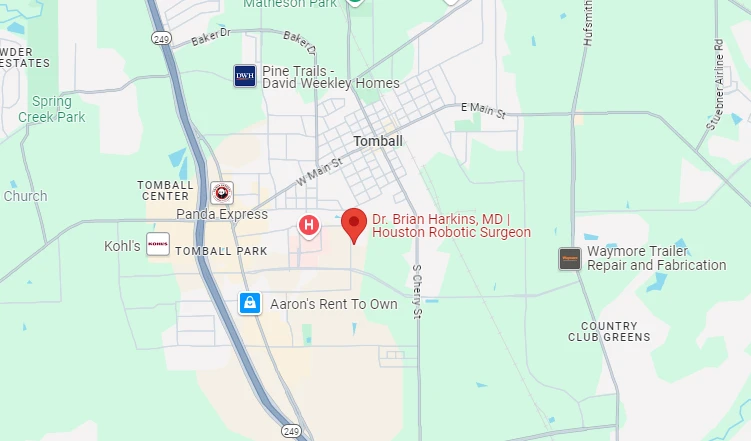
455 School St. Bldg. 1, Suite 10 Tomball, Texas 77375
Mon-Thu: 9:00 am – 5:00 pm | Fri: 9:00 am – 2:00 pm


A hernia typically announces itself as a soft bulge under the skin, groin pressure that worsens when you stand or strain, and aching discomfort that fades when you lie down. But those familiar early symptoms can evolve — and knowing the difference between a hernia that can wait and one that needs urgent attention could genuinely protect your health.
Most people discover their hernia the same way: they notice something feels different when they cough, lift something, or look in the mirror. That moment of recognition often brings a flood of questions — is this serious, do I need surgery now, what happens if I ignore it? Dr. Brian Harkins has been answering those questions for patients across northwest Houston since 1997, and the clarity he offers at consultation is one of the things patients most consistently mention in their reviews.
The short answer on surgery: a hernia won't heal on its own, it generally worsens over time, and the risks of waiting increase as the hernia grows. But not every hernia demands immediate surgery — and understanding where yours falls on that spectrum starts with recognizing your symptoms accurately.

The classic hernia symptom is a soft, reducible bulge — one that you can often push back in with gentle pressure and that disappears when you lie down. Accompanying symptoms include localized aching or pressure that worsens with activity, prolonged standing, or straining, and that eases with rest. These symptoms reflect an early-to-moderate hernia that hasn't yet developed complications.
Different hernia types produce slightly different symptom patterns depending on where the defect is located:
The most common hernia type, occurring in the lower abdomen or groin area. Symptoms include:
Unlike other hernias, hiatal hernias don't produce a visible bulge — they're internal. Symptoms are primarily digestive:
| Hernia Type | Primary Symptom | Visible Bulge? | Worsens With |
| Inguinal | Groin aching or pressure | Yes — groin/scrotum | Standing, lifting, coughing |
| Umbilical | Mild tenderness at belly button | Yes — navel | Straining, coughing |
| Ventral/Incisional | Abdominal heaviness or dragging | Yes — abdominal wall | Activity, prolonged standing |
| Hiatal | Reflux, heartburn, difficulty swallowing | No (internal) | Lying down, eating, bending |
| Spigelian | Lateral abdominal pain | Sometimes subtle | Activity, twisting |
A hernia becomes a medical emergency when it progresses to incarceration or strangulation. An incarcerated hernia is one where the protruding tissue can no longer be pushed back through the defect and becomes trapped. A strangulated hernia is a life-threatening condition where blood supply to the trapped tissue is cut off — requiring emergency surgery within hours.
This is where hernia management stops being a quality-of-life question and becomes a safety question. Knowing these warning signs is genuinely important:
Go to the emergency room immediately if you experience:
These symptoms indicate strangulation or incarceration in progress. Strangulated hernias require emergency surgery, and delay increases the risk of bowel resection and significantly raises complications compared to elective repair.
The risk of strangulation is one of the most compelling reasons to repair a symptomatic hernia electively — on your schedule, at your convenience — rather than waiting until it becomes a crisis.
| Symptom Category | What It May Indicate | Action Required |
| Soft reducible bulge, mild aching | Uncomplicated hernia | Schedule consultation soon |
| Bulge that no longer reduces | Incarceration developing | Call surgeon same day |
| Hard, tender bulge + severe pain | Possible incarceration | Go to ER immediately |
| Severe pain + nausea + vomiting | Possible strangulation/bowel obstruction | Emergency — call 911 or go to ER |
| Fever + hernia pain | Possible strangulation + infection | Emergency — go to ER |
| Sudden worsening pain in known hernia | Acute change requiring evaluation | Call surgeon immediately |

Surgery is the right choice when a hernia is symptomatic, enlarging, or poses a meaningful risk of complications — which describes the majority of hernias that patients bring to Dr. Harkins' practice. Watchful waiting is appropriate only in very specific circumstances, primarily small, asymptomatic inguinal hernias in patients with significant surgical risk. For most patients, the evidence favors repair. The American Hernia Society — the worldwide authority on hernia surgery — provides patient education resources to help you understand your options and what to ask your surgeon at consultation.
Here's the thought process Dr. Harkins walks through with patients at consultation:
Research suggests that in men with small, minimally symptomatic inguinal hernias, watchful waiting is a safe short-term strategy — with the understanding that most will eventually need surgery anyway, and that waiting risks missing the optimal window for elective repair. A hernia occurs when tissue pushes through a weak spot in surrounding muscle or connective tissue — a structural defect that cannot resolve without surgical repair. Dr. Harkins will give you a direct recommendation based on your specific hernia characteristics and personal circumstances.
Your consultation with Dr. Harkins at Surgical Advanced Specialty Center starts with a physical examination and a direct conversation about your symptoms, their progression, and how they're affecting your life. By the end of the appointment, you'll have a clear diagnosis, a recommendation, and a surgical plan drawn out — not a referral to wait for another appointment.
The consultation typically includes:
The practice is at 455 School St., Bldg. 1, Suite 10, Tomball, Texas 77375, and sees patients Monday through Thursday 9am–5pm and Friday 9am–2pm.
Hernia symptoms range from mildly inconvenient to life-threatening — and the window between those two points is the time to act. If you're noticing a bulge, groin pressure, or abdominal discomfort that fits the patterns described above, a consultation is the right next step. You'll get clarity, a diagnosis, and a direct recommendation from one of the most experienced robotic surgeons in Texas.
Don't wait for a crisis to make the appointment. Contact Dr. Brian Harkins' office today and get a clear answer about what your hernia means and what to do about it.
No. Hernias don't resolve without surgical intervention. The abdominal wall defect that causes the hernia can only be closed with repair. Most hernias gradually enlarge over time.
Early hernias typically feel like a soft bulge in the groin or abdomen accompanied by mild aching or pressure that worsens with activity and eases when lying down. Some people feel burning or pulling sensations at the hernia site.
It can be. An untreated hernia risks incarceration — where the hernia becomes trapped — and strangulation, where blood supply to trapped tissue is cut off. Strangulation is a life-threatening emergency. Elective repair eliminates this risk.
Signs of progression include: the bulge is larger than before, it's harder to push back in, the pain is more frequent or more severe, and you're limiting more activities to avoid discomfort. Any of these warrant a prompt consultation.
Light activity is generally fine, but high-impact exercise, heavy lifting, and activities that significantly increase abdominal pressure can worsen the hernia and increase pain. Ask Dr. Harkins for specific guidance based on your hernia type and size.
No. Hiatal hernias are entirely internal and produce no visible bulge — their symptoms are digestive (reflux, difficulty swallowing). Spigelian hernias can also be subtle and may not produce a visible protrusion.
An inguinal hernia is a true structural defect — tissue pushing through the abdominal wall. A sports hernia (athletic pubalgia) is a soft tissue injury without an actual defect. They can feel similar but are diagnosed and treated differently. A physical examination and imaging can distinguish them.
Yes, though less commonly than men due to anatomical differences. Women's inguinal hernias can be harder to diagnose because they may not produce a visible bulge. Femoral hernias — located just below the inguinal ligament — are more common in women and carry a higher strangulation risk.
Same-week and sometimes same-day consultations are typically available. Call 281-351-5409 to schedule. For suspected incarceration or strangulation, go directly to HCA Houston Healthcare Tomball emergency room.
Significantly less risky. Emergency hernia surgery carries higher complication rates, longer hospital stays, and greater risk of requiring bowel resection compared to planned elective repair. This is one of the strongest arguments for not delaying treatment.

Dr. Brian Harkins is a renowned surgeon specializing in advanced, minimally invasive, and robotic surgical techniques. With a dedication to innovation and personalized patient care, he has transformed countless lives by delivering exceptional outcomes.
I want a website like this, where do i start?