455 School St. Bldg. 1, Suite 10 Tomball, Texas 77375
Mon-Thu: 9:00 am – 5:00 pm | Fri: 9:00 am – 2:00 pm

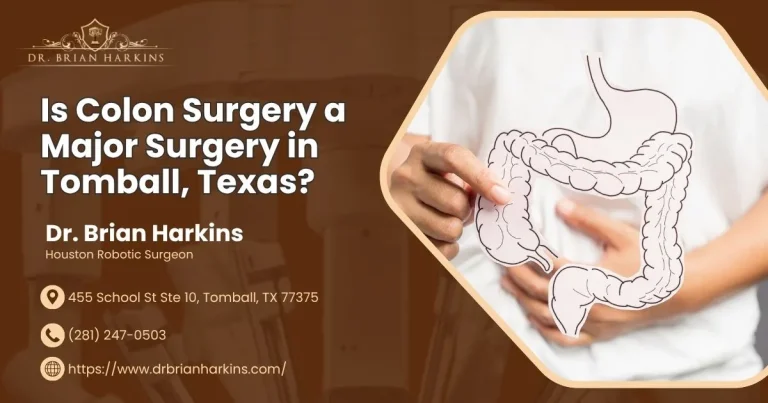
Yes. Removing a section of colon and rejoining the remaining ends is major abdominal surgery under general anesthesia regardless of how it is performed. What has changed is what "major" means for the patient. Minimally invasive approaches have reduced hospital stays from five to seven days down to one to three, cut blood loss substantially, and shortened recovery from six to eight weeks to roughly four to six.
Being told you need colon surgery raises an immediate question about severity, and the honest answer is that this is major surgery by any reasonable definition.
It involves general anesthesia, entry into the abdominal cavity, removal of bowel, and reconnection of the remaining segments. That said, the experience of major colon surgery today differs substantially from what it was two decades ago. This guide covers what the procedure actually involves, how the three approaches compare, and what recovery realistically looks like.
Colon resection meets every standard criterion for major surgery. It requires general anesthesia, opens the abdominal cavity, removes an organ segment, and creates an anastomosis, meaning a surgical connection between the remaining bowel ends.
That anastomosis is the element that makes the procedure genuinely serious. It must heal watertight, and failure of that healing, called an anastomotic leak, is the complication surgeons watch for most closely.
Leak rates run approximately 2 to 4 percent across modern techniques. The figure is low, but the consequence when it occurs is significant enough that it shapes everything about postoperative monitoring and the timing of discharge.
None of this changes based on the size of the incisions. A minimally invasive resection removes the same tissue and creates the same connection as an open one.
Understanding the indication helps put the decision in context, since the alternative to surgery is rarely simply doing nothing.
Resection is the primary curative treatment for colon cancer, removing the tumor along with a margin of healthy bowel and the associated lymph nodes for staging.
The extent of resection depends on tumor location, and the lymph node yield matters for determining whether additional treatment is needed afterward. This is a case where the surgery accomplishes two things at once: removing disease and providing the information that guides what follows.
Recurrent diverticulitis, or a single episode with complications such as perforation or abscess, frequently leads to elective resection of the affected segment.
The decision balances the risk of further episodes against the risk of surgery, which is why it is usually made after a pattern has established rather than following a first attack.
Surgery for Crohn's disease or ulcerative colitis becomes appropriate when medical management no longer controls symptoms or when complications develop such as stricture, fistula, or dysplasia.
The surgical approach differs meaningfully between the two conditions, and the timing decision involves a gastroenterologist alongside the surgeon.
Polyps too large or positioned unfavorably for endoscopic removal sometimes require segmental resection, particularly where there is concern about occult malignancy within them.
This is the indication where the surgery is most clearly preventive, removing something that has not yet become cancer but carries meaningful risk of doing so.
Traditional open resection uses a large abdominal incision, typically six to twelve inches, providing direct visual and manual access. This remains the standard for certain scenarios and is not an inferior technique so much as a different one.
It stays essential where severe adhesions from prior surgery, extensive tumor involvement, or emergency conditions require immediate broad access. Hospital stays average five to seven days, with recovery spanning six to eight weeks.
Wound infection rates run notably higher than with minimally invasive approaches, which is a direct function of incision size rather than of technique quality.
Laparoscopic resection introduced minimally invasive colorectal surgery using small incisions and camera-guided visualization through ports measuring five to twelve millimeters.
The advantages are substantial against open surgery: reduced tissue trauma, less postoperative pain, faster recovery, and lower wound complication rates. Recovery typically runs four to six weeks.
The technique requires operating with two-dimensional visualization and instruments offering four degrees of freedom, which makes some maneuvers technically demanding. Conversion to open surgery occurs in roughly 12.6 percent of cases.
Robotic colon resection addresses several laparoscopic limitations directly. The platform provides three-dimensional high-definition visualization, seven degrees of instrument freedom, tremor filtration, and improved surgeon ergonomics during long procedures.
The measured differences are meaningful. Blood loss averages substantially less than with laparoscopic resection, and conversion to open surgery occurs in roughly 6.3 percent of cases, approximately half the laparoscopic rate.
National data covering 2010 through 2020 across nearly 500,000 patients shows robotic assistance became the most common approach for rectal cancer by 2020, comprising 48.8 percent of procedures. That adoption reflects genuine advantages in the confined space of the pelvis.
| Measure | Open | Laparoscopic | Robotic |
| Hospital stay | 5 to 7 days | 3 to 5 days | 1 to 3 days |
| Recovery to full activity | 6 to 8 weeks | 4 to 6 weeks | 4 to 6 weeks |
| Conversion to open | Not applicable | 12.6% | 6.3% |
| 30-day mortality | 3.5% | 1.5% | 0.8% |
| Anastomotic leak | 2 to 4% | 2 to 4% | 2 to 4% |
| Wound infection | Highest | Substantially lower | Substantially lower |
The mortality figures deserve context rather than being read directly as technique comparison. Patients selected for minimally invasive surgery tend to be healthier and to have less advanced disease than those requiring open approaches, which accounts for part of the difference.
What the data supports clearly is that where a minimally invasive approach is feasible, it produces less trauma, shorter stays, and faster recovery. It does not support the idea that technique alone accounts for the entire mortality gap.
Anastomotic leak rates being similar across all three is worth noting specifically. The most serious complication of colon surgery is not reduced by minimally invasive technique, which is a useful reminder that the operation remains major regardless of access.
The immediate priorities are pain control, return of bowel function, and early mobilization. Walking begins within hours rather than days, since early movement reduces clot risk and helps bowel function resume.
Bowel function typically returns between days two and four. Discharge depends on tolerating oral intake, adequate pain control with oral medication, return of bowel function, and independent mobility rather than on a fixed timeline.
Fatigue is the symptom patients most consistently underestimate. Major abdominal surgery imposes a systemic recovery burden that persists well after incisional pain resolves.
Light walking is encouraged from the first days. Lifting restrictions typically extend four to six weeks to protect the internal suture lines and prevent incisional hernia formation.
Return to desk work is commonly possible within two to three weeks after minimally invasive resection, while physically demanding work requires longer.
Bowel habits frequently change after resection, particularly when a substantial length has been removed or when the surgery involved the rectum. Some patients experience altered frequency or urgency for months.
Low anterior resection syndrome, affecting bowel function after rectal surgery specifically, can persist for twelve to eighteen months. It generally improves, and knowing it is expected rather than a complication helps considerably.
Minimally invasive surgery suits most elective colorectal procedures, including resection for cancer, diverticular disease, inflammatory bowel disease, and large polyps not removable endoscopically.
Open surgery remains appropriate where extensive adhesions from prior operations make safe minimally invasive dissection unlikely, where tumor involvement is extensive, and in emergency situations requiring immediate access such as perforation or obstruction with instability.
Conversion from minimally invasive to open during a procedure is not a failure. It reflects a surgeon judging that conditions found do not permit safe completion by the planned route, and that judgment protects the patient.
Understanding your specific colorectal condition is what determines which approach is realistic, which is why the conversation is worth having in detail before surgery.
Surgeon experience matters more than platform. Learning curves for colorectal surgery techniques typically show measurable improvement over the first twenty to thirty cases, and outcomes continue improving with volume beyond that.
Questions worth asking:
The stoma question deserves specific attention, since it is the outcome patients worry about most and the one least often addressed directly before surgery. A surgeon should be able to tell you the realistic likelihood in your case.
Working with a Tomball surgical practice that performs these regularly means the assessment, surgery, and follow-up happen locally rather than requiring travel into Houston during recovery. Patients facing a colorectal diagnosis can discuss their options before committing to a surgical plan.
The consultation is where most of the useful information exchange happens, and specific questions produce better answers than general ones.
Ask what portion of colon will be removed and why that extent is necessary, since it affects both the operation and long-term bowel function.
Ask whether a temporary stoma is a realistic possibility and under what circumstances one would be created. Patients frequently discover this was a possibility only after waking up with one, which is avoidable through a direct conversation beforehand.
Ask what the plan is if the minimally invasive approach proves unsafe during surgery, since knowing conversion is a recognized possibility makes it far less alarming if it happens.
Ask what recovery looks like specifically for your occupation and household responsibilities rather than accepting a general figure that may not reflect your situation at all.
Yes. It requires general anesthesia, entry into the abdominal cavity, removal of a bowel segment, and creation of a surgical connection between the remaining ends. Minimally invasive technique changes the recovery, not the classification.
It reduces trauma, hospital stay, and recovery time substantially, but the operation itself is the same. Anastomotic leak rates of 2 to 4 percent are similar across all approaches, which is the complication that matters most.
One to three days after robotic resection, three to five after laparoscopic, and five to seven after open surgery. Discharge depends on tolerating food, controlling pain orally, bowel function returning, and independent mobility.
Four to six weeks for full recovery after minimally invasive resection, six to eight after open surgery. Desk work is commonly possible within two to three weeks, while physically demanding work takes longer.
Failure of the surgical connection between the remaining bowel ends to heal watertight. It occurs in roughly 2 to 4 percent of cases, and its potential severity is what drives careful postoperative monitoring before discharge.
Because three-dimensional visualization and wristed instruments handle the confined pelvic space and difficult dissections that cause laparoscopic conversions. Rates run roughly 6.3 percent robotic against 12.6 percent laparoscopic.
Sometimes, and often temporarily. The likelihood depends on the location of the disease, whether the rectum is involved, and conditions found during surgery. Ask your surgeon for a realistic assessment of your specific case.
Frequently they change for a period. After rectal surgery specifically, low anterior resection syndrome can affect function for twelve to eighteen months before improving, which is expected rather than a complication.
Where extensive adhesions from prior operations prevent safe minimally invasive dissection, where tumor involvement is extensive, and in emergencies such as perforation or obstruction with instability requiring immediate broad access.
Ask about annual resection volume, what proportion they complete minimally invasively, their conversion rate, and their leak rate. Learning curves show improvement over the first twenty to thirty cases and continue with volume.
Colon surgery is major surgery, and no framing of minimally invasive technique changes that. The operation removes a segment of bowel and joins what remains, and that connection has to heal watertight. The 2 to 4 percent leak rate holds across open, laparoscopic, and robotic approaches alike, which is the clearest evidence that smaller incisions have not made the underlying procedure less consequential.
What has genuinely changed is everything surrounding it. A hospital stay of one to three days rather than five to seven, recovery measured in four to six weeks rather than six to eight, substantially lower blood loss, and conversion to open surgery in half as many robotic cases as laparoscopic. Those are real improvements in the patient experience, achieved without altering what the surgery accomplishes. The useful preparation is understanding both halves of that picture: this is a serious operation, and it is one most people recover from considerably faster than they expect.
Understand what colon surgery involves before you decide on an approach.
Discuss your diagnosis with Dr. Brian Harkins in Tomball.


Dr. Brian Harkins is a renowned surgeon specializing in advanced, minimally invasive, and robotic surgical techniques. With a dedication to innovation and personalized patient care, he has transformed countless lives by delivering exceptional outcomes.
I want a website like this, where do i start?