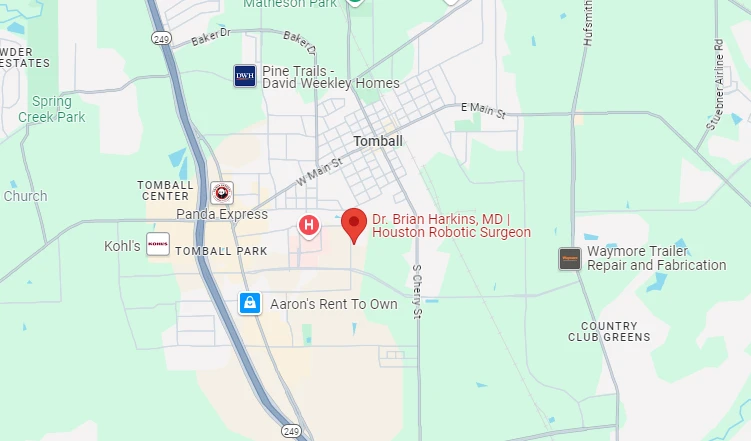
455 School St. Bldg. 1, Suite 10 Tomball, Texas 77375
Mon-Thu: 9:00 am – 5:00 pm | Fri: 9:00 am – 2:00 pm


Most patients recovering from robotic hernia surgery with Dr. Brian Harkins go home the same day as their procedure, return to light activity within a few days, and are back to normal routines within one to two weeks. That recovery arc is faster than traditional hernia surgery because of two compounding factors: minimally invasive robotic technique and ERAS (Enhanced Recovery After Surgery) protocols.
Recovery after hernia surgery used to mean three to five days in the hospital, weeks of strict activity restrictions, and a slow, uncomfortable return to normal life. That was open surgery — a large incision through the abdominal wall to access the hernia. Robotic hernia repair uses incisions smaller than a centimeter, causes dramatically less tissue disruption, and places Dr. Harkins' wristed Da Vinci Xi instruments exactly where they need to be without the collateral damage of traditional technique.
Add ERAS protocols to robotic technique and the recovery timeline compresses further. Patients who understand what to expect — day by day, week by week — recover better, have fewer anxiety-related setbacks, and call the office with the right questions at the right times. This guide is designed to give you that understanding before your procedure.
ERAS (Enhanced Recovery After Surgery) is a multimodal perioperative protocol that treats the surgical recovery process as something the medical team and patient manage together, not something that just happens to the patient. The ERAS Society describes it as a treatment program that reduces physical surgical stress through evidence-based interventions before, during, and after the operation — enabling recovery time to be shortened by 30% or more.
Dr. Harkins integrates ERAS across all hernia procedures. The specific elements that affect hernia surgery recovery most directly:
The result: most same-day discharge hernia patients go home comfortable, managing their pain with over-the-counter medications, and feeling meaningfully better within 48 hours.

Recovery from robotic hernia repair is individual — it depends on hernia type, repair complexity, your baseline fitness, and how consistently you follow post-operative instructions. The timeline below reflects the experience of most Dr. Harkins patients with uncomplicated robotic hernia repair under ERAS protocols.
You arrive at HCA Houston Healthcare Tomball, go through pre-operative preparation, and your procedure is performed under general anesthesia. Operative time for most robotic hernia repairs is 45–90 minutes. You're monitored in recovery for 1–2 hours, then moved to a step-down area. Most patients are discharged home the same afternoon or evening. You'll need a driver — you can't operate a vehicle for 24 hours after general anesthesia.
This is typically the most uncomfortable stretch of recovery. Expect:
Pain is manageable with scheduled acetaminophen and ibuprofen in most cases. A short course of prescription pain medication is provided as backup.
Most patients notice meaningful improvement by day 3. By the end of the first week:
For most patients, the second week marks a return to a recognizable version of normal life. Most light-activity routines are fully resumed. Driving becomes possible once you're off prescription pain medication and can react normally.
Full resumption of normal activity for most hernia types. Walking, light exercise, and most routine tasks are unrestricted. Lifting restrictions are typically lifted at 4 weeks for standard repairs.
| Recovery Phase | Expected Status | Activity Level |
| Day of surgery | Discharged home, comfortable | Rest, brief walks encouraged |
| Days 1–2 | Peak soreness, manageable with OTC meds | Light movement, short walks |
| Days 3–7 | Clear improvement, CO₂ discomfort resolving | Light household activity, work from home |
| Week 2 | Near-normal daily function | Light activity, resume driving off Rx pain meds |
| Weeks 3–4 | Full activity for most hernia types | Normal routines, lifting restrictions lifted at 4 weeks |
| 6 weeks | Full recovery including physical labor | No restrictions for most patients |

The goal of post-operative activity restrictions is to protect the repair while healing occurs — not to confine patients to bed rest. Dr. Harkins' approach emphasizes early movement within appropriate limits, because immobility carries its own risks: blood clots, muscle deconditioning, and slower GI return.
The specific restrictions for most robotic hernia repairs:
These restrictions vary by hernia type, repair approach, and individual patient factors. Dr. Harkins provides personalized instructions at discharge.
Most hernia surgery recovery is uncomplicated and manageable at home. Knowing which symptoms warrant a call to the office — versus a trip to the emergency room — is part of managing recovery confidently.
Call Dr. Harkins' office at 281-351-5409 if you notice:
Go to HCA Houston Healthcare Tomball ER if you experience:
The American Hernia Society notes that patients should always have a clear point of contact with their surgical team for post-operative concerns. Dr. Harkins' office provides after-hours guidance for urgent questions between business hours.
Recovery from robotic hernia surgery with Dr. Brian Harkins is faster, more comfortable, and more predictable than what most patients expect from surgery — because most people's reference point is open surgery, which is a fundamentally different experience. With the robotic approach and ERAS protocols working together, the majority of patients are living normal lives within two weeks of their procedure.
If you have questions about your upcoming procedure or want to schedule a hernia consultation, contact the office at 281-351-5409 or visit the hernia surgery page for a full overview of the repair approaches Dr. Harkins uses.
Most patients recover from robotic hernia repair within 1–2 weeks for light activity and 3–4 weeks for full unrestricted activity. Open hernia surgery recovery typically takes 3–6 weeks.
Yes. Abdominal bloating from CO₂ gas used during robotic surgery is very common in the first 24–48 hours. It resolves on its own as the gas is absorbed. Walking accelerates this process.
CO₂ gas can irritate the diaphragm, causing referred pain in the right shoulder or upper back. This is common after laparoscopic and robotic surgery, is not dangerous, and typically resolves within 24–48 hours. Dr. Harkins uses low-pressure insufflation to minimize this.
Most patients can shower 24–48 hours after surgery. Keep incision sites clean and dry; do not soak in a bath, pool, or hot tub until incisions are fully closed — typically 2 weeks.
Desk or sedentary work: typically 5–7 days. Light physical work: 2–3 weeks. Heavy physical labor: 4–6 weeks. These timelines vary by hernia type and repair complexity.
Hernia recurrence presents as a new bulge, increased discomfort, or returning symptoms at or near the repair site. If you notice any of these, call the office for evaluation. Recurrence rates for robotic hernia repair are low, particularly for inguinal repairs using mesh.
A regular diet is generally fine after robotic hernia repair. Start with bland, easy-to-digest foods if nausea is present, then advance to your normal diet as tolerated. Avoid constipation — high fiber foods and adequate hydration help, as straining puts stress on the repair.
Avoid heavy lifting (over 15 pounds for the first 2 weeks), vigorous exercise, soaking in water, driving while on opioid pain medication, and activities that significantly increase abdominal pressure (including constipation straining).
Most patients have a post-operative appointment at 2 weeks. Dr. Harkins' team schedules this before or at discharge. If any concerns arise before that appointment, call the office at 281-351-5409.
Warning signs include increasing rather than decreasing pain after day 2, fever above 101°F, redness or discharge at incision sites, inability to keep fluids down, and difficulty urinating. Call the office promptly for any of these — most complications are straightforward to manage when caught early.

Dr. Brian Harkins is a renowned surgeon specializing in advanced, minimally invasive, and robotic surgical techniques. With a dedication to innovation and personalized patient care, he has transformed countless lives by delivering exceptional outcomes.
I want a website like this, where do i start?