455 School St. Bldg. 1, Suite 10 Tomball, Texas 77375
Mon-Thu: 9:00 am – 5:00 pm | Fri: 9:00 am – 2:00 pm

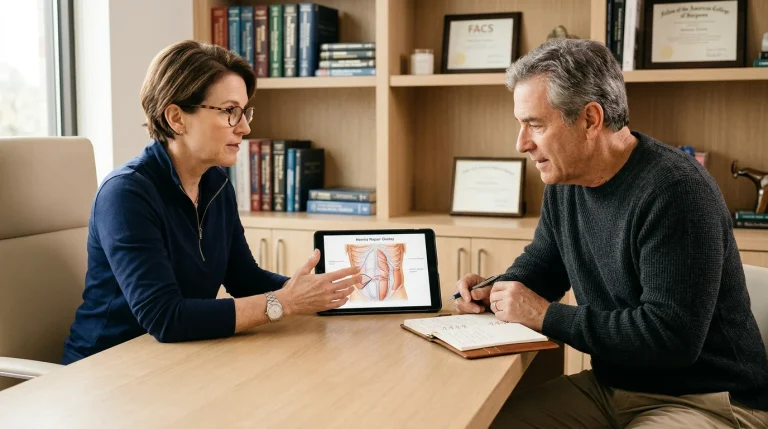
To choose a hernia surgeon in Houston, ask seven questions: (1) How many of this specific hernia repair have you performed? (2) What surgical approach do you recommend and why? (3) What mesh will you use? (4) What are your complication and recurrence rates? (5) Will you personally perform the entire case? (6) Where will surgery take place? (7) What does recovery actually look like? A surgeon's answers, not their marketing, tell you who is right for your hernia.
Most patients walk into a hernia consultation focused on getting the problem fixed and on scheduling. The patients who end up with the best outcomes walk in with a list of questions. Houston is saturated with general surgeons who repair hernias, from the Texas Medical Center and HCA Houston Healthcare locations to UT Physicians and private practices in Tomball, Katy, Sugar Land, and The Woodlands. What varies between them, sometimes dramatically, is the surgical approach they prefer, the mesh they use, how many of your specific type of hernia they handle per year, and what they will do if something does not go according to plan.
This guide walks through the seven questions you should ask at every consultation when choosing the right hernia surgeon, explains why each matters for long-term robotic hernia surgery outcomes, and notes what a strong answer sounds like. The goal is not to memorize a script. It is to walk out of your consultation knowing whether the surgeon in front of you is the right hernia specialist for your specific hernia, whether that is a small umbilical hernia, a complex incisional hernia, an abdominal wall reconstruction, or anything in between.
Volume matters, and "hernia surgery" is not one thing. The right hernia specialist for an inguinal hernia repair is not necessarily the right hernia surgeon for an umbilical hernia, incisional hernia, or hiatal hernia repair. A general surgeon who performs 200 inguinal hernia surgeries a year is not necessarily the right surgeon for a complex incisional hernia or a full abdominal wall reconstruction. Ask about the specific type of hernia you have, where the hernia occurs, whether it is small, whether it is recurrent, and whether any intestine or fatty tissue may protrude through the weakened area.
Research on surgical learning curves shows outcomes for complex procedures stabilize after roughly 25 to 30 cases and continue improving with higher annual volume. For robotic hernia repair specifically, studies suggest complication rates drop and operative times shorten as surgeons accumulate cases past 50. You are listening for a surgeon whose answer includes specifics, not generalities. A strong answer sounds like: "I do about 150 inguinal hernias a year, roughly 60 of those robotically. I have done well over 100 robotic hernia repairs overall, including incisional and hiatal cases." A vague answer such as "I do plenty" is itself the answer to your question.
Table 1: Surgeon volume thresholds and outcome implications
| Annual case volume (specific hernia type) | Stage of expertise | Typical outcome implication |
| Under 25 cases | Early in learning curve | Higher reported complication risk for complex repairs |
| 25 to 50 cases | Outcomes stabilizing | Approaching established benchmarks |
| 50 to 100 cases | Established practice | Outcomes consistent with published averages |
| 100 or more cases per year | High-volume specialist | Best-published complication and recurrence rates |
There are three ways to repair a hernia in modern practice, and each has a place. Open hernia surgery uses a single larger incision directly over the hernia site and remains the right choice for some cases, especially strangulated hernias needing emergency surgery. Traditional laparoscopic hernia repair uses small incisions with a laparoscope and straight instruments and has decades of track record in primary inguinal and umbilical repairs. Robotic-assisted laparoscopic hernia repair uses the same small-incision concept while adding magnified 3D vision, wristed instruments, and tremor filtration through the da Vinci platform.
No approach is universally correct. A good surgeon explains why they are recommending one approach over another for your specific hernia, citing factors such as the hernia's size and location, whether it is a primary or recurrent hernia, your body type, prior abdominal surgeries, the presence of scar tissue, and your overall health. A surgeon who recommends the same approach for every patient is a signal worth noting. The strongest robotic surgeons are also skilled laparoscopic and open surgeons because they choose the technique that fits the patient rather than the tool they prefer.
Table 2: Hernia repair approach comparison
| Approach | Best suited for | Incision profile | Typical return to full activity |
| Open hernia surgery | Strangulated or emergency cases, certain large defects | Single 5 to 15 cm incision | 4 to 6 weeks |
| Laparoscopic hernia repair | Most primary inguinal and umbilical hernias | 3 small ports (5 to 12 mm) | 2 to 4 weeks |
| Robotic hernia repair | Complex, recurrent, large incisional, abdominal wall reconstruction | 3 to 5 small ports (8 to 12 mm) | 2 to 4 weeks |

Most modern hernia repair procedures use surgical mesh to reinforce the abdominal wall where the hernia occurs. Mesh choice matters more than most patients realize. Hernia mesh products vary in material (synthetic, biologic, or absorbable), weight, pore size, and how the body integrates them. Different mesh products carry different reported recurrence rates and different risk profiles for chronic pain, infection, signs of infection, or mesh migration. Modern hernia mesh selection is a real clinical decision, not a default.
Ask your surgeon what mesh they will use for your hernia type, why that specific product, and what the reported recurrence rate is with it. A surgeon who can name the product, explain the decision, and cite recurrence data is a surgeon thinking carefully about your long-term outcome. A surgeon who shrugs off mesh selection as "standard" is not giving you the full picture. It is also reasonable to ask about mesh-related complications, since chronic pain, infection, and mesh migration are uncommon but real. You want a surgeon who discusses them openly, not one who dismisses them.
Table 3: Common surgical mesh types and their use
| Mesh type | Material | Typical use case | Key consideration |
| Synthetic permanent | Polypropylene, polyester | Most primary inguinal and ventral repairs | Long track record, durable reinforcement |
| Synthetic absorbable | PGA-TMC and similar | Contaminated fields, certain primary repairs | Lower infection profile, gradual resorption |
| Biologic | Porcine or bovine derived | Infected fields, hostile abdomens | Higher cost, used selectively |
| Composite | Multiple layered materials | Intraperitoneal placement | Reduces visceral adhesion to mesh |
This question makes some surgeons uncomfortable. A good one answers it directly. Ask specifically about surgical site infection rate, 30-day readmission rate, recurrence rate at one year and five years, and rate of chronic post-operative pain. If a surgeon tells you their complication rate is zero, that is a red flag because no honest surgeon has a zero rate. The published benchmark ranges in the table below give you context for evaluating any surgeon's numbers. Individual practice varies, but a surgeon's reported rates should sit within a reasonable range of the evidence, and a surgeon who knows their own numbers cold is doing the work to track outcomes.
Table 4: Hernia repair benchmark data (published research averages)
| Metric | Open hernia surgery | Laparoscopic hernia repair | Robotic hernia repair |
| Overall complication rate | 12 to 18% | 5 to 8% | 5 to 6% |
| Surgical site infection rate | 3 to 8% | 1 to 3% | 1 to 3% |
| Chronic post-operative pain (groin hernia) | 10 to 15% | 5 to 10% | 5 to 10% |
| 5-year recurrence (primary inguinal) | 5 to 10% | 2 to 5% | Under 3% (high-volume) |
| Typical length of stay | 1 to 3 nights | Same-day to 1 night | Same-day to 1 night |

In teaching hospitals and some large group practices, parts of a procedure may be performed by residents, fellows, or physician assistants under supervision. That is not inherently wrong, since training surgeons is how the field sustains itself, but it is information you are entitled to know. Ask directly: will you personally be at the console for the entire robotic procedure, who else will be involved, and in what role? The answer should be specific rather than reassuring.
Dr. Brian Harkins operates the da Vinci console personally for every case. That is a question worth asking any surgeon you are considering, not just because of who holds the instruments but because surgical judgment during the operation, including identifying structures, adjusting for unexpected anatomy, and managing bleeding, is what shapes the outcome. A clear answer about who is operating means you know exactly who is responsible for your result.
The hospital matters almost as much as the surgeon. Facilities designated as Centers of Excellence in Robotic Surgery meet specific volume, outcomes, and protocol standards that smaller programs may not. HCA Houston Healthcare Tomball, where Dr. Harkins operates, holds this designation. At the facility level, you are listening for a dedicated robotic surgery program with trained operating room staff, an up-to-date da Vinci platform such as the Xi or the more recent SP and Da Vinci 5 systems, a low facility-level surgical site infection rate, and Enhanced Recovery After Surgery (ERAS) protocols.
Published research has linked ERAS protocols to reduced post-operative pain, faster discharge, and lower complication rates. Strong anesthesia and recovery support are part of the same picture, and a high-volume hospital with experienced robotic staff is part of the outcome. You are not just choosing a surgeon, you are choosing the team behind them. Ask what the hospital's robotic case volume is, how many robotic-trained scrub techs and circulating nurses they have, and whether the surgeon has dedicated operating-room time at that facility.
This is the question that separates a good consultation from a sales pitch. A surgeon who rushes past recovery or offers vague reassurance such as "you'll be back to normal in no time" is not preparing you. A useful answer is specific about what to expect day-by-day and week-by-week, including pain levels, activity restrictions, and what is normal versus concerning.
Most patients return to light activity within 7 to 10 days after a robotic inguinal hernia repair, with full recovery including lifting restrictions typically taking 4 to 6 weeks. Expect some bruising, swelling, and moderate pain controlled by a combination of acetaminophen, ibuprofen, and a short course of prescription medication. Specific symptoms that should prompt a phone call include fever above 101°F, increasing redness or drainage at incisions, severe or worsening pain, or signs of recurrence. You also want to know how to reach the practice after hours, how quickly calls are returned, and what the follow-up visit schedule looks like in the first two weeks.
If you are choosing a hernia surgeon in the Houston area, you have realistic options across the Texas Medical Center, The Woodlands, Katy, Sugar Land, and Tomball. Geography matters for follow-up visits, especially in the first two weeks after hernia surgery when driving may be restricted. Patients who live in Northwest Houston, Tomball, Magnolia, Spring, Cypress, and The Woodlands often find that a local Tomball hernia surgeon offers real advantages, including shorter drives for pre-op and post-op visits, faster access if an urgent question comes up, and a surgical team embedded in a community hospital that knows its patients.
Verifying credentials should be the first step regardless of location. Confirm board certification through the American Board of Surgery, check Fellow of the American College of Surgeons (FACS) status, and review the surgeon's affiliations with hospitals that have dedicated robotic surgery programs. Volume and outcome data should follow credentials, and the seven questions in this guide work whether the surgeon practices at an academic medical center, a community hospital, or a private practice.
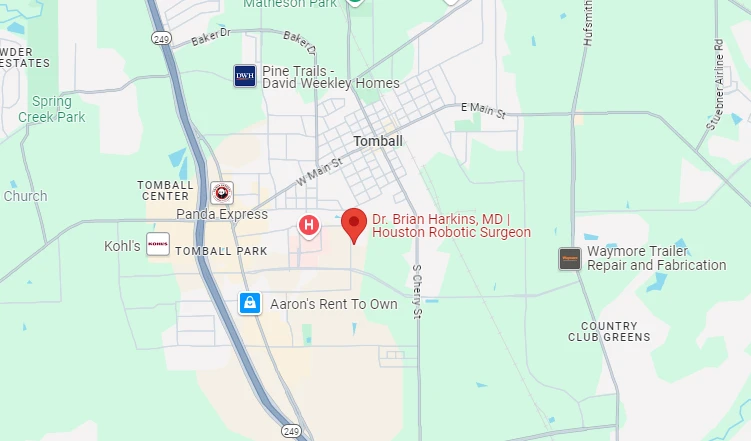
Dr. Harkins' practice is located at 455 School Street in Tomball, and hernia surgeries are performed at HCA Houston Healthcare Tomball's Center of Excellence in Robotic Surgery, a facility designed around advanced care of complex hernias, abdominal wall reconstruction, and minimally invasive hernia repair. If your primary care doctor has mentioned a hernia repair, this is a useful place to start the conversation by calling the office to schedule an appointment, bringing your seven questions, and letting the answers guide you.
Write the seven questions down. Bring them to every consultation. Listen to how directly each surgeon answers, how comfortable they are with data, and how honestly they discuss tradeoffs. The right surgeon for your hernia is the one who takes the questions seriously, not the one with the smoothest pitch.
If you would like to schedule a consultation with Dr. Brian Harkins at our Tomball office, call 281-351-5409 or request an appointment online. We see patients from across the greater Houston area, with most surgeries performed at HCA Houston Healthcare Tomball's Center of Excellence in Robotic Surgery.
Start with surgeon volume for your specific hernia type, board certification by the American Board of Surgery, FACS designation, and hospital credentialing at a facility with a dedicated robotic or minimally invasive surgery program. Ask for published complication and recurrence rates rather than accepting reassurance.
A hernia specialist is typically a board-certified general surgeon who has focused a substantial portion of their practice on hernia repair, including inguinal, umbilical, incisional, and hiatal hernias plus abdominal wall reconstruction. Volume and outcomes matter more than title alone.
For complex or recurrent hernias, robotic precision through magnified 3D vision and wristed instruments offers meaningful advantages with an experienced surgeon. For straightforward primary hernias, outcomes are often comparable when the surgeon has high volume in either approach. Surgeon experience matters more than platform.
Self-pay hernia surgery costs vary by hernia type, approach, and facility. Outpatient inguinal hernia repair can range from roughly $5,000 to $15,000 including surgeon and facility fees, while complex incisional or recurrent repairs cost more. Most commercial insurance plans, Medicare, and Medicaid cover medically necessary hernia repair.
No. Surgeons differ in preferred approach (open, laparoscopic, robotic), mesh selection, fixation technique (sutures, tacks, absorbable tacks, glue), and use of ERAS protocols. Two surgeons with the same credentials can produce meaningfully different recovery experiences and complication rates, which is why specific technique questions matter.
Most patients return to light activity in 7 to 10 days. Desk workers commonly return to work within 5 to 7 days. Patients with physically demanding jobs typically need 4 to 6 weeks before returning without restrictions. Full recovery with lifting clearance averages 4 to 6 weeks.
Most uncomplicated robotic inguinal hernia repairs take 60 to 90 minutes of operative time, plus additional time for anesthesia setup and recovery room observation. Complex incisional repairs and abdominal wall reconstructions can take two to four hours depending on the size of the defect and prior abdominal surgeries.
Most robotic hernia repairs are outpatient procedures with same-day discharge. Larger or more complex repairs and patients with significant comorbidities may require an overnight stay for observation and pain management. Discharge depends on stable vitals, tolerated oral intake, and adequate pain control.
Yes. General anesthesia means you cannot drive yourself home, and most practices will not discharge a patient without a designated adult driver. Many patients also need a responsible adult at home for the first 24 hours. Most can resume driving within 5 to 7 days, off prescription pain medication.
Many small, non-painful hernias can be watched safely with a surgeon's guidance, but hernias generally do not heal on their own and often grow over time. Warning signs warranting immediate evaluation include increasing pain, a hernia that becomes hard or cannot be reduced, nausea, vomiting, or signs of bowel obstruction.

Dr. Brian Harkins is a renowned surgeon specializing in advanced, minimally invasive, and robotic surgical techniques. With a dedication to innovation and personalized patient care, he has transformed countless lives by delivering exceptional outcomes.
I want a website like this, where do i start?