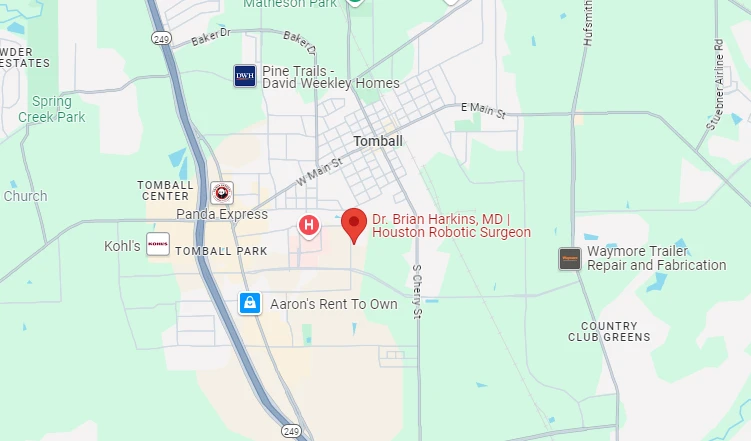
455 School St. Bldg. 1, Suite 10 Tomball, Texas 77375
Mon-Thu: 9:00 am – 5:00 pm | Fri: 9:00 am – 2:00 pm


In general surgery, gallbladder removal leads by a wide margin at roughly 37 percent of all robotic cases nationally, followed by hernia repair, colorectal resection, and anti-reflux procedures. These share the characteristics that make robotic assistance worthwhile: work in confined abdominal spaces, suturing that benefits from wristed instruments, and dissection where three-dimensional visualization changes what the surgeon can see.
If you are considering robotic surgery in Tomball, you probably want to know which procedures are actually performed this way, whether it genuinely improves on traditional methods, and what recovery looks like.
Most robotic procedures use the da Vinci system, which lets surgeons operate through small incisions with enhanced precision and three-dimensional visualization. This guide covers the general surgery procedures most commonly performed robotically, how they compare with open and laparoscopic approaches, and what to expect from consultation through recovery.
General surgery accounts for a substantial share of robotic volume, and four procedures dominate.
Cholecystectomy is the most frequently performed robotic procedure nationwide, accounting for approximately 37 percent of all robotic cases. Patients have access to both standard robotic cholecystectomy using four small incisions and the single-site approach.
Single-site gallbladder removal allows the entire procedure through one incision at the navel, roughly an inch long. The cosmetic result is substantially better, and postoperative pain is typically lower than with multi-incision approaches.
Most patients go home the same day and resume normal activity within about two weeks.
Robotic assistance has changed hernia repair meaningfully, particularly for ventral and incisional hernias. The platform allows surgeons to suture the defect closed and then reinforce it with mesh, rather than simply bridging the gap with mesh alone.
That distinction matters more than it sounds. Closing the defect and reinforcing produces substantially better durability than bridging, and high-volume surgeons report near-zero recurrence with the closed-and-reinforced technique compared with roughly 20 percent recurrence using laparoscopic bridging.
The procedure typically involves three to four small incisions, with recovery to full activity in three to four weeks.
Robotic colorectal procedures benefit from the platform's advantages in confined spaces, particularly deep in the pelvis where laparoscopic instruments have limited articulation.
Blood loss is measurably lower than with laparoscopic approaches, and conversion rates to open surgery are roughly half. Hospital stays typically run one to two days rather than the five to seven common after open resection.
Reflux procedures including fundoplication involve precise suturing around the esophagus in a confined space near the diaphragm, which is exactly the environment where wristed instruments help.
The work sits high in the abdomen at an awkward angle for straight laparoscopic instruments, and the platform's articulation addresses that directly.
The procedures that migrated to robotic platforms fastest share identifiable characteristics, which explains the pattern rather than leaving it as a list.
Deep pelvic dissection in colorectal work and the area around the diaphragm in reflux surgery both involve operating at angles that straight laparoscopic instruments handle awkwardly. Wristed articulation addresses that directly.
The benefit is largest where the surgeon cannot simply reposition to get a better angle, which describes both of those spaces well.
Intracorporeal suturing is among the more demanding laparoscopic skills, and it is central to hernia defect closure and to fundoplication. The platform makes it substantially more manageable.
That is the mechanism behind the recurrence difference in ventral hernia repair. Closing a defect and reinforcing it is better than bridging, and the technology makes closing practical in cases where it previously was not.
Gallbladder removal benefits less from technical advantage than from sheer numbers. It is the most commonly performed general surgery procedure, so even modest adoption produces large case counts.
The single-site technique also offers something genuinely unavailable laparoscopically, which drives selection independent of clinical outcome differences.
| Factor | Robotic | Laparoscopic | Open |
| Incisions | Several small ports | Several small ports | One large incision |
| Instrument articulation | Wristed, seven degrees of freedom | Straight, four degrees | Direct hand access |
| Visualization | 3D high definition, surgeon-controlled | 2D, assistant-controlled camera | Direct vision |
| Typical hospital stay | Same day to 2 days | Same day to 2 days | Several days |
| Operative time | 20 to 40 minutes longer | Baseline | Variable |
| Cost to facility | Higher per case | Baseline | Variable |
Against open surgery, the minimally invasive approaches produce clearly better outcomes on pain, hospital stay, and recovery. Against laparoscopic surgery, robotic advantages are more situational, concentrating in complex cases, confined spaces, and procedures requiring extensive suturing.
That nuance is worth understanding before assuming newer means better for your particular procedure.
Recovery from robotic surgery is substantially faster than open surgery and broadly comparable to laparoscopic approaches.
Most patients having robotic abdominal surgery go home the same day or within one to two days. Return to light activity typically occurs within two to three weeks, with full recovery including heavy lifting at three to four weeks.
Those timelines improve considerably on open surgery, which often requires extended hospitalization and months before full activity. Individual recovery varies with the specific procedure, your overall health, and whether any complications develop.
Lifting restrictions exist for a reason and are worth respecting. Internal healing continues well after external incisions close, and returning to heavy work early is a common cause of hernia formation at port sites.
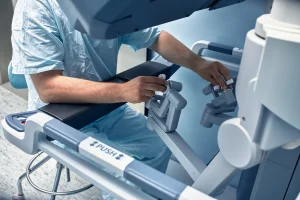
A persistent misconception holds that the robot operates autonomously. It does not. The surgeon maintains complete control from the console throughout, and the platform translates hand movements into instrument movements while filtering tremor.
It makes no independent decisions at any point. Understanding this helps set realistic expectations about where the benefit comes from, which is enhanced capability in the surgeon's hands rather than automation.
Wristed instruments articulate beyond human wrist range, which matters when suturing at awkward angles deep in the abdomen. Three-dimensional visualization restores the depth perception that two-dimensional laparoscopy sacrifices. Motion scaling translates larger hand movements into precise smaller instrument movements.
Fluorescence imaging, available on current platforms, highlights blood flow and anatomical structures in real time, which assists surgeons in identifying critical structures during a dissection where they might otherwise be difficult to distinguish.
Robotic procedures often take 20 to 40 minutes longer than laparoscopic equivalents, meaning longer anesthesia exposure and higher operating room costs. For most patients this does not affect outcomes, but it is a genuine factor.
Standard surgical risks persist. Bleeding, infection, organ injury, and anesthesia complications all remain possible, and conversion to open surgery may become necessary if unexpected anatomy or pathology is found. The benefits lie in smaller incisions and enhanced visualization rather than in eliminating risk.
Surgeon volume and experience influence outcomes more than the platform does. Robotic surgery carries a meaningful learning curve, and results improve substantially as case numbers accumulate.
When evaluating surgeons, look for those well past 50 to 100 robotic cases. A high-volume laparoscopic surgeon frequently produces better outcomes than a low-volume robotic surgeon, which is worth remembering when technology is presented as the differentiator.
Ask directly how many of your specific procedure they perform in a typical year. General robotic experience matters less than experience with the operation you are having.
Most major plans cover robotic-assisted surgery where they cover the laparoscopic version of the same procedure, and patients typically face no additional out-of-pocket cost for the robotic approach.
From the facility side, direct per-case costs run roughly $3,300 to $3,600 higher than laparoscopic, though insurers generally do not reimburse additional fees for the robotic approach. Verify coverage with your plan before scheduling, since most procedures fall under standard surgical benefits.
Symptomatic gallstones. A choice between standard robotic cholecystectomy with four incisions or the single-site approach through one navel incision. Most patients go home the same day and return to normal activity within two weeks.
Ventral hernia after prior surgery. Robotic repair using three to four incisions to close the defect and place mesh, producing a more durable repair than bridging. Recovery to full activity takes three to four weeks.
Colorectal resection. The robotic approach offers advantages working deep in the pelvis, with lower blood loss and conversion rates than laparoscopic. Hospital stay typically runs one to two days.
Chronic reflux unresponsive to medication. Fundoplication performed robotically, benefiting from articulation in the confined space near the diaphragm.
Understanding what robotic surgery can and cannot offer for your specific condition is the useful preparation for a consultation. Patients weighing options can ask about a procedure and get a direct answer about whether the approach suits their case.
Preparation differs little from any minimally invasive abdominal surgery, though a few points are worth knowing.
Your surgical team will review medications, since blood thinners and certain supplements typically need pausing beforehand. Smoking cessation even a few weeks prior measurably improves healing and reduces complications.
Fasting instructions are standard, generally nothing by mouth after midnight, and following them precisely is what prevents a last-minute cancellation on the day.
Arrange transportation home and someone to stay with you the first night. Same-day discharge is common, but you should not drive after general anesthesia.
Expect to arrive several hours before the procedure for preparation, anesthesia consultation, and marking. The operation itself frequently takes considerably less time than all the preparation surrounding it.
Port sites are typically closed with dissolvable sutures or surgical adhesive rather than staples, so a separate visit for suture removal is rarely needed afterward.
Walk early and frequently after surgery, which reduces clot risk and helps resolve the referred shoulder discomfort that residual carbon dioxide commonly produces.
Follow lifting restrictions carefully. Port site hernias are an avoidable complication that usually trace to returning to heavy work before internal healing is complete, and the external incisions look healed well before the deeper layers are.
In general surgery, gallbladder removal leads at roughly 37 percent of robotic cases nationally, followed by hernia repair, colorectal resection, and anti-reflux procedures such as fundoplication.
Because it is a high-volume procedure well suited to the platform, and because the single-site approach through one navel incision offers a cosmetic result that multi-incision techniques cannot match.
Removal performed entirely through one incision at the navel, roughly an inch long, rather than four separate ports. It produces better cosmetic results and typically lower postoperative pain than the standard approach.
The platform allows the surgeon to suture the defect closed and then reinforce it with mesh, rather than bridging the gap with mesh alone. That produces substantially better durability and lower recurrence.
No. The surgeon maintains complete control from a console throughout the procedure. The platform translates hand movements into instrument movements and filters tremor, but it makes no independent decisions.
Situationally rather than universally. The advantages concentrate in complex cases, confined anatomical spaces, and procedures requiring extensive suturing. For routine cases the two approaches frequently produce comparable results.
Most patients go home the same day or within one to two days, return to light activity within two to three weeks, and reach full recovery including heavy lifting at three to four weeks.
Most major plans cover it where they cover the laparoscopic version of the same procedure, with no additional out-of-pocket cost typically. Verify with your plan before scheduling, as most procedures fall under standard surgical benefits.
Well past 50 to 100 robotic cases, and ideally substantial volume in your specific procedure. A high-volume laparoscopic surgeon frequently outperforms a low-volume robotic one, so experience matters more than the platform.
No. Bleeding, infection, organ injury, and anesthesia complications remain possible, and conversion to open surgery may become necessary if unexpected findings arise. The benefits are smaller incisions and better visualization, not risk elimination.
The robotic procedures performed most often in general surgery are the ones where the technology addresses a real limitation. Gallbladder removal leads on volume, and the single-site technique offers something laparoscopy cannot. Hernia repair benefits because the platform makes suturing a defect closed practical rather than difficult, and that changes recurrence rates substantially. Colorectal and anti-reflux work benefits from articulation in spaces where straight instruments struggle.
What the technology does not do is replace the surgeon or eliminate risk. The console operator controls every movement, procedures run 20 to 40 minutes longer than their laparoscopic equivalents, and bleeding, infection, and conversion to open remain possible outcomes. The consistent finding across the literature is that case volume predicts results more reliably than which platform is in the room, which makes the most useful question for a consultation a simple one: how many of these do you do a year?
Understand which approach suits your procedure before you choose.
Ask Dr. Brian Harkins about your procedure in Tomball.


Dr. Brian Harkins is a renowned surgeon specializing in advanced, minimally invasive, and robotic surgical techniques. With a dedication to innovation and personalized patient care, he has transformed countless lives by delivering exceptional outcomes.
I want a website like this, where do i start?