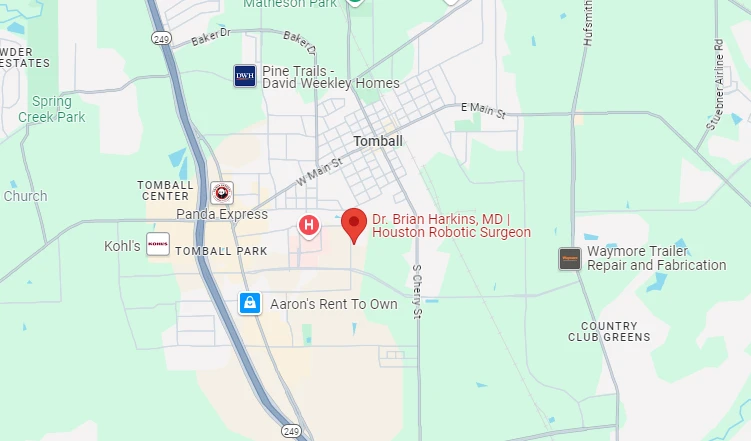
455 School St. Bldg. 1, Suite 10 Tomball, Texas 77375
Mon-Thu: 9:00 am – 5:00 pm | Fri: 9:00 am – 2:00 pm

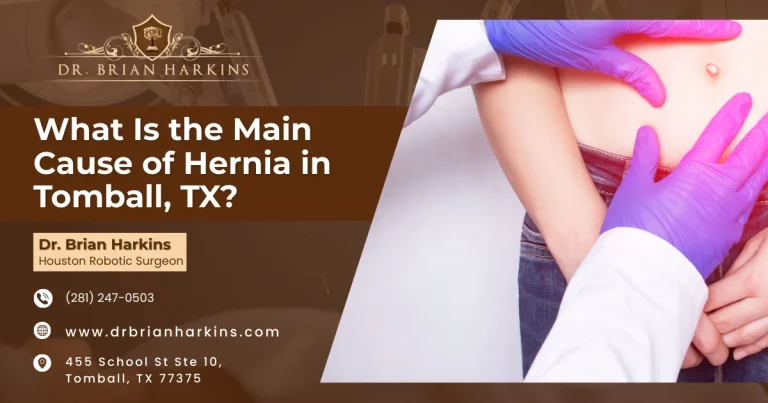
The main cause of hernia in Tomball, TX, is a pre-existing weak spot in the abdominal wall combined with increased intra-abdominal pressure. When tissue pushes through this weakness, whether in the groin, near the belly button, or at a prior incision site, a visible bulge forms that typically requires hernia surgery to repair.
Hernias are the most common surgical problem seen by general surgeons worldwide, and Tomball residents experience them frequently. A hernia occurs when part of the intestine, fat, or stomach protrudes through the muscle or fascia that normally contains it. While some hernias are congenital and present at birth, many develop later due to repeated strain on weakened tissue.
Working with a qualified Tomball hernia surgeon ensures proper diagnosis and access to modern treatment options. Understanding the different types of hernias and their causes helps patients recognize warning signs early and seek appropriate care before life-threatening complications develop.
A hernia occurs the moment abdominal tissue protrudes through a structural defect in the muscle layer. Different symptoms appear depending on hernia site, size, and contents. While hernias may not cause discomfort initially, any hernia can become incarcerated or lead to strangulation if left untreated.
The abdominal wall consists of skin, fat, and three muscle layers protecting internal organs. The inguinal canal in the groin area and the umbilicus near the belly button represent natural thin spots where hernias commonly develop. Prior incision lines from abdominal surgery create additional weak zones that invite incisional hernia formation.
Normal breathing produces gentle pressure of 5 to 7 mmHg within the abdomen. Heavy lifting, straining, or chronic cough can send that number past 150 mmHg, and that surge is when a dormant hernia defect opens. The combination of a weak spot and repeated pressure spikes creates conditions for tissue to push through the abdominal wall.
Because men lift more occupational loads, men will develop an inguinal hernia far more often than women. Up to 27 percent of men will develop an inguinal hernia during their lifetime versus about 3 percent of women. However, femoral and umbilical hernias occur more frequently in women, especially after multiple pregnancies.
Hernias can occur almost anywhere along the diaphragm or abdominal wall. Each type of hernia presents unique characteristics and treatment considerations.
An inguinal hernia occurs in the groin area and accounts for 75 percent of all abdominal wall hernias. Patients develop an inguinal hernia from repetitive strain, heavy lifting, or congenital weakness in the inguinal canal. This common type of hernia appears more frequently in men than women.
Umbilical hernias create an outward bulge near the belly button where the abdominal wall remains weak. Infants may develop umbilical hernias that resolve by age two, but adults rarely experience natural closure. Ventral hernia serves as a broad term including epigastric hernia above the navel and incisional hernia developing through prior surgery scars.
Femoral hernias occur just below the groin crease, appear more commonly in women, and carry higher strangulation risk. A hiatal hernia develops when part of the stomach pushes through the diaphragm, often causing acid reflux. Diaphragmatic hernia occurs when part of the intestine enters the chest cavity, representing a rare but serious condition.
| Hernia Type | Location | Most Affected | Strangulation Risk |
| Inguinal hernia | Groin area | Men (75% of all hernias) | Moderate |
| Umbilical hernia | Near the belly button | Infants, pregnant women | Low to moderate |
| Ventral hernia | Abdominal wall | Prior surgery patients | Moderate |
| Femoral hernia | Below groin crease | Women | High |
| Hiatal hernia | Diaphragm | Adults over 50 | Low |
| Incisional hernia | Surgical scars | Prior abdominal surgery | Moderate to high |
Several factors increase the likelihood of hernia formation. Obesity places continuous strain on the abdominal wall and weakens tissue over time. Heavy labor jobs involving repetitive lifting create repeated pressure spikes that open dormant defects. Pregnancy stretches and weakens abdominal muscles, explaining why women develop umbilical hernias more frequently.
Chronic cough from smoking, allergies, or respiratory conditions generates repeated forceful contractions that stress weak areas. Straining with constipation or prostate issues further increases internal pressure. Smoking weakens collagen and slows tissue healing, compounding the problem. The Tomball economy features many construction and warehouse positions that create more lifting-related hernias than sedentary occupations.
Recognizing hernia symptoms early allows patients to seek elective repair before emergencies develop. Hernias may cause different symptoms depending on location and severity.
A soft or firm lump that appears with standing and disappears when lying down represents the classic presentation. Dull groin pain, heaviness, or burning sensation indicates hernia pain that warrants evaluation. Some hernias do not cause symptoms initially, but hernias may cause sudden pain as they enlarge or if contents become trapped.
Emergency warning signs include nausea, vomiting, or a bulge that turns purple or becomes extremely tender. These symptoms suggest the hernia can become strangulated, cutting off blood supply to trapped tissue. Strangulation requires immediate surgical intervention to prevent life-threatening complications.
| Symptom | Urgency Level | Recommended Action |
| Reducible bulge, no pain | Low | Schedule consultation |
| Bulge with mild discomfort | Moderate | Evaluate within 2 weeks |
| Persistent pain, cannot reduce | High | Same-day evaluation |
| Nausea, vomiting, discoloration | Emergency | Immediate care |
A surgeon will examine you while you cough to observe the hernia defect, then confirm findings with ultrasound or CT imaging if needed. This evaluation determines hernia type, size, and appropriate repair approach.
Modern minimally invasive hernia techniques have transformed treatment outcomes. Robotic surgery and laparoscopic approaches place lightweight mesh over the defect through small incisions. These methods offer reduced pain, faster recovery, and lower infection rates compared with traditional open surgery.
Open surgery remains valuable for massive or strangulated hernias where emergency access provides the safest approach. Complex cases involving large ventral or incisional hernias may require abdominal wall reconstruction techniques for durable, long-term repair.
Mesh reinforcement decreases recurrence by strengthening weak tissue. Small epigastric or umbilical hernias in children sometimes close with suture alone, but most adult abdominal wall hernias benefit from lightweight, flexible mesh for tension-free repair.
While some hernias are congenital or unavoidable, lifestyle modifications reduce risk for many patients. These strategies prove especially valuable for individuals with family history of hernias.
Core strengthening exercises including planks, bridges, and dead-bug movements fortify deep abdominal muscle fibers. Proper lifting technique using your legs rather than your back, exhaling on exertion, and wearing supportive braces for repetitive heavy work all reduce strain.
Maintaining a healthy weight decreases continuous pressure on the abdominal wall. Even a 10-pound reduction significantly lessens strain near weak areas. Treating chronic cough, acid reflux, or constipation early prevents repeated pressure spikes that open defects.
Staying smoke-free protects collagen integrity and supports tissue healing. Proper training with gradual progression makes resistance exercise safe rather than dangerous, actually fortifying the abdominal wall against future hernia formation.
Hernias are a common condition affecting Tomball residents of all ages, but understanding causes and risk factors empowers patients to seek appropriate care. The combination of weak spots in the abdominal wall and increased pressure creates conditions where tissue pushes through, forming bulges that typically require surgical repair.
Early evaluation prevents hernias from enlarging and reduces the risk of serious complications like strangulation. Modern minimally invasive hernia repair options provide faster recovery and excellent long-term outcomes for most patients.
If you think you may have a hernia or want to discuss prevention strategies, contact Dr. Brian Harkins to schedule a comprehensive evaluation and learn about your treatment options.
Watchful waiting works only if you have no symptoms, the bulge reduces easily, and your surgeon agrees to monitor. Because hernias do tend to enlarge over time, most patients plan elective hernia repair within a year to avoid emergency surgery.
Supportive garments can reduce discomfort but cannot heal the hernia defect. Think of a truss as temporary support that buys time until you schedule definitive hernia repair surgery with a qualified surgeon.
Robotic platforms offer enhanced dexterity for complex ventral or incisional hernias. For straightforward inguinal hernia repair, both robotic and standard laparoscopic approaches yield similar low recurrence rates based on hernia type and size.
Mesh decreases recurrence by reinforcing weak tissue. Small epigastric or umbilical hernias in children sometimes close with suture alone, but most adult abdominal wall hernias benefit from lightweight mesh for tension-free repair.
Light walking starts day one after surgery. Most patients resume cardio by week two and weight training around week four. Heavy lifting over 30 pounds usually waits six weeks, varying by hernia site and repair method.
Yes. Up to 27 percent of men will develop an inguinal hernia during their lifetime versus about 3 percent of women. However, femoral and umbilical hernias appear more frequently in women, especially after multiple pregnancies.
Many newborns present with an umbilical bulge that closes spontaneously by age two. If the defect persists beyond four years or becomes larger than 2 cm, pediatric surgeons can perform a simple outpatient repair.
No. Proper form, gradual progression, and core stabilization make resistance training safe. The danger comes from sudden maximal lifts without bracing or from pre-existing weakness. Smart training actually fortifies the abdominal wall.
A diaphragmatic hernia occurs when abdominal organs migrate into the chest through an opening in the diaphragm. Surgical repair returns the organs to the abdomen and closes the defect, preventing life-threatening respiratory complications.
Chronic acid reflux can signal a hiatal hernia where part of the stomach pushes through the diaphragm. Endoscopy or barium swallow confirms the diagnosis. If medications fail, laparoscopic hiatal hernia repair effectively treats reflux symptoms.


Dr. Brian Harkins is a renowned surgeon specializing in advanced, minimally invasive, and robotic surgical techniques. With a dedication to innovation and personalized patient care, he has transformed countless lives by delivering exceptional outcomes.
I want a website like this, where do i start?