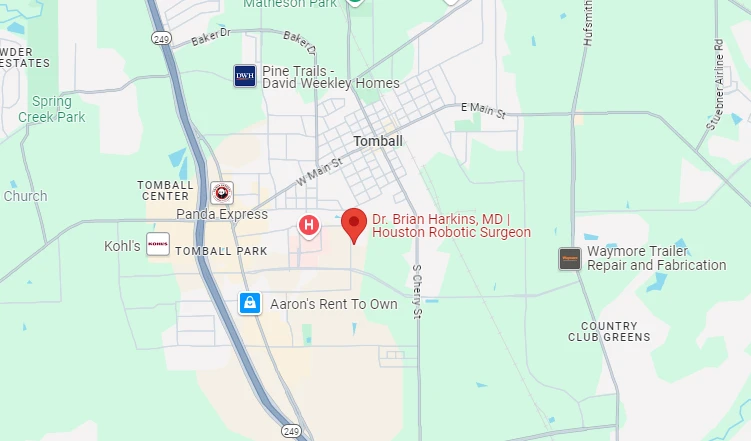
455 School St. Suite 10 Tomball, Texas 77375
Mon-Thu: 9:00 am – 5:00 pm | Fri: 9:00 am – 2:00 pm

Robotic surgery is a minimally invasive surgical technique where the surgeon controls a set of robotic instruments from a nearby console, using a 3D high-definition camera and precision-articulating tools to operate through incisions smaller than a centimeter. The robot doesn't make decisions — the surgeon does. The robotic system simply gives that surgeon capabilities that human hands alone cannot achieve.
If you've been told you need surgery and robotic surgery was mentioned as an option, you probably have a version of the same question most patients arrive with: is this actually better, or is it just newer? It's a fair question. Dr. Brian Harkins has been performing robotic surgery in Tomball since the Da Vinci platform became viable for general surgery in the mid-2000s — long before it became the standard of care it is today. His perspective is grounded in decades of both laparoscopic and robotic experience.
The short answer is yes, it's better — for specific procedures and in the hands of a trained, high-volume surgeon. Understanding why requires understanding exactly what the Da Vinci Xi system does and doesn't do.

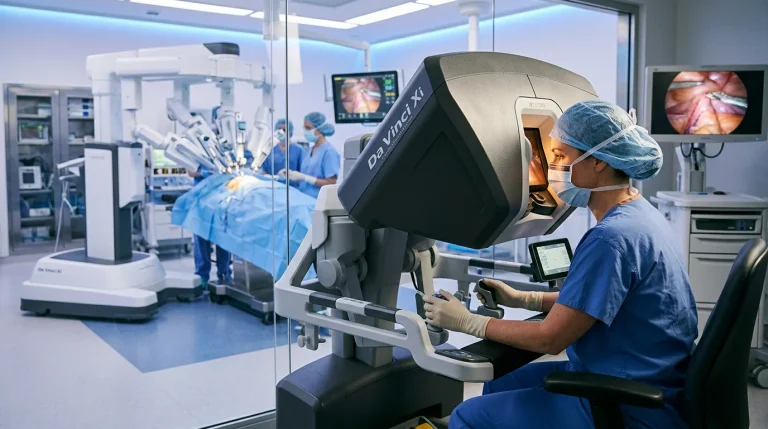
The Da Vinci Xi system has three main components: a patient-side cart with robotic arms, a 3D vision system, and a surgeon console. The surgeon sits at the console a few feet from the patient, views a magnified 3D image of the surgical field, and controls the robotic instruments using hand and foot controls. The system translates every movement in real time — filtering out natural hand tremor and scaling movements for precision impossible to achieve manually.
Here's each component in plain terms:
Four robotic arms extend over the patient, each inserted through a small incision (port) in the abdomen or pelvis. One arm holds the 3D camera. The others hold surgical instruments that can be swapped out during the procedure. The arms are positioned precisely before surgery and remain stable throughout — they don't shift or fatigue.
This is where Dr. Harkins sits during the entire procedure. He views a real-time, high-definition 3D image of the interior of the body — magnified up to 10x normal size. His hands rest in finger controls that translate his movements directly into the instrument tips inside the patient's body. If he turns his wrist, the instrument turns. If he pinches, the instrument pinches. Every movement is mirrored with precision.
Here's the feature that separates robotic surgery from standard laparoscopy: EndoWrist instruments have a wrist joint at the tip, giving them a full 360-degree range of motion. A human wrist bending inside the body — that's what it's equivalent to. Standard laparoscopic tools are rigid straight rods that pivot at the incision point. The difference in dexterity for intricate dissection and suturing is substantial.
| Feature | Open Surgery | Standard Laparoscopic | Da Vinci Xi Robotic |
| Visualization | Direct, 2D | 2D camera, limited magnification | 3D HD, up to 10x magnification |
| Instrument range of motion | Full (surgeon's hands) | Limited — pivots at incision | 360° wristed — full articulation |
| Tremor filtering | None | None | Yes — filters natural hand tremor |
| Incision size | 3–6+ inches | 0.5–1 cm | 0.5–1 cm |
| Surgeon ergonomics | Standing, hunched | Standing, awkward posture | Seated, natural position |
| Camera stability | Manual assistant | Manual assistant | Robotic arm — perfectly stable |
The most persistent misconception about robotic surgery is that the robot performs the operation autonomously. It doesn't. The Da Vinci Xi is a sophisticated tool — it has no artificial intelligence, makes no independent decisions, and cannot move unless Dr. Harkins is actively controlling it from the console. Every incision, every suture, every dissection move is the surgeon's judgment executed through the robotic system.
This distinction matters because it explains why surgeon experience still determines outcomes. The robotic system amplifies what the surgeon can do — it doesn't replace surgical judgment, anatomical knowledge, or decision-making under unexpected circumstances. A surgeon in the top 1% nationally using the Da Vinci Xi produces meaningfully better results than an inexperienced surgeon using the same machine.
Other things robotic surgery is not:
| Misconception | Reality |
| "The robot operates independently" | The surgeon controls every movement in real time — no autonomy |
| "Robotic surgery is experimental" | 2+ decades of clinical use, millions of procedures performed |
| "It's only for simple cases" | Most valuable in complex cases requiring fine dissection |
| "It takes much longer" | Comparable or faster for high-volume surgeons |
| "Recovery is the same as open surgery" | Significantly faster recovery due to small incisions and less tissue disruption |

Dr. Brian Harkins' adoption of the Da Vinci robotic platform wasn't driven by novelty — it was driven by a specific technical threshold. He performed advanced laparoscopic surgery in Tomball for years before switching, and made the transition to robotics when the Da Vinci Xi platform reached a point where it was genuinely superior to laparoscopy for his general surgery procedures. That selective, evidence-based adoption is characteristic of how he approaches surgical innovation. Intuitive Surgical, the maker of the Da Vinci system, provides patient-focused information about robotic surgery including procedure types, what to expect on surgery day, and questions to ask your surgeon.
The specific advantages that convinced him — and that still define his practice today:
The 3D magnified view makes critical structures — bile ducts, nerves, blood vessels — clearer than any other surgical approach. For cholecystectomy, this visualization enables near-infrared fluorescence imaging to confirm bile duct anatomy in real time. For hernia repair, it gives clear views of the myopectineal orifice and surrounding nerves. For colorectal surgery, it enables nerve-sparing dissection in the pelvis that protects urinary and sexual function.
Some of the most consequential surgical work happens in tight anatomical corridors — the pelvis for rectal surgery, the space beneath the liver for cholecystectomy, the narrow preperitoneal plane for inguinal hernia repair. The wristed instruments reach these spaces with a dexterity that straight laparoscopic tools struggle to match.
Dr. Harkins' top-1% national ranking in robotic surgery volume means he's performed this work thousands of times. That case volume produces a consistency of technique that translates directly into predictable patient outcomes. The learning curve of robotic surgery is steep — and he's well past it.
Dr. Harkins performs a comprehensive range of general surgery procedures using the Da Vinci Xi at HCA Houston Healthcare Tomball. The robotic platform is used for:
Not every case requires the robotic platform — Dr. Harkins uses it when its capabilities add meaningful benefit, and selects the optimal approach for each patient's specific anatomy and condition.
The Da Vinci Xi robotic system is the most sophisticated tool available for minimally invasive general surgery — and in the hands of a top-1% nationally ranked surgeon with decades of Tomball-area experience, it delivers outcomes that patients across northwest Houston travel hours to access. Understanding how it works is the first step toward understanding why it might be the right choice for your procedure.
If you have a condition that may require surgery and you want to understand whether a robotic approach is appropriate for your specific case, schedule a consultation with Dr. Harkins. He'll give you a straight answer about what the robotic system offers your surgery — and what the alternative approaches would look like.
No. The Da Vinci Xi system has no artificial intelligence and makes no independent decisions. Every movement is controlled in real time by Dr. Harkins from the surgeon console. The robot cannot move without the surgeon actively controlling it.
Yes. Decades of clinical use across millions of procedures have established robotic surgery as safe for appropriate candidates. Studies consistently show complication rates comparable to or lower than open surgery for procedures within the Da Vinci's range.
The Da Vinci Xi is the latest generation of Intuitive Surgical's robotic platform, featuring redesigned robotic arms that allow greater repositioning during multi-quadrant procedures. It includes fluorescence imaging capability and supports a wider range of instrument sizes compared to earlier generations.
Both use small incisions. The key difference is instrument capability: laparoscopic tools are rigid and pivot at the entry point, while robotic instruments have a wrist joint at the tip giving 360-degree range of motion. Robotic also provides 3D magnified visualization versus 2D laparoscopic cameras.
The incisions are small — typically 0.5 to 1 centimeter each — and leave minimal scarring that fades significantly over months. The visual difference compared to open surgery (3–6 inch incision) is dramatic.
The hospital facility costs for robotic surgery are typically higher, but most major insurance plans cover robotic procedures when medically indicated. The overall cost-of-care difference narrows when accounting for shorter hospital stays and faster return to work with robotic technique.
The da Vinci Surgical System received FDA clearance in 2000. The platform has been continuously refined through multiple generations, with the Xi being the current system used at Dr. Harkins' practice. Over two decades of clinical use have established an extensive safety and outcomes record.
Robotic surgery has a steep learning curve. Outcomes — including complication rates and operative times — improve substantially as surgeons accumulate case volume. Dr. Harkins' top-1% national ranking reflects thousands of robotic procedures and the consistency that comes from it.
Yes, though most robotic surgery is performed in elective or semi-urgent settings where the full setup can be prepared. Acute appendicitis, urgent cholecystitis, and other emergency conditions can be addressed robotically when appropriate.
Most patients who are surgical candidates are also candidates for the robotic approach. Factors like prior abdominal surgeries, body habitus, and the specific procedure involved are all considered. Dr. Harkins will advise whether robotic technique is optimal for your specific case at your consultation.

Dr. Brian Harkins is a renowned surgeon specializing in advanced, minimally invasive, and robotic surgical techniques. With a dedication to innovation and personalized patient care, he has transformed countless lives by delivering exceptional outcomes.
I want a website like this, where do i start?