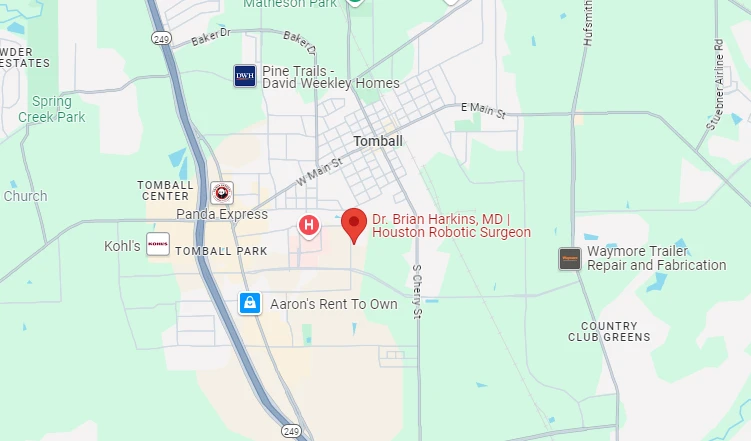
455 School St. Bldg. 1, Suite 10 Tomball, Texas 77375
Mon-Thu: 9:00 am – 5:00 pm | Fri: 9:00 am – 2:00 pm


Most robotic colorectal procedures use four to six small port incisions of 8 to 12 mm each, with one extended to roughly 3 to 5 cm to remove the specimen. Right-sided procedures typically need five, left-sided and rectal procedures five to six, and newer single-port systems can reduce visible scars to one.
If you're preparing for robotic colorectal surgery in Tomball, TX, one of your first practical questions is likely how many incisions you'll have and what your recovery will look like. Most modern robotic procedures use four to six small keyhole incisions rather than one large open cut, though newer single-port techniques may reduce that number even further.
Understanding the incision pattern for your specific procedure can help you set realistic expectations about pain, healing time, and cosmetic results. National health resources such as MedlinePlus describe large bowel resection performed laparoscopically or robotically through several small cuts in the abdomen. This guide explains how incision counts vary across different robotic platforms, what factors influence port placement, and how these choices affect your overall surgical experience.
The number of incisions needed for robotic colorectal surgery depends primarily on which part of the colon or rectum requires treatment, and therefore on which of the colon and rectal conditions is being addressed. Most procedures use between four and six small port sites, each creating a small incision on the abdomen.
Each port serves a specific purpose. One holds the camera, three or four accommodate robotic instruments, and one allows the surgical assistant to help during the operation. One of these incisions is typically extended slightly to remove the diseased tissue at the end of the procedure, which is why the final incision count and the final scar sizes are not the same thing.
The table below summarizes typical configurations by procedure type before each is discussed in detail.
| Procedure | Typical Incisions | Configuration Notes |
| Right colectomy | 5 | Four robotic ports plus one assistant port; 12-mm camera port left of the navel, 8-mm robotic ports in a diagonal or straight line |
| Left colectomy / sigmoid resection | 5 to 6 | Camera, three robotic arms, one or two assistant ports; extra port for splenic flexure mobilization |
| Rectal surgery | 5 | Four robotic trocar sites plus camera and assistant ports; APR adds a separate perineal incision |
| NICE procedure (select diverticulitis) | 4 | No extraction incision; specimen removed through the rectum |
| Single-port (da Vinci SP) | 1 | Single 25 mm cannula, usually umbilical |
For procedures involving the right side of the colon, surgeons typically use four robotic ports plus one assistant port, resulting in five small incisions on the abdomen. A common approach places a 12-mm camera port slightly to the left of the belly button, with additional 8-mm robotic ports arranged in a diagonal or straight-line pattern.
One of these incisions, usually the assistant or camera port, is extended to approximately 3 to 5 cm to extract the specimen. This extraction site represents the largest incision but remains much smaller than traditional open surgery cuts, which is the single biggest difference patients notice in the mirror afterward. It is also the incision that most influences healing, since the other port sites are small enough to close quickly.
Procedures on the left side of the colon require slightly different port placement. Experts describe using five to six ports for robotic left colectomy, including the camera, three robotic arms, and one or two assistant ports.
The additional port is often needed because left-sided procedures require mobilization of the splenic flexure, the bend where the colon turns near the spleen. A typical configuration places a 12-mm camera port above the belly button, with robotic instrument ports in the right lower and right upper abdomen, plus an additional left-sided upper port to reach this area effectively.
Rectal surgery for conditions like rectal cancer typically uses a five-incision approach. Surgeons place four robotic trocar sites along with camera and assistant ports, enabling completion of the entire procedure without repositioning the patient or robot.
In practice, this means one camera port, three additional robotic instrument ports, and one assistant port. For abdominoperineal resection (APR), surgeons add a separate perineal incision between the buttocks, distinct from the abdominal incisions, which is a function of the anatomy being addressed rather than the robotic platform itself.
Two newer approaches reduce incision count further, though both come with meaningful availability limits.
The NICE procedure, developed at Houston Methodist for diverticulitis, uses robotic assistance through four small port incisions while extracting the diseased sigmoid colon through the rectum. This approach leaves patients with four dime-sized incisions and no additional abdominal incision for specimen removal, which eliminates the risk of developing an incision infection or incisional hernia at an extraction site. However, this technique is currently limited to select cases of diverticulitis and is not suitable for all colorectal conditions.
The newest advancement is the da Vinci Single-Port (SP) system. This technology channels a flexible camera and up to three articulated instruments through a single 25 mm cannula, reducing visible scars to just one incision. The most common entry site for SP colorectal procedures is the umbilicus, followed by a low transverse incision just above the pubic bone, and this approach can reduce the number of visible abdominal incisions from four to six down to one.
Evidence suggests lymph node yield averaged around 22 nodes in SP procedures compared with 21 nodes in multi-port robotic operations, indicating that cancer treatment quality is maintained. However, most SP colorectal series involve relatively small numbers of patients and are conducted at specialized centers, limiting widespread availability. That distinction matters when weighing options, because a technique being technically impressive is not the same as it being available, appropriate, and well-supported by evidence for your particular diagnosis.
The jump from open surgery to minimally invasive techniques provides dramatic benefits, but differences between four versus six small incisions are more subtle. When total incision length and surgical trauma are similar, differences in pain scores and recovery metrics between multi-port and single-port approaches are modest.
Available data suggest there is a threshold effect. The transition from one large open incision to multiple small minimally invasive incisions yields substantial benefits in pain, recovery, and cosmesis, whereas differences within the minimally invasive range produce more incremental effects. In other words, going from open to robotic surgery is a bigger leap than going from five ports to one port, which is worth remembering if you find yourself weighing surgeons primarily on incision count.
Appearance matters to many patients. Patients frequently report higher satisfaction with a single umbilical incision or a small set of dime-sized port sites than with a long open midline scar.
Multi-port robotic surgery generally offers very favorable cosmetic outcomes relative to open surgery, and the scars often become barely visible over time, particularly when placed in low transverse or periumbilical positions. Most patients find that their small robotic surgery scars fade significantly within six to twelve months, so the appearance in the first weeks after surgery is not a reliable guide to the final result.
Large midline open incisions are associated with higher rates of surgical site infection (SSI) and incisional hernia. These complications can require additional surgery and significantly impact quality of life, which makes them a genuine clinical consideration rather than a cosmetic one.
Multi-port robotic colorectal surgery reduces the need for large incisions by confining larger cuts to the extraction site while leaving other ports small, thereby decreasing overall wound burden. The smaller incisions heal faster and have lower infection rates compared to traditional open surgery. This is where incision strategy stops being a cosmetic question and becomes a clinical one, since fewer centimeters of open fascia means fewer opportunities for a hernia to form later.
Several important factors influence how many incisions your surgeon will need:
Experts emphasize that port placement should first and foremost enable safe, effective dissection, with cosmesis considered secondarily. Your surgeon will prioritize the configuration that offers the best chance of a successful operation, even if that means using an additional port for safety, and that is the right priority order for a cancer operation.
In Tomball, Texas, robotic surgery for colorectal conditions is performed using advanced da Vinci Xi technology, and local practice patterns align with national standards. Patients in the Tomball area have access to experienced surgeons who specialize in minimally invasive techniques.
For a robotic right colectomy in Tomball, patients would typically have four small 8-mm robotic incisions arranged along a diagonal or straight-line pattern, plus one 12-mm assistant incision, resulting in five small port sites. For left-sided procedures, the need for splenic flexure mobilization often adds an upper quadrant port, yielding five to six small incisions.
Single-port robotic colorectal surgery using the da Vinci SP system likely remains limited to certain tertiary centers with dedicated SP programs. However, because Tomball is close to Houston, patients have relatively easy access to high-volume centers offering advanced minimally invasive colorectal techniques, including SP robotic surgery and the NICE procedure.
Most robotic colorectal procedures use four to six small port incisions of 8 to 12 mm each. One incision is typically extended to about 3 to 5 cm so the diseased tissue can be removed at the end of the operation.
A robotic right colectomy typically uses five incisions: four robotic ports plus one assistant port. The 12-mm camera port usually sits slightly left of the belly button, with 8-mm robotic ports arranged diagonally or in a straight line.
Left-sided procedures require mobilization of the splenic flexure, the bend where the colon turns near the spleen. Reaching that area effectively often requires an additional left-sided upper port, yielding five to six incisions total.
The extraction site, usually the assistant or camera port, is extended to approximately 3 to 5 cm to remove the specimen. This remains substantially smaller than the long midline incision used in traditional open surgery.
The da Vinci Single-Port system channels a flexible camera and up to three articulated instruments through one 25 mm cannula, usually at the belly button. It can reduce visible abdominal scars from four to six down to a single incision.
Evidence suggests it does not. Lymph node yield averaged around 22 nodes in single-port procedures compared with 21 in multi-port robotic operations, though most single-port series involve small patient numbers at specialized centers.
Not dramatically. The major benefit comes from moving from open surgery to minimally invasive techniques. Differences in pain and recovery within the minimally invasive range, such as four ports versus six, are modest.
Developed at Houston Methodist for diverticulitis, the NICE procedure uses four small port incisions and extracts the sigmoid colon through the rectum. This eliminates the extraction incision along with its infection and incisional hernia risk.
Most patients find small robotic scars fade significantly within six to twelve months, particularly when placed in low transverse or periumbilical positions. Cosmetic satisfaction is generally high compared with a long open midline scar.
Disease location and extent, your body size and prior abdominal surgeries, the robotic platform available, and your surgeon's experience all shape port placement. Safe, effective dissection takes priority over minimizing incision count.
For most patients in Tomball, the practical answer is four to six small incisions, with one slightly larger site used to remove the specimen. Right-sided procedures cluster around five ports, left-sided and rectal work around five to six, and specialized approaches like the NICE procedure or single-port systems can reduce that count further where they are available and appropriate.
The more useful framing, though, is that incision count is a secondary consideration. The large recovery gain comes from choosing a minimally invasive approach at all, and port placement should follow what allows safe, complete dissection rather than the lowest possible number. Choosing an experienced robotic colorectal surgeon matters far more to your outcome than whether you end up with five incisions or six.
Understand the approach that fits your procedure.
Schedule a consultation with a Tomball robotic surgery specialist.


Dr. Brian Harkins is a renowned surgeon specializing in advanced, minimally invasive, and robotic surgical techniques. With a dedication to innovation and personalized patient care, he has transformed countless lives by delivering exceptional outcomes.
I want a website like this, where do i start?