455 School St. Bldg. 1, Suite 10 Tomball, Texas 77375
Mon-Thu: 9:00 am – 5:00 pm | Fri: 9:00 am – 2:00 pm

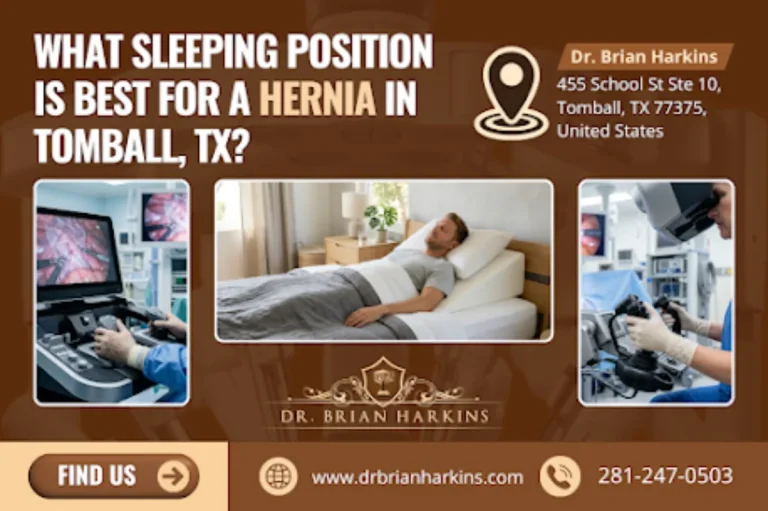
The best position depends on your hernia type. Inguinal and umbilical hernias generally do best on your back with the upper body elevated and a pillow under the knees, while hiatal hernias respond best to left-side sleeping at a 30 to 45 degree elevation. Stomach sleeping should be avoided after any hernia surgery.
If you're dealing with a hernia in Tomball, TX, you've probably discovered that something as simple as sleeping can suddenly feel complicated. Whether you're recovering from hernia surgery or managing symptoms before treatment, the position you sleep in directly affects your pain levels, healing progress, and overall comfort.
Many patients wonder if sleeping on their side will damage their surgical repair, why certain positions help with specific hernia types like hiatal hernias, and what warning signs mean their sleep setup isn't working. In this guide, you'll learn which sleeping positions work best for different types of hernias, how to adjust your approach as you heal, and practical tips to reduce discomfort throughout the night.
The location of your hernia determines which sleeping position will provide the most comfort and support. Different types of hernias create unique pressures and symptoms that respond better to specific positions.
Your body's anatomy plays a crucial role in determining the best approach, and the right answer for one hernia type can be the wrong answer for another. What works for an inguinal hernia may actually worsen symptoms for a hiatal hernia, making it essential to understand your specific hernia conditions before settling on a sleep setup. The table below summarizes the recommended approach by type.
| Hernia Type | Recommended Position | Avoid |
| Inguinal | Back, upper body slightly elevated, pillow under knees | Stomach sleeping |
| Umbilical | Back with pillow under knees; some elevation | Lying flat; sides and back immediately post-surgery |
| Hiatal | Left side, upper body elevated 30 to 45 degrees | Right side, back, and lying flat |
For most patients with inguinal hernias in the groin area, sleeping on the back with the upper body slightly elevated is recommended. This position reduces pressure on the abdominal muscles and the affected area.
Elevating the upper body reduces pressure on abdominal muscles and the surgical site, which helps minimize discomfort whether you're managing the hernia before surgery or recovering afterward. Adding pillows beneath your knees provides additional support and helps maintain proper spinal alignment, which also reduces the low back strain that often comes with sleeping flat on your back. Many patients find this combination is what finally lets them sleep through the night in the first week after surgery.
Side sleeping may be appropriate on the opposite side of the surgical site, with a pillow between your knees. The pillow keeps your hips stacked and stops your upper leg from pulling across your abdomen during the night. This option becomes more comfortable as healing progresses, typically after the first two weeks of recovery.
Stomach sleeping is strongly discouraged due to pressure on the abdominal area. This position forces your abdomen to bear your body weight, which can aggravate the hernia or disrupt the healing process after hernia repair. If you are a lifelong stomach sleeper, placing a body pillow along one side before you fall asleep makes it far harder to roll over during the night.
Sleeping on your back with a pillow under your knees reduces abdominal pressure for umbilical hernias located near the belly button. This configuration helps distribute weight evenly and prevents strain on the affected area.
Side sleeping may be comfortable but avoid lying flat. Maintaining some elevation helps reduce pressure on the hernia site and improves overall comfort throughout the night, particularly if the hernia is large enough to be noticeable when you change position.
After umbilical hernia surgery, positioning requirements become more specific. Avoid sleeping flat on your sides and back, as this can compromise healing and increase discomfort.
Elevate your upper body 30 to 45 degrees using a wedge pillow or adjustable bed, and avoid sleeping on your sides to prevent drainage issues during the initial recovery period. These restrictions are temporary and ease as the incision heals, but they are the strictest of any hernia type in the first days after surgery and are worth following closely.
Hiatal hernias require a different approach because they involve the diaphragm and often cause acid reflux symptoms. National health resources such as MedlinePlus note that for a hiatal hernia, lifestyle changes may help when symptoms are present. Sleeping on the left side is recommended for this type of hernia.
Medical research shows resting on the left side is most beneficial for digestion. Lying on your left keeps the stomach below the esophagus to prevent backflow of acid, which is the primary cause of nighttime discomfort. This is also why positioning is often discussed alongside anti-reflux surgery as part of managing hiatal hernia symptoms.
Elevating the upper body is advised using a wedge pillow, and avoid lying flat. Gravity becomes your ally in preventing stomach acid from flowing back into your esophagus, and the effect holds all night rather than wearing off the way medication can.
A wedge pillow is recommended for elevation of 30 to 45 degrees. Avoid resting on your right side or back, as these positions can worsen reflux symptoms rather than relieve them. The difference between left and right side sleeping is not a matter of preference here, it follows directly from where the stomach sits relative to the esophagus.
Several important factors beyond hernia type should guide your sleeping position decisions. Understanding these elements helps you create the most effective sleep strategy for your situation.
Surgical approach significantly impacts positioning restrictions. Laparoscopic procedures typically allow more flexibility in positions sooner than open repairs due to smaller incisions and less tissue disruption. If you've had minimally invasive surgery, you may be able to return to more comfortable positions earlier in your recovery, while patients who undergo traditional open hernia repair generally need to maintain stricter positioning guidelines for a longer period.
Proper pillow configuration matters more than position alone. A properly positioned wedge pillow maintaining consistent elevation throughout the night proves more effective than stacked regular pillows that shift during sleep. Regular pillows tend to flatten or slide out of position, compromising the benefits of elevation, whereas a quality wedge pillow designed for medical use maintains its shape and angle throughout the night.
Timing of position changes during recovery follows predictable patterns:
Understanding this timeline helps set realistic expectations and prevents the frustration of expecting normal sleep too early. Progress is rarely linear, and a night of worse sleep in week three does not mean healing has reversed.
Seeing how others have managed their sleep positions can provide practical insights for your own situation. These examples demonstrate how proper positioning makes a measurable difference.
A 55-year-old male undergoing laparoscopic inguinal hernia repair successfully manages post-operative discomfort by sleeping supine with upper body elevated 20 to 30 degrees using a wedge pillow and a small pillow under his knees, transitioning to side sleeping on the non-operative side after two weeks with a pillow between his knees, as guided by his surgeon's phased recovery protocol. This graduated approach allowed him to maintain comfort while supporting proper healing, and he returned to normal sleeping positions within six weeks.
A 42-year-old female with a symptomatic hiatal hernia experiences persistent nighttime acid reflux despite over-the-counter medications until implementing left-side sleeping with 35-degree elevation using a proper wedge pillow, which significantly reduces symptoms within three nights by leveraging gravitational advantages to prevent gastric content reflux. Her experience highlights how positioning can sometimes be more effective than medication alone for managing symptoms. It also shows how quickly the change can take effect, since the improvement appeared within a few nights rather than after weeks of adjustment.
Beyond basic positioning, several additional strategies can improve your sleep quality while managing a hernia. These practical tips complement proper sleep positions rather than replacing them, and most cost nothing beyond a small change in routine.
Consider using multiple pillows strategically placed to prevent rolling during sleep. Body pillows can help maintain side-sleeping positions, while smaller pillows provide targeted support for knees and lower back. An adjustable bed frame offers another option for maintaining consistent elevation, allowing you to find the perfect angle and hold it throughout the night without relying solely on pillows.
Your evening routine matters as much as your setup:
Your sleep position needs may change as your condition evolves or as you progress through recovery. Recognizing when to modify your approach ensures continued comfort and healing.
If you experience increased pain, swelling, or discomfort in your current position, consult your healthcare provider before making changes. These symptoms may indicate that your current positioning isn't providing adequate support or that complications have developed, and that distinction is one only a clinician can make reliably.
Watch for signs that you're ready to expand your positioning options, such as decreased tenderness, improved mobility, and reduced need for pain medication. Your surgeon can confirm when it's safe to try new positions based on your healing progress rather than the calendar alone. Two patients at the same point after the same operation can be ready at different times, which is why the check-in matters more than the week number.
It depends on the type. Inguinal and umbilical hernias do best on your back with the upper body elevated and a pillow under the knees, while hiatal hernias respond best to left-side sleeping with 30 to 45 degrees of elevation.
Lying on your left keeps the stomach below the esophagus, which prevents backflow of acid. Research shows resting on the left side is most beneficial for digestion, making it the preferred position for nighttime reflux symptoms.
No. Stomach sleeping is strongly discouraged because it forces your abdomen to bear your body weight. This places direct pressure on the surgical site and can aggravate the hernia or disrupt healing.
Side sleeping on the non-operative side with a pillow between your knees typically becomes comfortable after the first two weeks. After umbilical hernia surgery, avoid side sleeping initially to prevent drainage issues.
A wedge pillow providing 30 to 45 degrees of elevation is recommended for both umbilical post-surgical recovery and hiatal hernia symptom management. Some patients find 20 to 30 degrees sufficient after laparoscopic inguinal repair.
Yes. A wedge pillow maintains consistent elevation throughout the night, while stacked regular pillows tend to flatten or slide out of position, compromising the benefit of elevation exactly when you are least likely to notice.
Most patients return to their preferred sleeping positions by 4 to 6 weeks after surgery. The strictest positioning requirements apply during the first 1 to 2 weeks, then gradually ease through weeks three to six.
Yes. Laparoscopic procedures typically allow more positional flexibility sooner due to smaller incisions and less tissue disruption, while traditional open repair generally requires stricter positioning guidelines for a longer period.
No. Positioning helps manage symptoms and supports recovery, but it cannot close the defect. Surgical repair remains the only definitive treatment for most symptomatic hernias.
Avoid eating within three hours of bedtime to reduce nighttime reflux. Stay hydrated during the day but limit evening fluids, since bathroom trips disrupt the elevation and positioning you have set up.
Sleep position is one of the few parts of hernia recovery you fully control, and getting it right makes a real difference in comfort and healing. Back sleeping with elevation suits inguinal and umbilical hernias, left-side sleeping with a wedge pillow suits hiatal hernias, and stomach sleeping should be off the table after any repair.
The restrictions are tightest in the first two weeks and ease steadily from there, with most patients back to their preferred position by six weeks. Position well, use a proper wedge rather than stacked pillows, and let your surgeon rather than the calendar tell you when it is safe to change.
Get positioning guidance built around your specific hernia.
Schedule a consultation with a Tomball hernia specialist today.


Dr. Brian Harkins is a renowned surgeon specializing in advanced, minimally invasive, and robotic surgical techniques. With a dedication to innovation and personalized patient care, he has transformed countless lives by delivering exceptional outcomes.
I want a website like this, where do i start?