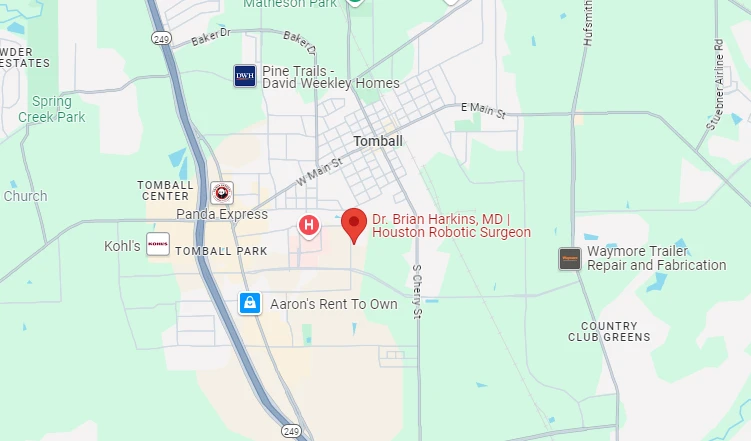
455 School St. Bldg. 1, Suite 10 Tomball, Texas 77375
Mon-Thu: 9:00 am – 5:00 pm | Fri: 9:00 am – 2:00 pm


One to two days for most patients, compared with five to seven after open surgery. Discharge is determined by four functional criteria rather than by the calendar: tolerating food by mouth, controlling pain with oral medication, return of bowel function, and independent mobility. Enhanced recovery protocols have shortened stays further while also reducing thirty-day complications by roughly 35 percent.
The hospital stay after robotic colon surgery is short enough that it surprises most patients, typically one to two days against the week-long admissions that open resection required.
That compression comes from two things working together: reduced surgical trauma from the minimally invasive approach, and structured recovery protocols that changed how the postoperative period is managed. This guide covers what determines your discharge, what the weeks afterward look like, and how to prepare for a transition home that happens faster than you might expect.
Discharge is not scheduled in advance. It follows from meeting functional criteria, which is why two patients having the same operation can leave a day apart.
Vital signs must be stable without concerning trends, and laboratory values should reflect normal postoperative parameters rather than suggesting a developing complication.
Of the four, return of bowel function is most often the limiting factor. Bowel typically resumes working between postoperative days two and four, and it cannot be accelerated much beyond what early mobilization and appropriate diet advancement achieve.
This is also why walking is emphasized so heavily from the first hours. Movement genuinely helps the bowel restart, which is the difference between leaving on day one and leaving on day three.
| Period | What typically happens |
| Hours 6 to 12 | Initial mobility, walking with assistance |
| Days 1 to 2 | Discharge for most patients |
| Days 2 to 4 | Bowel function returns |
| Days 3 to 7 | Noticeable pain improvement, transition to over-the-counter medication |
| Days 10 to 14 | Driving typically permitted once off narcotic medication |
| Weeks 2 to 3 | Return to desk work |
| Weeks 2 to 4 | Complete functional recovery for most patients |
| Weeks 4 to 6 | Lifting restrictions remain in place |
The immediate period is the most closely monitored, with pain medication given at regular intervals rather than on request. Most patients are eating soft foods and walking with assistance within the first day.
Pain levels typically run in the range of three to four out of ten during the first week after robotic resection, meaningfully lower than the six to seven commonly reported following open surgery. That difference is what makes early mobilization practical rather than aspirational.
Many patients are surprised by how soon they can walk and manage basic activities, which contrasts sharply with the extended bed rest that open surgery historically required.
The focus shifts to establishing functional capacity while internal healing continues. Light walking is encouraged from day one, stairs are permitted with assistance initially, and showering is generally allowed after 48 to 72 hours.
Driving typically resumes 10 to 14 days after surgery, contingent on being off narcotic pain medication and having enough core strength to brake firmly without hesitation.
Light household tasks resume around week two. Desk work becomes possible within two to three weeks for most people, though this varies with individual healing and job demands.
Complete functional recovery from colectomy typically occurs within two to four weeks after robotic colon surgery, reflecting the reduced tissue trauma of the minimally invasive approach.
Most patients achieve full independence in daily activities during this period, and work capacity returns to baseline for most occupations.
Heavy lifting restrictions remain for four to six weeks regardless of how well you feel. They protect internal suture lines and prevent incisional hernia formation, and the external incisions look healed well before the deeper layers are.
Individual variation exists within the one to two day expectation, and knowing what drives it helps set realistic personal expectations.
Younger patients and those in better preoperative condition generally recover bowel function faster and mobilize more readily. Good nutritional status before surgery measurably improves healing.
Smaller resections and procedures without complicating factors during surgery allow faster advancement through the discharge criteria.
Strong engagement with early mobilization makes a genuine difference. Patients who walk frequently from the first hours consistently reach discharge criteria sooner than those who do not.
Prolonged return of bowel function, sometimes called postoperative ileus, is the most common reason for an extended stay. It resolves on its own but cannot be forced.
Difficulty controlling pain on oral medication, persistent nausea preventing adequate intake, and any concern about a developing complication all appropriately delay discharge.
Older patients, those with significant comorbidities, and those who had more extensive surgery generally need somewhat longer. That is expected rather than a setback.
If a procedure planned robotically converts to open during surgery, the recovery timeline shifts toward the open surgery profile. Conversion happens in roughly 6.3 percent of robotic colorectal cases.
This is worth knowing in advance so that it registers as a recognized possibility rather than as bad news. Conversion reflects a surgeon making a safety judgment about conditions found, which is the right call when it happens.
Enhanced Recovery After Surgery protocols represent a structured, multidisciplinary approach to the entire surgical episode rather than a single intervention.
They combine preoperative education and nutritional preparation, intraoperative techniques minimizing physiologic stress, and postoperative practices including early feeding, early mobilization, and multimodal pain control.
The results are measurable. Multi-institutional implementation has been associated with a 35 percent decrease in thirty-day complications, alongside reductions in median hospital stay.
Patients undergoing minimally invasive procedures show higher compliance with these protocols, which is part of why stays after robotic surgery run shorter than the technique alone would predict.
Modern pain control uses multiple medication classes simultaneously, targeting different pain pathways rather than relying on opioids alone.
The foundation typically includes non-steroidal anti-inflammatory medication for inflammatory response, acetaminophen for baseline relief, regional anesthesia techniques where appropriate, and controlled opioid use reserved for breakthrough pain.
Reduced tissue trauma from the robotic approach often allows adequate comfort using over-the-counter medication combined with prescribed anti-inflammatories, which minimizes side effects and dependency risk.
Scheduled dosing during the early days prevents pain from escalating, which is more effective and typically requires less total medication than waiting until discomfort builds.
Tapering follows as healing progresses, and most patients transition off prescription medication within the first week to ten days.
Cold therapy reduces inflammatory response during the first 48 to 72 hours, after which heat becomes more useful for promoting circulation and muscle relaxation.
Positioning matters more than patients expect. Proper alignment reduces strain on surgical sites and supports comfortable rest, which in turn affects how well recovery progresses.
Because the admission is brief, preparation matters more than it would with a week-long stay. Much of it should happen before surgery rather than during it.
Organize medications before you go in, including anything you take regularly and whatever is prescribed for afterward.
Set up a recovery space on a floor you can reach without difficulty, with things you need within arm's reach.
Plan nutrition for the dietary progression required in early recovery, since shopping is not something you will want to do on day two.
Arrange support. Someone should be with you for at least the first night home, and available for the first several days.
Know the warning signs before you leave the hospital: fever, worsening rather than improving pain, wound drainage, persistent vomiting, or absence of bowel function.
Patients with organized support at home consistently show lower readmission rates, which is a good argument for treating preparation as part of the treatment.
Nutrition after colon and rectal surgery follows a progressive approach that respects the digestive system's temporary limitations while supporting healing.
The typical sequence moves from clear liquids to full liquids to soft foods to a regular diet, with advancement based on tolerance rather than a fixed schedule. The reduced trauma of minimally invasive surgery often permits faster advancement than open procedures allow.
Eat smaller portions more frequently rather than three full meals initially. Adequate protein supports tissue repair, and hydration matters particularly during the early period.
Some foods commonly cause difficulty during recovery, including high-fiber items, carbonated drinks, and very fatty foods. Reintroducing them gradually lets you identify what agrees with you.
A short admission means more of the recovery happens at home, which makes the follow-up schedule more important than it would be after a longer stay.
A wound check typically occurs within one to two weeks, confirming incisions are healing and reviewing how the early recovery has gone.
Where surgery was performed for cancer, pathology results are usually discussed at that visit, and they determine whether additional treatment is recommended. That conversation is frequently the more significant part of the appointment.
Longer-term surveillance depends on the original indication. Cancer resection carries a defined follow-up schedule including colonoscopy at intervals, while surgery for diverticular disease generally does not require ongoing surveillance beyond routine screening.
Keep your operative report and pathology results somewhere accessible. Any future physician managing your care will want them, and they are considerably easier to obtain now than years from now.
One to two days for most patients, compared with five to seven days after open resection. The exact timing depends on meeting functional discharge criteria rather than on a predetermined schedule.
Four criteria: tolerating food and drink without significant nausea, controlling pain with oral medication, return of bowel function, and independent mobility. Vital signs and laboratory values must also be reassuring.
Because the bowel temporarily stops working after abdominal surgery and cannot be pushed to restart much faster than it does naturally. Early walking genuinely helps, which is why mobilization begins within hours.
Typically three to four out of ten during the first week, notably lower than the six to seven commonly reported after open surgery. Scheduled medication during early days prevents escalation better than waiting for pain to build.
Usually 10 to 14 days after surgery, once you are off narcotic pain medication and have enough core strength to brake firmly without hesitation. Both conditions matter, not just the medication one.
Desk work within two to three weeks for most people, with complete functional recovery typically at two to four weeks. Physically demanding work requires longer and should be discussed with your surgeon specifically.
Because internal suture lines heal considerably more slowly than skin incisions. Returning to heavy lifting early is a common cause of incisional hernia, which then requires its own surgical repair.
A structured approach spanning the whole surgical episode, combining preoperative preparation, techniques that minimize physiologic stress during surgery, and early feeding and mobilization afterward. Implementation has reduced thirty-day complications by roughly 35 percent.
Organize medications, set up an accessible recovery space, plan food for the dietary progression, arrange for someone to stay the first night, and learn the warning signs before you leave the hospital.
Fever, pain that worsens rather than improves after the first days, wound drainage, persistent vomiting preventing fluid intake, and absence of bowel function. Any of these warrant contacting your surgical team, and patients can ask about recovery expectations before surgery so they know what is normal.
One to two days is the realistic expectation after robotic colon surgery, and the reason it is so much shorter than the week open resection required is not only the smaller incisions. Structured recovery protocols changed the postoperative period substantially, moving from prolonged bed rest and delayed feeding toward walking within hours and eating on the first day, with measurable results including roughly 35 percent fewer thirty-day complications.
The practical implication is that discharge depends on you meeting four functional criteria rather than on a date, and the one that usually governs is bowel function returning between days two and four. That is also the one early walking most directly helps. Prepare the house before you go in rather than after you come home, respect the four to six week lifting restriction even when you feel fine, and know the warning signs before you leave. A short stay is only an advantage if the transition home is set up properly.
Know what to expect before, during, and after a short hospital stay.
Ask Dr. Brian Harkins about recovery expectations in Tomball.


Dr. Brian Harkins is a renowned surgeon specializing in advanced, minimally invasive, and robotic surgical techniques. With a dedication to innovation and personalized patient care, he has transformed countless lives by delivering exceptional outcomes.
I want a website like this, where do i start?