455 School St. Bldg. 1, Suite 10 Tomball, Texas 77375
Mon-Thu: 9:00 am – 5:00 pm | Fri: 9:00 am – 2:00 pm

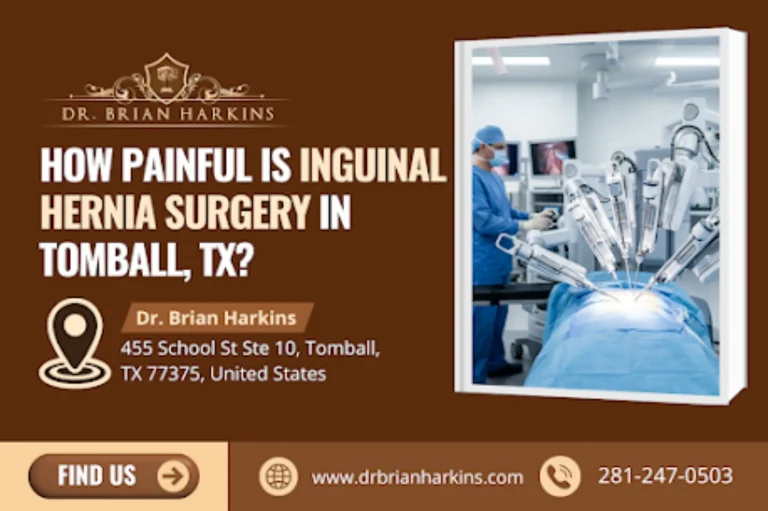
Most patients describe pain after inguinal hernia repair as mild to moderate rather than severe, peaking in the first few days and improving noticeably by day seven. Minimally invasive and robotic techniques produce 26 to 42% less pain than open repair in the first 48 hours, and 99% of patients recover without opioids using scheduled acetaminophen, ibuprofen, and ice.
If you're facing inguinal hernia surgery in Tomball, TX, you're probably wondering just how painful the recovery will be. The good news is that modern surgical techniques, especially minimally invasive and robotic approaches, have dramatically reduced both immediate and long-term pain compared to traditional open repair.
Most patients experience mild to moderate discomfort for just a few days after surgery, with significant improvement within the first week. National health resources such as MedlinePlus note that treatment for hernia is usually surgery to repair the opening in the muscle wall, and the technique used has a direct bearing on how that recovery feels. In this article, you'll learn what to expect at each stage of recovery, how different surgical methods affect pain levels, and what you can do to manage discomfort effectively.
The single largest factor in how much pain you experience is which technique your surgeon uses. The table below compares the three main approaches before each is examined in detail.
| Technique | Approach | Pain Profile |
| Open (Lichtenstein) | Larger groin incision, extensive tissue dissection | Greater acute pain; 32% chronic pain at twelve months |
| Laparoscopic (TAPP, TEP) | Several small incisions, mesh in preperitoneal space | 26 to 31% less pain at 24 hours; 28% lower at 48 hours; 42% fewer pain medications; 3.6% chronic pain at twelve months |
| Robotic | TAPP-type repair with 3-D visualization and precision instruments | May further reduce immediate and chronic nerve-related pain through meticulous, nerve-sparing dissection |
Open repair involves a larger incision in the groin area, typically using the Lichtenstein technique. This approach requires more extensive tissue dissection, which often results in greater acute postoperative pain and a higher likelihood of chronic groin discomfort.
The direct dissection through multiple layers of tissue means patients can expect more soreness in the days following surgery. Studies show that this traditional approach, while effective, tends to produce more immediate pain than newer techniques, which is the main reason minimally invasive options have become the default where they are available.
Laparoscopic techniques (TAPP and TEP) use several small incisions to place mesh behind the abdominal wall in the preperitoneal space. The difference in pain levels is significant and measurable rather than merely theoretical.
Research comparing the two approaches found that at 24 hours after surgery, patients who had laparoscopic repair experienced approximately 26% less pain by the McGill Pain Score and 31% less pain by visual analogue scale compared to open repair patients. By 48 hours, the laparoscopic group had 28% lower pain scores and used 42% fewer pain medications. These smaller incisions and reduced tissue trauma translate directly into a more comfortable recovery for most patients.
Robotic hernia repair uses advanced robotic platforms to perform TAPP-type repairs with enhanced 3-D visualization and precision instruments. The improved ergonomics allow surgeons to perform more meticulous dissection and nerve-sparing maneuvers.
This precision may help reduce both immediate postoperative pain and the risk of chronic nerve-related discomfort. Because much of the chronic pain that follows hernia repair is nerve-related, techniques that improve the surgeon's ability to see and avoid those nerves address the problem at its source rather than after the fact.
The choice of surgical technique has a dramatic impact on chronic pain rates. At twelve months after surgery, 32% of patients who had open Lichtenstein repair reported chronic pain, compared to only 3.6% of patients who underwent laparoscopic TAPP repair.
It's worth noting that recent research suggests many older studies exaggerated chronic pain rates by using unvalidated questionnaires and not accounting for advances in surgical techniques. Modern hernia repair, especially minimally invasive approaches, carries significantly lower chronic pain risk than commonly cited statistics suggest.
Immediately following inguinal hernia repair, you'll typically experience pain around the surgical site, often accompanied by bruising, swelling, and a sensation of tightness or pulling in the groin area. Patients are commonly advised to expect to be very sore for a week or two.
Don't be misled by small incisions in minimally invasive surgery. The titanium screws or tacks holding the mesh in place penetrate multiple muscle layers in the pelvis, which creates soreness that goes deeper than the skin-level incisions suggest. This is why a patient with three tiny scars can still feel meaningfully sore in the first days.
Most patients describe the pain as mild to moderate rather than severe. The discomfort typically peaks in the first few days, shows significant improvement by day seven, and continues to decrease over two to four weeks.
Occasional pulling, tugging, burning, and other unusual sensations are completely normal for weeks after surgery. These sensations gradually improve week by week as the tissues heal and adapt to the mesh. You might feel:
These sensations don't mean something is wrong. They're part of the normal healing process, and knowing to expect them prevents a lot of unnecessary worry during the second and third weeks.
A proactive medication approach is recommended: take acetaminophen 1000 mg the night before surgery, then continue 1000 mg every six hours for the first three days. If pain persists, add ibuprofen 600 mg every six hours.
The key is staying ahead of the pain rather than waiting until it becomes severe. Taking medications on a schedule, even if you feel okay, prevents pain from building up to a point where it is harder to bring back down, which is why the first dose is timed the night before surgery rather than after you wake up.
Continuous icing of the surgical site, twenty minutes on and twenty minutes off, combined with scheduled acetaminophen and ibuprofen allows 99% of patients to recover without needing opioid medications. Other helpful strategies include:
Tomball residents have access to experienced hernia surgeons including Dr. Brian Harkins, who performs robotic hernia repairs, and specialists at nearby facilities like the Baylor College of Medicine Hernia Center in Houston, which uses minimally invasive approaches and standardized protocols. Choosing a surgeon experienced in minimally invasive or robotic techniques can significantly impact your pain levels and recovery speed.
Most patients undergoing robotic hernia surgery go home the same day and follow this general timeline:
| Stage | What to Expect |
| Days 1 to 3 | Significant soreness, limited mobility, rest at home |
| Days 4 to 7 | Many return to desk work at about 50% capacity; pain decreasing noticeably |
| Week 2 | Approximately 75% back to normal daily activities; still avoiding heavy lifting |
| Week 3 | About 85% of normal function; can begin light running and cycling |
| Week 4 | At or near 100% for daily activities; cleared for normal exercise |
This timeline holds true for most laparoscopic and robotic repairs, though individual experiences vary based on overall health and the complexity of the repair.
Dr. Harkins provides specific guidelines for his Tomball patients:
For driving, most centers recommend waiting until you've stopped taking opioid pain medications for at least two days and can comfortably perform an emergency braking maneuver without significant pain.
Most recovery discomfort is expected, but certain symptoms warrant a call and others warrant immediate care. Call your surgeon's office if you experience:
Go to the emergency department immediately if you develop severe, sudden worsening pain, especially with nausea or fever, signs of wound opening or significant bleeding, chest pain or difficulty breathing, shortness of breath, or leg swelling that may indicate a blood clot. These symptoms are rare but require immediate medical attention.
Research has identified a statistically significant association between the severity of pain you experience before surgery and the likelihood of developing chronic postoperative pain. If you have significant pain from your hernia before repair, discuss this with your surgeon, since it changes the risk calculation. Understanding your specific hernia conditions helps frame that conversation. Chronic pain after hernia repair can be:
If you develop pain that persists beyond the normal recovery period, management begins with thorough evaluation to rule out hernia recurrence, mesh infection, or other structural problems. Treatment options include pharmacologic therapy such as nerve pain medications and anti-inflammatories, physical therapy and targeted exercises, ultrasound-guided nerve blocks of the ilioinguinal, iliohypogastric, or genitofemoral nerves, and in refractory cases, re-operation with mesh removal and neurectomy.
The good news is that with modern surgical techniques, especially minimally invasive approaches available in Tomball, the risk of chronic pain requiring these interventions is significantly lower than it was in the past.
Most patients describe the pain as mild to moderate rather than severe. Discomfort typically peaks in the first few days, improves significantly by day seven, and continues decreasing over two to four weeks.
Minimally invasive approaches cause less pain than open repair. Laparoscopic patients reported roughly 26 to 31% less pain at 24 hours and 28% less at 48 hours, while using 42% fewer pain medications than open repair patients.
Usually not. Continuous icing at twenty minutes on and twenty minutes off, combined with scheduled acetaminophen and ibuprofen, allows 99% of patients to recover without opioid medications.
Pain peaks in the first few days, improves noticeably by day seven, and continues decreasing over two to four weeks. Occasional pulling, tugging, or burning sensations can remain normal for several weeks after that.
At twelve months, 32% of open Lichtenstein patients reported chronic pain versus only 3.6% of laparoscopic TAPP patients. Recent research also suggests older studies overstated chronic pain rates.
The titanium screws or tacks holding the mesh in place penetrate multiple muscle layers in the pelvis. That creates soreness deeper than the skin-level incisions suggest, so small scars do not mean shallow discomfort.
Sharp twinges with certain movements, pulling when standing or sitting, burning or tingling near the incisions, and tightness in the groin are all normal. They gradually improve as tissues heal and adapt to the mesh.
Most centers recommend waiting until you have been off opioid pain medications for at least two days and can comfortably perform an emergency braking maneuver without significant pain.
Avoid lifting over 10 to 15 pounds for two weeks and over 25 to 30 pounds for four weeks, with no vigorous exercise for four weeks. Desk work is typically cleared at 5 to 7 days and heavy labor at 4 to 6 weeks.
Call if pain increases over time rather than improving, or if you develop fever of 100.4°F or greater, shaking chills, redness or drainage from incisions, persistent nausea or vomiting, or difficulty urinating.
The honest answer is that inguinal hernia repair hurts, but far less than most patients fear and far less than it did a generation ago. Expect real soreness in the first few days, meaningful improvement by the end of the first week, and a steady return toward normal over the following month.
What most influences that experience is the technique used and how proactively you manage discomfort. Minimally invasive and robotic repairs consistently produce lower acute pain and a markedly lower chance of lasting nerve-related pain, and a scheduled regimen of acetaminophen, ibuprofen, and ice keeps the large majority of patients off opioids entirely.
Get a clear picture of your recovery before surgery.
Schedule a consultation with a Tomball hernia specialist today.


Dr. Brian Harkins is a renowned surgeon specializing in advanced, minimally invasive, and robotic surgical techniques. With a dedication to innovation and personalized patient care, he has transformed countless lives by delivering exceptional outcomes.
I want a website like this, where do i start?