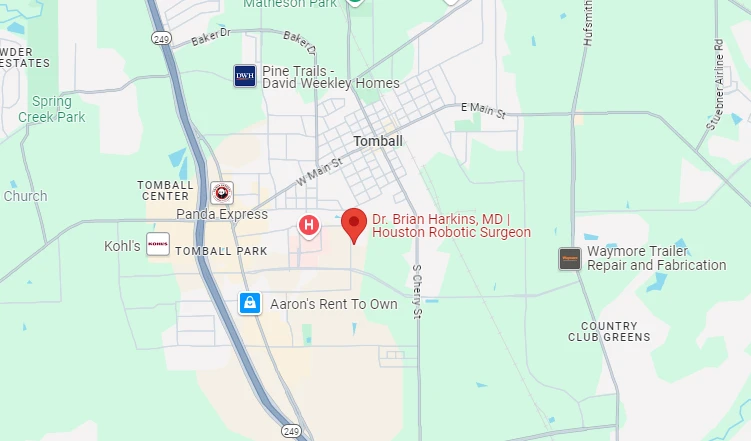
455 School St. Bldg. 1, Suite 10 Tomball, Texas 77375
Mon-Thu: 9:00 am – 5:00 pm | Fri: 9:00 am – 2:00 pm

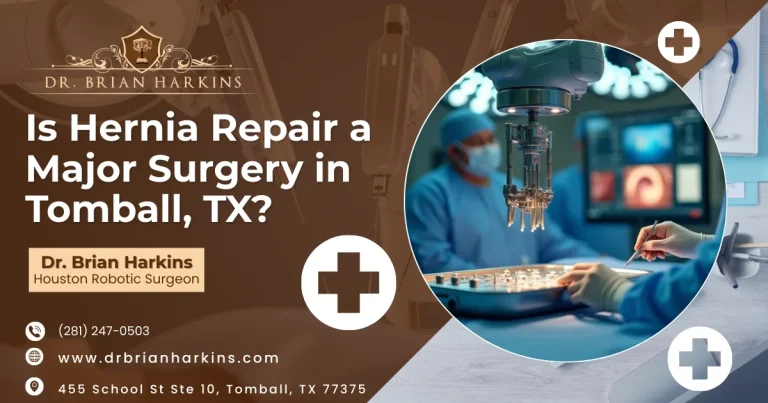
When a hernia occurs, tissue from the intestine, abdominal muscle, or even the stomach can push through a weakened area in the fascia. Modern hernia repair surgery in Tomball, TX offers everything from quick keyhole surgery to advanced robotic surgical techniques. Whether your procedure is labeled “major” or “minor” depends on the size of the hernia, the type of hernia (inguinal, ventral, umbilical, hiatal, or incisional), and your general health.
Dr. Brian Harkins—a local hernia specialist serving Tomball—uses a full spectrum of surgical techniques, including open surgery and minimally invasive options, to repair the hernia safely and efficiently.
A hernia forms whenever internal organs or fat poke through muscle. In the inguinal canal a bulge in the groin signals an inguinal hernia. Near the belly button, you may have an umbilical hernia. If a prior operation left a weak scar, you could develop an incisional hernia. Each requires slightly different hernia treatment and sometimes different types of surgery, yet they share common hernia causes:
Ignoring a bulge risks a strangulated hernia, where blood supply is cut off. That scenario rapidly escalates into emergency surgery and often qualifies as major surgery.
Tomball surgical services include every major hernia procedure on today’s medical menu—open, laparoscopic surgery, and robotic hernia repair. Your hernia surgeon will assess the defect and recommend the type of surgery with the best risk-benefit balance.
| Approach | Incision Size & Location | Anesthesia | Hospital Stay | Recovery Time | Ideal For |
|---|---|---|---|---|---|
| Open Hernia Repair | 3–6" incision over defect | General or Local + Sedation | 0–2 nights | 4–6 weeks | Huge ventral or strangulated hernias, complex revisions |
| Laparoscopic Hernia Repair | Three 0.5" ports (keyhole) | General anesthesia | Same-day outpatient | 2–4 weeks | Routine inguinal hernia surgery, small umbilical defects |
| Robotic Hernia Repair | Three-four 0.5" ports, robotic arms | Performed under general anesthesia | Same-day | 1–3 weeks | Recurrent incisional or hiatal hernias, need for precision suturing |
Minimally invasive laparoscopic and robotic hernia procedures provide three-dimensional imaging, better dexterity, and fewer adhesions. Many patients from across TX choose Tomball because the city’s Tomball surgical services include same-day discharge options, bundled pricing, and experienced OR teams.
Size, complexity, mesh removal, or compromised blood supply can all elevate an otherwise intermediate surgical procedure. A small groin bulge rarely lasts more than 45 minutes in the OR, but a football-sized defect with bowel obstruction can become a half-day operation requiring drains and an ICU bed.
Most hernia procedures in Tomball are outpatient. Surgery is performed under general anesthesia, and minimally invasive procedures use carbon-dioxide insufflation so surgical instruments can navigate the abdomen. After skin closure your surgical care team transfers you to recovery, where nurses monitor pain, blood pressure, and nausea.
If the hernia is small and fixed laparoscopically, recovery can be even faster. Always follow the instructions your hernia specialist Dr. Harkins provides.
General surgery experience matters, but fellowship training in minimally invasive surgery or abdominal wall reconstruction elevates results. Ask about recurrence rates, laparoscopic and robotic hernia volumes, and whether your repair will require general anesthesia. Transparent surgical services protect you from hidden fees and surprise bills.
From open hernia surgery to cutting-edge robotic hernia repair, Tomball, TX offers a comprehensive menu of various surgical techniques. Hernia repair is usually a straightforward outpatient event, especially when performed with minimally invasive laparoscopic tools.
However, large or strangulated defects can still demand a lengthy hospital stay. The safest path is early evaluation—schedule a consultation with a qualified surgeon to keep your repair on the “minor” side of the scale.
No. While symptoms may fluctuate, the underlying defect in the abdominal wall will not close spontaneously. Over time, the gap can widen, letting more intestine or fat protrude and increasing the chance of a strangulated hernia that requires emergency surgery.
Yes, modern synthetic or biologic mesh lowers recurrence and is routinely used in minimally invasive hernia repair. Complication rates are low when implanted by an experienced surgeon who follows strict sterile technique and selects the appropriate mesh type.
Both are minimally invasive, but robotic surgery offers wristed instruments and 3-D visualization, improving dexterity around nerves and vessels. Laparoscopic procedures are “straight-stick,” which can be quicker for straightforward inguinal hernias.
Most minimally invasive and robotic repairs require general anesthesia. However, an open inguinal repair can sometimes be done with local anesthesia and light sedation if you have risk factors that make general anesthesia inadvisable.
Light lifting under 15 pounds is usually allowed by week two. Full weight-training often resumes at six weeks, but that timeline may extend if your hernia was large or the repair required a component separation technique.
No firm age limit exists. Surgeons assess physiologic, not chronologic, age. Healthy adults in their 80s have safely undergone laparoscopic and robotic hernia repair when cleared by anesthesia and their primary physician.
Recurrent hernias often contain scar tissue, so your surgeon may recommend robotic or open component separation. These approaches provide better visualization, let the surgeon release tension, and offer a stronger long-term repair.
Most major insurers cover robotic hernia repair because studies show faster recovery and fewer complications. Check with your insurer and surgical billing team in Tomball to clarify deductibles, co-pays, and any prior authorization requirements.
Mild swelling or a firm ridge near the incision can last four to six weeks as sutures dissolve and tissue remodels. Gentle ice packs and wearing an abdominal binder help minimize fluid accumulation and discomfort.
Yes. Although small umbilical hernias near the belly button often appear harmless, trapped intestine can cut off blood flow quickly. If you notice severe pain, redness, or nausea, seek immediate surgical evaluation.


Dr. Brian Harkins is a renowned surgeon specializing in advanced, minimally invasive, and robotic surgical techniques. With a dedication to innovation and personalized patient care, he has transformed countless lives by delivering exceptional outcomes.
I want a website like this, where do i start?