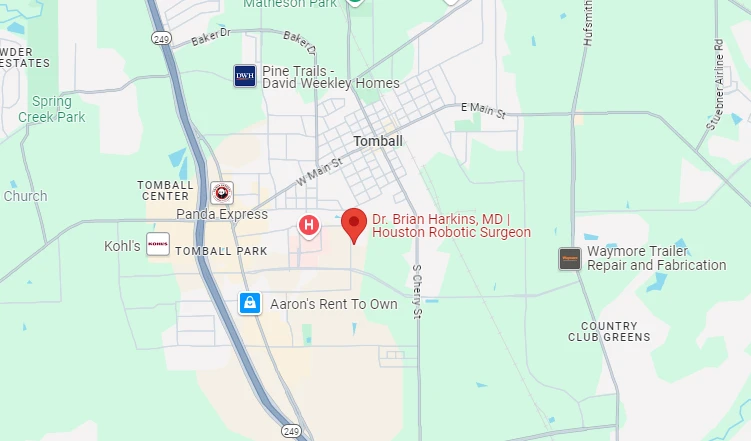
455 School St. Bldg. 1, Suite 10 Tomball, Texas 77375
Mon-Thu: 9:00 am – 5:00 pm | Fri: 9:00 am – 2:00 pm


For most uncomplicated inguinal and small to mid sized ventral hernias, robotic and laparoscopic hernia repair offer smaller incisions, lower surgical site infection rates, and faster recovery than open repair, with comparable recurrence rates in published series. Open repair remains the right choice for very large, complex, recurrent, or strangulated hernias, and in some emergency settings. Robotic surgery shows particular advantage in obese patients, complex anatomy, and pelvic dissection. Surgeon experience matters more than the platform alone.
A hernia repair operation in 2026 can be performed three ways: open hernia surgery, traditional laparoscopic hernia repair, or robotic assisted hernia repair using the da Vinci Xi system. All three are established, well studied, and widely available in major hernia centers. The decision between them is not "robotic is better" or "open is outdated." The right approach depends on hernia type, size, complexity, surgeon experience, and individual patient factors.
This guide compares all three for the most common hernia types, including inguinal, umbilical, incisional, hiatal, and ventral hernias. It walks through how the operations differ at the skin level, how they compare on recovery, infection, recurrence, and cost, and how a thoughtful surgeon decides between them. For patients considering Dr. Brian Harkins' practice in Tomball, the goal is to help you walk into your consultation with the right questions and a clear sense of what is at stake. Most of the operations described below fall within Dr. Harkins' robotic hernia surgery program at HCA Houston Healthcare Tomball, part of his broader robotic surgery practice.

All three approaches share the same fundamental goal: reduce the hernia, close the fascial defect, and (in most modern repairs) reinforce the area with surgical mesh. They differ in how the surgeon accesses the defect.
A single longer incision (typically 5 to 15 cm depending on hernia size) directly over the hernia. The surgeon dissects through skin and subcutaneous fat to reach the hernia sac, reduces the contents, closes the defect, and places mesh as needed. Open repair has the longest track record of any approach, with decades of published outcome data. It remains the standard for very large or complex hernias, recurrent hernias after prior minimally invasive repair, and many emergency presentations.
Three to four small incisions (5 to 12 mm) through which a laparoscope and straight long instruments are inserted. Carbon dioxide gas is used to inflate the abdomen and create working space. The surgeon performs the repair using the laparoscopic instruments while viewing a 2D high-definition monitor. The standard minimally invasive approach for two decades, with extensive published outcome data and broad availability.
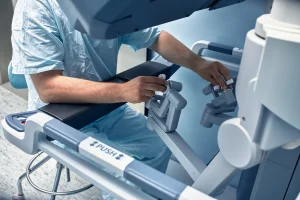
Same small-incision concept as laparoscopic, with the da Vinci Xi platform adding magnified 3D vision, wristed instruments with seven degrees of freedom, tremor filtration, and motion scaling. Three to five port incisions (8 to 12 mm). The surgeon sits at a console controlling every instrument movement in real time. The robot does not move autonomously. Robotic-assisted hernia repair includes techniques such as robotic transabdominal preperitoneal (rTAPP) repair for inguinal hernias, robotic intraperitoneal onlay mesh (rIPOM), robotic extended totally extraperitoneal (eTEP), and robotic transversus abdominis release (rTAR) for larger ventral hernias.
The table below summarizes the on-the-day patient experience differences between the three approaches for a typical primary inguinal hernia repair.
| Factor | Open hernia repair | Laparoscopic hernia repair | Robotic assisted hernia repair |
| Number of incisions | 1 incision | 3 to 4 small ports | 3 to 5 small ports |
| Incision size | 5 to 10 cm (typical inguinal) | 5 to 12 mm per port | 8 to 12 mm per port |
| Typical operative time | 45 to 75 minutes | 45 to 90 minutes | 60 to 120 minutes |
| Anesthesia | General, regional, or local with sedation | General | General |
| Hospital stay (uncomplicated) | Same-day to 1 night | Same-day discharge (most) | Same-day discharge (most) |
| Conversion to open surgery | N/A | 1 to 3 percent | 0.5 to 2 percent |
For ventral hernia repair (umbilical, incisional, epigastric), incision and stay differences are more meaningful: open ventral hernia repair typically uses a single longer midline or transverse incision and a 3 to 7 night hospital stay, while laparoscopic and robotic ventral hernia repair use small ports with a 1 to 3 night stay.

This is where most patients have the most questions. The published comparison data, summarized from multiple cohort studies and Americas Hernia Society Quality Collaborative data, points to several consistent patterns.
The recovery curves for laparoscopic and robotic are effectively similar at the patient experience level. Both are meaningfully faster than open repair.
Published series consistently report lower SSI rates with minimally invasive (robotic or laparoscopic) hernia repair compared with open, particularly for ventral hernia repair. Typical published ranges:
For inguinal hernia repair, SSI rates are lower overall across all three approaches (1 to 3 percent for minimally invasive, 2 to 5 percent for open), and the differences are smaller. SSI matters because infection is one of the strongest predictors of mesh failure and recurrence.
Published 1 to 5 year recurrence rates for modern mesh-reinforced hernia repair range from approximately 2 to 15 percent depending on hernia type, size, technique, mesh selection, and patient risk factors. The published data consistently shows:
The platform alone is not the dominant predictor of recurrence. Surgeon volume, mesh choice, and technical execution matter more.
For complex cases, robotic and laparoscopic hernia repair can be converted to open during the operation if needed. Published data suggests:
Inguinal hernias are the most common hernia type and the most studied. Findings from large cohort analyses and randomized trials:
Ventral hernias (umbilical, incisional, epigastric, parastomal) span a wider range of complexity than inguinal hernias. The choice between approaches becomes more nuanced:
Hiatal hernias sit at the upper end of the abdomen, behind the lower ribs and through the diaphragm. Surgical repair almost always involves a fundoplication (typically a Nissen or Toupet wrap) in addition to closing the hiatal defect. For hiatal hernia repair:
For most hiatal hernia patients, the question is robotic vs laparoscopic rather than including open.
Robotic surgery generally involves higher facility costs than laparoscopic or open, due to platform and disposable expenses. Whether that translates to higher out of pocket cost for the patient depends entirely on insurance. Most major commercial plans, Medicare, and Medicaid cover robotic hernia repair at the same rate as laparoscopic or open when medically indicated. Copays and deductibles are typically identical. The practice's billing team can verify benefits for any approach before surgery is scheduled.
The published data and clinical judgment favor robotic assisted hernia repair when:
Laparoscopic hernia repair often remains an excellent choice when:
Open hernia repair often remains the right choice when:
A surgeon does not default to one platform. They match the approach to the patient. During consultation, the conversation should cover:
Dr. Harkins performs robotic, laparoscopic, and open hernia repair in high volume at HCA Houston Healthcare Tomball's Center of Excellence in Robotic Surgery. For patients in Tomball, Magnolia, Spring, Cypress, The Woodlands, and greater Houston, that dual training means the decision is driven by your case, not by which tool the surgeon prefers.
For straightforward primary hernia repair, robotic and laparoscopic produce comparable short term and long term outcomes in published series, with similar recovery times, complication rates, and recurrence rates. The robotic platform shows meaningful advantage in complex cases: obese patients, significant adhesions, pelvic dissection, hiatal and paraesophageal hernias, and cases requiring retromuscular mesh placement. Surgeon experience with each approach influences outcomes more than the platform alone.
For most uncomplicated inguinal and small to mid sized ventral hernias, robotic assisted hernia repair offers smaller incisions, lower surgical site infection rates, and faster recovery than open repair, with comparable recurrence rates. For very large or complex hernias requiring component separation, recurrent hernias after prior minimally invasive repair, and emergency presentations, open repair often remains the right choice.
Robotic assisted hernia repair is a minimally invasive operation performed through small port incisions using the da Vinci Xi platform. The surgeon sits at a console and controls every instrument movement; the robot translates those movements into precise actions inside the abdomen using magnified 3D vision, wristed instruments, tremor filtration, and motion scaling. The robot does not perform the surgery autonomously. The same surgical operation (reduce the hernia, close the defect, place mesh) is performed, with the technology adding precision and the smaller-incision recovery profile of minimally invasive surgery.
Most commercial insurance plans, Medicare, and Medicaid cover robotic assisted hernia repair when medically indicated, at the same rate as laparoscopic or open. Copays and deductibles are typically identical across the three approaches. Coverage specifics vary by plan and procedure. The billing team can verify benefits before surgery is scheduled.
Robotic and laparoscopic hernia repair port sites are similar in size and location for most operations. Robotic ports are typically 8 to 12 mm; laparoscopic ports are typically 5 to 12 mm. After six months of healing, scars from either approach are small and usually difficult to see. Open hernia repair leaves a single longer scar that depends on hernia type and incision size.
Recovery timelines are effectively the same between robotic and laparoscopic hernia repair for most patients. Both are meaningfully faster than open repair: typically 1 to 2 weeks to light activity and 4 to 6 weeks to full activity for minimally invasive, vs 2 to 4 weeks to light activity and 6 to 8 weeks to full activity for open.
Yes, in many cases. Recurrent hernias after prior open repair are often well suited to robotic or laparoscopic re-repair, where the surgeon enters fresh tissue planes rather than scarred ones. Recurrent hernias after prior minimally invasive repair sometimes call for open re-repair to address the existing mesh and scar. The decision is individualized at consultation based on the prior operation and the current hernia.
Published 1 to 5 year recurrence rates for modern mesh-reinforced hernia repair (robotic, laparoscopic, or open) range from approximately 2 to 15 percent depending on hernia type, size, technique, mesh choice, and patient risk factors. Most uncomplicated primary inguinal hernia repairs have published recurrence rates under 5 percent at 5 years across all three approaches. Individual outcomes vary; statistics are population averages.
Most adult patients with a symptomatic hernia who are healthy enough for general anesthesia are candidates for robotic assisted hernia repair. Specific factors that may favor robotic vs laparoscopic vs open include hernia size and complexity, prior abdominal surgical history, BMI, anatomy, comorbidities, and surgeon experience. Patients with severe pulmonary or cardiac disease that contraindicates pneumoperitoneum are not candidates for minimally invasive approaches.
Both are robotic-assisted minimally invasive approaches to hernia repair, but they enter different anatomic planes. Robotic transabdominal preperitoneal (rTAPP) enters the abdomen, opens the peritoneum to place mesh in the preperitoneal space, then closes the peritoneum. Robotic extended totally extraperitoneal (eTEP) repair stays in the extraperitoneal plane throughout, avoiding the abdominal cavity entirely. Each has different advantages for different hernia types and patient factors.
The right hernia repair approach depends on your hernia, your anatomy, your overall health, and your surgeon's experience, not on which platform is theoretically newest. Most patients in 2026 have real options, and the conversation between you and your surgeon should compare them on the metrics that matter to you: recovery time, incision pattern, infection risk, recurrence rate, and how well the approach fits your specific case.
If you would like to discuss which approach is right for your hernia, schedule a consultation with Dr. Brian Harkins at our Tomball office by calling 281-351-5409 or request an appointment online. We see patients from across the greater Houston area, with robotic, laparoscopic, and open hernia repairs all performed in high volume at HCA Houston Healthcare Tomball's Center of Excellence in Robotic Surgery.
Sarah Chen is a healthcare communications specialist with 12+ years of experience in clinical environments. She writes about robotic and minimally invasive surgery for patients and families navigating surgical decisions. Her work is clinically reviewed by Dr. Brian Harkins, MD, FACS, ensuring medical accuracy and evidence-based information.
Based in: Tomball, TX | Serves: Greater Houston Area
This information is educational and is not a substitute for professional medical advice. Every patient is different. The choice between robotic, laparoscopic, and open hernia repair is individualized based on hernia type, size, complexity, anatomy, comorbidities, prior surgical history, and patient preference. Dr. Brian Harkins will discuss which approach is best for your specific situation in consultation. Statistics cited reflect published research on aggregate patient populations; individual outcomes vary. This content has been reviewed for medical accuracy by Dr. Brian Harkins, MD, FACS.

Dr. Brian Harkins is a renowned surgeon specializing in advanced, minimally invasive, and robotic surgical techniques. With a dedication to innovation and personalized patient care, he has transformed countless lives by delivering exceptional outcomes.
I want a website like this, where do i start?