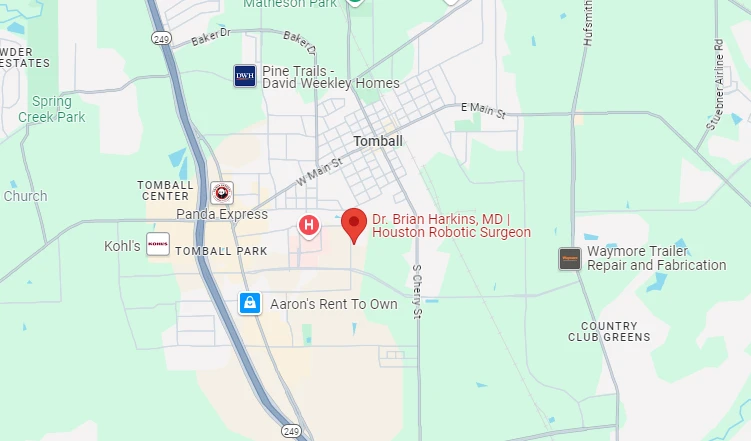
455 School St. Bldg. 1, Suite 10 Tomball, Texas 77375
Mon-Thu: 9:00 am – 5:00 pm | Fri: 9:00 am – 2:00 pm

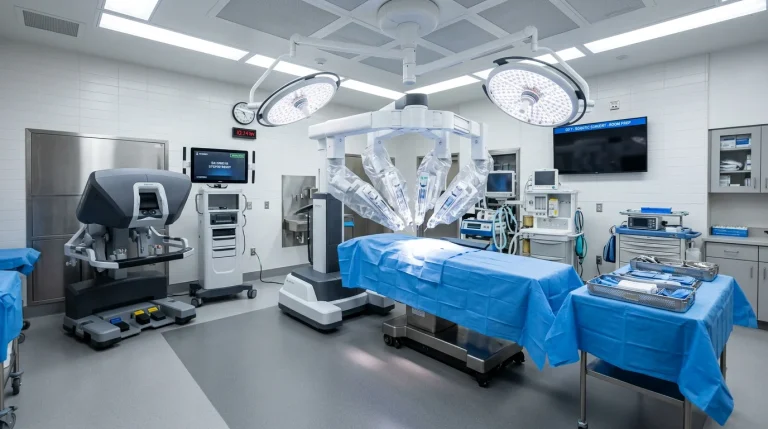
Robotic hernia surgery in Tomball, TX with Dr. Brian Harkins uses the Da Vinci Xi system to repair hernias through tiny incisions, resulting in less pain, lower recurrence risk, and recovery measured in days rather than weeks. As a top-1% nationally ranked robotic surgeon with military-trained precision, Dr. Harkins brings a level of expertise to hernia repair that most patients in northwest Houston never realized was available right in their community.
If you've been told you need hernia surgery, or you're living with hernia pain and wondering whether it's time to act, this guide covers everything you need to know — from how robotic hernia surgery works to what your recovery actually looks like at the Surgical Advanced Specialty Center in Tomball. Understanding your options is the first step toward making a confident decision about your care.
The days of choosing between suffering through hernia pain and enduring a long open-surgery recovery are behind us. Robotic-assisted hernia repair has changed the equation entirely, and patients across the Houston metro — many traveling hours to get here — are discovering what's possible when precision technology meets decades of surgical experience.
Robotic hernia surgery uses the Da Vinci Xi surgical system to give the surgeon unmatched visualization and control through incisions smaller than a fingertip. The robotic arms translate the surgeon's hand movements into precise actions inside the body, eliminating the limitations of traditional open surgery while achieving superior outcomes compared to standard laparoscopic techniques.
A hernia occurs when tissue or an organ pushes through a weak spot in the surrounding muscle or connective tissue — most commonly in the abdominal wall or groin area. Left untreated, hernias don't resolve on their own and can progress to serious complications, including incarceration (where the hernia becomes stuck) or strangulation (where blood supply to trapped tissue is cut off).
Here's what happens during a robotic hernia repair at Dr. Harkins' practice:
The result is a repair that looks minimal on the outside but achieves comprehensive anatomical restoration on the inside.
| Feature | Open Surgery | Laparoscopic | Robotic (Da Vinci Xi) |
| Incision size | 3–6 inches | 0.5–1 cm | 0.5–1 cm |
| 3D visualization | No | 2D only | High-definition 3D |
| Instrument range of motion | Full | Limited | 360° wristed |
| Tremor filtering | N/A | N/A | Yes |
| Average hospital stay | 1–3 days | Same day | Same day |
| Return to light activity | 4–6 weeks | 1–2 weeks | 3–7 days |
| Hernia recurrence risk | Higher | Moderate | Lowest |

Dr. Brian Harkins performs robotic repair for all major hernia types, including inguinal, ventral, umbilical, hiatal, incisional, and spigelian hernias. Each repair is tailored to the patient's anatomy, the hernia's size and location, and whether the patient has had previous surgeries that affect the approach.
Robotic inguinal hernia repair is the most common hernia procedure performed at the practice. Inguinal hernias appear as a bulge in the groin or inner thigh area, and they're significantly more common in men than women — though they occur in both. Dr. Harkins uses either the TAPP (transabdominal preperitoneal) or TEP (totally extraperitoneal) robotic technique depending on the patient's anatomy and prior surgical history.
The robotic approach to inguinal hernia repair is particularly valuable when treating bilateral inguinal hernias (both sides), because both can be repaired through the same small incisions in a single operation — something open surgery handles far less elegantly.
Robotic ventral hernia repair addresses hernias that develop through the front of the abdominal wall. Incisional hernias — a subtype that develops at the site of a previous surgical incision — can be especially complex to repair because of scar tissue and altered anatomy. The Da Vinci Xi's magnified 3D view and articulating instruments give Dr. Harkins precise access to these challenging defects.
Robotic umbilical hernia repair corrects hernias at the belly button, where the abdominal wall naturally has a small opening. These hernias are common in adults who've experienced increased abdominal pressure from factors like pregnancy, obesity, or heavy lifting.
Robotic hiatal hernia repair addresses hernias where the stomach pushes through the diaphragm into the chest cavity. These are often associated with severe acid reflux (GERD) and can become dangerous when they progress to paraesophageal hernias. Robotic repair is ideal here because of the confined, anatomically complex surgical space near the esophagus and heart.
| Hernia Type | Location | Common Symptoms | Robotic Approach |
| Inguinal | Groin/inner thigh | Bulge, groin pain, pressure | TAPP or TEP technique |
| Ventral | Front abdominal wall | Bulge, abdominal discomfort | Primary repair + mesh |
| Incisional | Previous surgery site | Bulge at scar, pain | Component separation if needed |
| Umbilical | Belly button | Visible bulge, tenderness | Mesh reinforcement |
| Hiatal | Diaphragm opening | Reflux, chest pain, difficulty swallowing | Crural repair + fundoplication |
| Spigelian | Lateral abdominal wall | Subtle bulge, pain | Robotic mesh placement |
The core advantage of robotic hernia repair over laparoscopic technique is enhanced dexterity and visualization. The Da Vinci Xi's wristed instruments move like a human wrist inside the body — something rigid laparoscopic tools cannot do. This translates to more precise mesh placement, better tissue handling, and lower recurrence rates, especially in complex or recurrent hernias.
And it's not just theory. The outcomes data consistently supports robotic hernia repair:
Here's the thing most surgical websites won't tell you: not all robotic surgeons are equal. The outcomes above reflect surgeons with high case volumes and proper training. Dr. Harkins' ranking in the top 1% nationally in robotic surgery volume isn't just a credential — it directly predicts better outcomes for his patients.
What else sets the approach at Surgical Advanced Specialty Center apart:
| Recovery Metric | Open Surgery | Laparoscopic | Robotic + ERAS (Dr. Harkins) |
| Same-day discharge | Rarely | Often | Standard |
| Return to desk work | 3–6 weeks | 1–2 weeks | 3–5 days |
| Return to physical work | 6–8 weeks | 3–4 weeks | 2–3 weeks |
| Post-op opioid use | High | Moderate | Minimal |
| Hernia recurrence | Higher long-term | Moderate | Lowest |
| Infection risk | Higher (large incision) | Low | Lowest |

The full journey from your first consultation with Dr. Brian Harkins to returning to normal activity typically spans two to four weeks for most hernia patients — dramatically shorter than the six-to-eight-week timeline associated with open repair. Here's a realistic picture of each stage.
Your consultation at Surgical Advanced Specialty Center (455 School St., Tomball, TX) starts with a thorough evaluation of your hernia — its type, size, and how it's affecting your daily life. Dr. Harkins diagrams the surgical plan with you directly at the consultation, which patients consistently describe as unusually transparent and reassuring.
Pre-operative preparation typically includes:
Most hernia repairs at Dr. Harkins' practice are performed at HCA Houston Healthcare Tomball as outpatient procedures. You'll arrive a couple of hours before surgery, be prepared by the nursing team, and receive general anesthesia. The robotic procedure itself typically takes one to two hours depending on the hernia type and complexity.
You'll wake up in recovery with small bandages over the incision sites — not a large abdominal wound. Most patients are surprised at how manageable the discomfort is when they wake up.
Physical restrictions gradually lift. Light activity continues to expand. Most patients with physically demanding jobs can return to modified duty around the two-to-three-week mark, with full activity clearance typically around four weeks.
The timeline above is not a guarantee — individual factors like hernia size, complexity, and overall health affect recovery. But it reflects the consistent pattern Dr. Harkins sees with his ERAS-integrated robotic approach.
Robotic hernia surgery with Dr. Brian Harkins at Surgical Advanced Specialty Center in Tomball represents the current standard of excellence for hernia repair — combining the precision of the Da Vinci Xi system, the accelerated healing of ERAS protocols, and the judgment of a surgeon who ranks in the top 1% nationally. For patients in northwest Houston and beyond, it means getting back to work, family, and life far sooner than they'd expected.If you're ready to stop managing hernia pain and start planning your recovery, the next step is straightforward. Schedule a consultation with Dr. Brian Harkins — bring your questions, your imaging if you have it, and expect to leave with a clear surgical plan tailored specifically to your hernia and your life.
Most robotic hernia repairs take one to two hours. Simple inguinal hernias are often on the shorter end; complex, recurrent, or bilateral repairs may take longer. Dr. Harkins will give you a specific time estimate based on your anatomy during your consultation.
Most patients go home the same day. Dr. Harkins uses ERAS protocols and outpatient surgical planning specifically to make same-day discharge the standard, not the exception. Occasionally, more complex repairs require an overnight stay.
Patients with desk or sedentary jobs often return to light work within three to five days. Physically demanding jobs typically require two to three weeks before modified duty and up to four weeks before full return. Your specific timeline will be discussed at your consultation.
Most major insurance plans, including Medicare, Aetna, Cigna, and Humana, cover hernia repair surgery when it's medically necessary. The practice's insurance specialist, Vicki, helps patients verify coverage and navigate prior authorization before surgery.
Robotic hernia repair, particularly for inguinal hernias, produces some of the lowest recurrence rates available. Studies indicate recurrence rates significantly lower than open mesh repair, especially for surgeons with high case volumes like Dr. Harkins.
Yes. One of the advantages of robotic inguinal hernia repair is that bilateral hernias (both sides) can be addressed through the same small incisions in a single operation, eliminating the need for two separate procedures and recovery periods.
Mesh selection is individualized based on the hernia type, location, and patient factors. Dr. Harkins discusses mesh options at your consultation, including the type, fixation method, and why a particular choice is right for your repair.
Dr. Harkins uses multi-modal pain management as part of his ERAS protocol — combining nerve blocks, non-opioid medications, and targeted local anesthesia techniques. The goal is effective pain control with minimal or no opioid use, which leads to faster, clearer recovery.
All surgery carries some risk. Potential complications include infection, bleeding, injury to surrounding structures, and hernia recurrence. Dr. Harkins' combination of robotic precision, high case volume, and ERAS protocols keeps his complication rates well below national averages.
Most patients with symptomatic hernias are candidates for robotic repair. Factors including hernia type, size, prior surgeries, and overall health are all considered. The best way to know is to schedule a consultation — Dr. Harkins will evaluate your specific situation and give you a direct recommendation.

Dr. Brian Harkins is a renowned surgeon specializing in advanced, minimally invasive, and robotic surgical techniques. With a dedication to innovation and personalized patient care, he has transformed countless lives by delivering exceptional outcomes.
I want a website like this, where do i start?