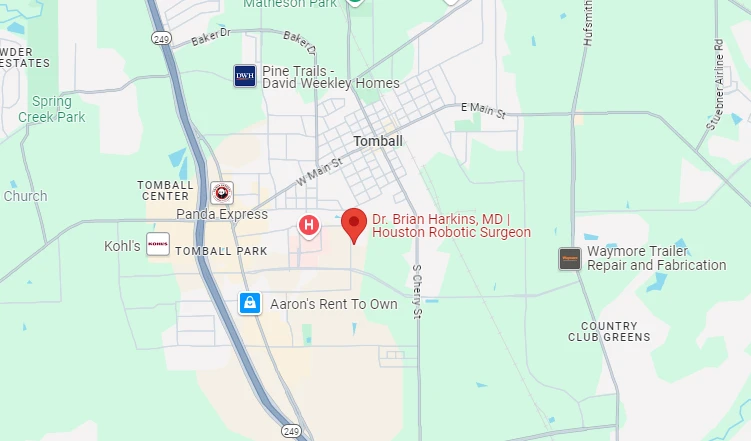
455 School St. Bldg. 1, Suite 10 Tomball, Texas 77375
Mon-Thu: 9:00 am – 5:00 pm | Fri: 9:00 am – 2:00 pm


A robotic surgeon uses the da Vinci surgical system to perform minimally invasive procedures with enhanced precision, 3D vision, and wristed instruments that move beyond the natural range of a human hand. The surgeon controls every movement from a console, and the robot never operates on its own. The result is smaller incisions, less pain, and faster recovery compared to open surgery.
If you're considering robotic surgery in Tomball, you probably have questions about what actually happens during the procedure and whether a machine is really operating on you. The truth is, robotic-assisted surgery is a tool that gives your surgeon enhanced precision and control through tiny incisions. Many patients wonder how quickly they'll recover, whether they'll have visible scars, and how experienced their surgeon is with the technology. This article explains what a robotic surgeon does, how the da Vinci system works, and what you can realistically expect from your experience and recovery.
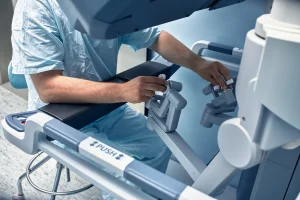
When you hear "robotic surgery," it's easy to imagine a machine operating on its own. That's not how it works. The surgeon sits at a console several feet from the patient and directs every movement. The robot doesn't operate autonomously. Think of it as a highly sophisticated tool, not a replacement for human expertise.
The da Vinci surgical system enhances what human hands can do. The instruments have seven degrees of freedom, meaning they rotate and bend in ways that mimic and exceed the natural movement of a human wrist. The system filters out hand tremors automatically and uses motion scaling to convert the surgeon's movements into precise micro-movements inside your body.
The surgeon views the surgical site through a high-definition 3D camera with roughly 10x magnification. This level of detail helps identify delicate structures like nerves and blood vessels. The wristed instruments, known as EndoWrist technology, allow the surgeon to maneuver in tight spaces with remarkable precision.
Several generations of the da Vinci system exist today. The table below outlines the key models and their primary use cases.
| Model | Type | Best For |
| da Vinci Xi | Multi-port | Most widely deployed; broad surgical range |
| da Vinci X | Multi-port | Cost-efficient multi-port option |
| da Vinci SP | Single-port | Procedures requiring one small incision |
| da Vinci 5 | Latest generation | Advanced force feedback and enhanced imaging |
Robotic-assisted surgery is used for a wide range of procedures across multiple specialties. Any procedure that can be done laparoscopically can typically be performed robotically, often with added precision.
Urology is one of the most common applications for robotic surgery. Procedures include:
Gynecologic surgeons use robotic platforms for hysterectomy, myomectomy (fibroid removal), and treatment for endometriosis. General and colorectal surgeons use the technology for hernia repair and colorectal resections. Cardiothoracic surgeons perform mitral valve repairs, and the technology is also used in head and neck, thoracic, and orthopedic procedures.
In Tomball, the emphasis tends to be on urology and gynecology, reflecting local surgical expertise and patient demand.
Compared to traditional open surgery, minimally invasive robotic surgery delivers several measurable patient benefits. Smaller incisions mean less postoperative pain, which often translates to reduced need for pain medication. Recovery time is typically faster at 4 to 6 weeks versus 8 to 12 weeks for open surgery.
| Outcome | Robotic Surgery | Open Surgery |
| Hospital stay | Same day or 24 hours | 3 to 5 days |
| Recovery time | 4 to 6 weeks | 8 to 12 weeks |
| Incision size | Under 1 inch | 6 to 12 inches |
| Blood loss | Significantly reduced | Higher risk |
| Infection risk | Lower | Higher |
| Complication rate | 0.08 to 0.1% | Higher for comparable indications |
For surgeons, the benefits include improved ergonomics. Sitting comfortably at a console rather than standing hunched over the patient reduces fatigue and allows for better focus during long procedures. Tremor elimination and greater range of motion in confined spaces make delicate work easier. Better visualization also aids in training the next generation of surgeons.
Robotic surgery isn't without trade-offs. One key limitation is longer operative times. Robotic-assisted surgery typically takes 15 to 60 minutes longer than laparoscopy for the same procedure. The docking process, which involves positioning the robotic arm and instruments, can take 4 to 30 minutes and requires careful setup.
Surgeons lose haptic feedback during robotic procedures, meaning they can't physically feel the tissue they're working with. They rely entirely on visual feedback and must infer tissue resistance from what they see. This lack of tactile sensation can increase the risk of unintended tissue damage in untrained hands, which is why experience and discipline are critical.
The learning curve for robotic surgery is steeper than for laparoscopy. It typically takes 50 to 300 cases to reach proficiency, depending on the complexity of the procedure. Outcomes improve significantly after a surgeon completes around 50 cases.
Conversion to open surgery is always a possibility. Conversion rates range from 1 to 5%, which is actually lower for robotic surgery than for laparoscopy in most procedures. If an urgent issue arises, the surgeon undocks the robot and proceeds with an open approach. This is not a failure. It's a standard safety protocol.
Not every patient is a good candidate for robotic surgery. The procedure is contraindicated if you can't tolerate pneumoperitoneum or steep Trendelenburg positioning. Significant prior abdominal surgery, severe obesity (BMI over 40), or extensive scar tissue may complicate the procedure, and open surgery may be safer in those cases.
Informed consent should include specific details about your procedure. Ask your surgeon the following before agreeing to robotic surgery:
Board certification alone is not sufficient to evaluate a surgeon's robotic experience. Look for signs of continuing education and involvement in proctorship programs.
Understanding how robotic surgery applies to real cases helps set expectations. Below are three representative scenarios.
A 65-year-old male with localized prostate cancer may undergo robotic radical prostatectomy. The surgeon performs precise nerve-sparing techniques critical for preserving continence and erectile function. Small incisions mean the patient can often go home the same day. Continence recovery rates are 86 to 91% by one year post-op.
A 42-year-old female with symptomatic fibroids may be a candidate for robotic myomectomy, a uterine-sparing procedure. The precision dissection reduces blood loss, and the patient can return to work in 2 to 3 weeks versus 6 to 8 weeks after open surgery.
A 58-year-old with a complex hiatal hernia and prior abdominal surgery presents a higher-risk case. The surgeon encounters dense adhesions or unexpected anatomy early in the procedure and converts to an open approach. Total time increases, but safety is prioritized. This outcome is built into the consent process and is not a complication.
There is no standardized national credentialing system for robotic surgery yet. Training typically includes online modules, simulation in dry labs or wet labs, virtual reality practice, and proctored operating room cases. Most programs require 20 to 50 supervised cases before a surgeon is granted independent privileges.
Credentialing standards vary widely from hospital to hospital. Some institutions have rigorous requirements. Others rely heavily on vendor-led training, which may be insufficient on its own.
Surgeon experience at the time of informed consent is now legally relevant. Emerging case law, such as Forrest v. Bonifield (2017), has established that patients have a right to know their surgeon's experience level before consenting to a procedure. When choosing a surgeon, ask about their training pathway and the number of cases they've completed.
| Standard | Minimum Threshold | Notes |
| Proctored cases for privileges | 20 cases | Minimum threshold only |
| Cases for improved outcomes | 50+ cases | Where proficiency increases significantly |
| Full proficiency range | 50 to 300 cases | Varies by procedure complexity |
| SRC accreditation requirement | Ongoing volume and outcomes tracking | Hospital-level quality standard |
No. The robot does not operate independently. Your surgeon controls every instrument movement from a console with 3D vision and precision tools. The robot translates your surgeon's movements into precise actions inside your body.
Robotic procedures typically take 15 to 60 minutes longer than equivalent laparoscopic procedures due to setup and docking time. The additional time is generally offset by faster recovery and reduced complications after the procedure.
Incisions are typically less than one inch long. Most patients have minimal visible scarring. The number of incisions depends on the procedure, but multi-port systems use several small ports while the SP model requires only one entry point.
Most patients return to light desk work within 1 to 2 weeks and resume full activity within 4 to 6 weeks. Recovery timelines vary by procedure, individual health, and job demands. Your surgeon will give you a specific timeline based on your case.
Robotic systems have multiple built-in safety protocols, and malfunctions are rare. If a technical issue occurs during a procedure, the surgeon can immediately switch to laparoscopic or open surgery. Malfunction rates are extremely low across more than 1.7 million annual procedures.
Ask directly. Your surgeon should be able to tell you how many times they've performed your specific procedure robotically. Look for at least 50 completed cases and involvement in continuing education or proctorship programs beyond the initial credentialing minimum.
Most major insurance plans cover robotic-assisted surgery when it is the appropriate standard of care for your condition. Coverage varies by plan and diagnosis. Contact your insurance provider before scheduling and ask your surgeon's office to verify benefits on your behalf.
Patients who cannot tolerate CO2 gas insufflation, who require steep tilting of the operating table, or who have significant scar tissue from prior abdominal surgery may be better candidates for open surgery. A BMI over 40 also increases procedural risk and may affect the recommendation.
SRC accreditation is a third-party designation given to hospitals that meet rigorous standards for robotic procedure volume, surgeon training, safety protocols, and outcomes tracking. It is an objective quality signal when evaluating where to have your surgery performed.
Yes. Robotic surgery is widely used for cancer removal in urology, gynecology, colorectal, and thoracic surgery. Procedures like radical prostatectomy and nephrectomy for kidney tumors are among the most common robotic cancer surgeries performed.
Robotic surgery gives your surgeon a level of precision and visualization that traditional techniques simply cannot match. Smaller incisions, less pain, faster recovery, and lower complication rates make it the preferred approach for a wide range of urologic, gynecologic, and general surgery procedures. But the technology is only as good as the surgeon using it.
Choosing the right surgeon matters more than anything else. Ask about experience, ask about outcomes, and make sure you receive full informed consent before agreeing to any procedure. Hospital accreditation, proctorship history, and case volume are objective standards worth investigating.
If you're ready to discuss your options with a robotic surgeon in Tomball, Dr. Brian Harkins welcomes your questions. Call 281-247-0503 or visit the contact page to schedule a consultation and get answers specific to your condition.


Dr. Brian Harkins is a renowned surgeon specializing in advanced, minimally invasive, and robotic surgical techniques. With a dedication to innovation and personalized patient care, he has transformed countless lives by delivering exceptional outcomes.
I want a website like this, where do i start?