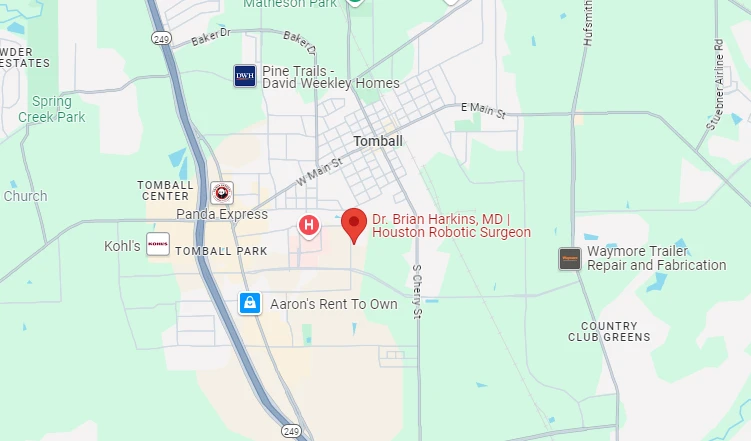
455 School St. Bldg. 1, Suite 10 Tomball, Texas 77375
Mon-Thu: 9:00 am – 5:00 pm | Fri: 9:00 am – 2:00 pm

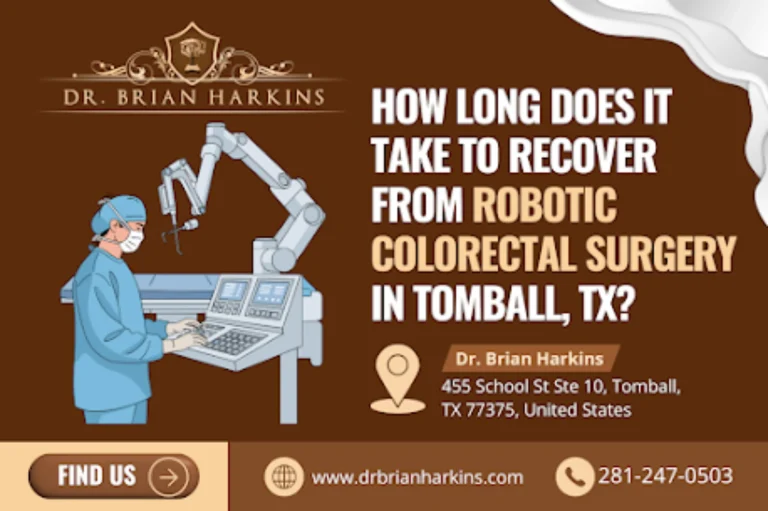
Most patients spend 2 to 5 days in the hospital after robotic colorectal surgery, return to desk work in about 2 to 3 weeks, and avoid heavy lifting for at least 4 to 6 weeks. Colon procedures generally reach full recovery in 2 to 4 weeks, while rectal surgery takes 3 to 6 weeks initially, with bowel, urinary, and sexual function continuing to improve for months.
If you're facing robotic colorectal surgery in Tomball, TX, one of your first questions is likely how long recovery will take. The answer depends on several factors, including the type of procedure, whether it involves your colon or rectum, and your overall health.
Most patients spend 2 to 5 days in the hospital after robotic surgery for colorectal cancer, with many returning to light activities within a few weeks, though full recovery including bowel, urinary, and sexual function can take several months for more complex operations. National health resources such as MedlinePlus describe large bowel resection as a procedure that can be performed robotically through several small incisions. In this guide, you'll learn what to expect during each phase of recovery and how robotic surgery compares to traditional approaches.
For robotic colorectal surgery, hospital stays typically range from 2 to 5 days when combined with Enhanced Recovery After Surgery (ERAS) pathways. Meta-analytic data show that robotic procedures are associated with significantly lower conversion rates to open surgery and slightly shorter postoperative hospital stays compared to laparoscopy.
For colon cancer surgery, bowel function usually returns approximately two to three days after surgery. Most patients undergoing robotic colon surgery leave the hospital within one to two days in uncomplicated cases, which is a meaningful improvement over historical benchmarks for open resection.
Observational data indicate that more than half of patients experience moderate to severe pain on each postoperative day through at least the third day, despite ERAS analgesia programs. Younger patients report higher pain scores, with the numerical rating scale decreasing by roughly 0.7 units per decade of age.
ERAS guidelines encourage ambulation on the day of surgery or the first postoperative day and rapid advancement from clear liquids to solid food as tolerated. Early movement matters more than most patients expect, because it helps prevent blood clots, speeds up the return of bowel function, and reduces overall recovery time. Patients are often surprised to be asked to walk within hours of a major abdominal operation, but that early activity is one of the most consistently beneficial parts of the entire recovery pathway.
Recovery follows a predictable pattern, but colon and rectal procedures diverge meaningfully. The table below compares the two before each is discussed in detail.
| Milestone | Robotic Colon Resection | Robotic Rectal Cancer Surgery |
| Hospital stay | 1 to 3 days for uncomplicated cases | A few days, similar to colon surgery |
| Initial recovery | 2 to 4 weeks | 3 to 6 weeks |
| Return to work | About 2 to 3 weeks for desk work | About one month |
| Heavy lifting restriction | At least 4 to 6 weeks | At least 4 to 6 weeks |
| Longer-term recovery | Conservative estimates suggest 2 to 3 months | Bowel function may take months to years |
For patients undergoing robotic colon surgery, hospital stays run 1 to 3 days in uncomplicated cases, return to desk work takes approximately 2 to 3 weeks, and full recovery reaches 2 to 4 weeks for most patients, though conservative estimates suggest 2 to 3 months for complete recovery. Heavy lifting restrictions apply for at least 4 to 6 weeks.
These timelines assume no complications and vary based on individual health factors. Patients who follow ERAS protocols and maintain good overall health tend to recover faster, which is part of why preoperative preparation carries real weight in the final outcome.
Rectal surgery typically involves a longer and more complex recovery. Hospital stay is a few days, similar to colon surgery, but initial surgical recovery runs 3 to 6 weeks and return to work takes approximately one month. Bowel function stabilization is measured in months to years, with potential for persistent low anterior resection syndrome (LARS).
Rectal procedures require more time for the body to adjust to changes in bowel function and anatomy. Patience during this phase is essential for optimal outcomes, and knowing in advance that the timeline is longer helps patients avoid interpreting normal progress as a setback. The surgical wound heals on roughly the same schedule as it would after colon surgery, but the functional recovery underneath it follows a much slower curve, and that gap between feeling healed and functioning normally is what surprises patients most.
Robotic rectal surgery is associated with significantly reduced intraoperative blood loss and accelerated postoperative recovery of urinary and reproductive function. Patients undergoing robotic procedures had higher odds of better urinary function at three months and better male and female sexual function at six months.
By twelve months, urinary function in the robotic group had largely returned to preoperative levels. By twenty-four months, approximately 95% of patients achieved complete functional recovery, which is one of the clearest advantages of the robotic approach in rectal work.
However, sexual and urinary dysfunction remain significant potential complications that must be disclosed. Persistent deficits are possible despite optimal technique, particularly in complex rectal cases, so these outcomes should be discussed candidly before surgery rather than after. The nerves involved in urinary and sexual function run close to the surgical field in rectal work, which is why the precision of the robotic platform matters here more than in most other abdominal procedures, and why even excellent surgery cannot guarantee a complete return of function in every patient.
For rectal procedures, particularly low anterior resection, the rectal reservoir may be partially removed, altering defecation dynamics and raising the risk of low anterior resection syndrome (LARS). LARS encompasses symptoms such as:
These symptoms may persist for months or even longer, and many patients find that their bowel habits never return completely to preoperative norms. Working with your surgical team and potentially a pelvic floor specialist can help manage these symptoms, and understanding this pattern of colon and rectal conditions in advance sets realistic expectations for life after surgery. Most patients adapt well over time, particularly with dietary adjustment and pelvic floor rehabilitation, but the adaptation is gradual and should not be mistaken for a failed operation when progress feels slow in the early months.
Two broad categories shape how quickly a patient recovers: personal health going into surgery, and the complexity of the operation itself.
Several personal health factors influence your timeline. Age plays a role, since younger patients report higher postoperative pain scores though they often heal faster overall. Comorbidities such as diabetes, cardiovascular disease, and pulmonary disorders affect wound healing and recovery speed. Baseline functional status, including nutritional reserve and physical fitness, shapes recovery speed significantly. Patients in better overall health before surgery tend to experience smoother and faster recoveries.
Surgical complexity matters just as much:
Your surgeon will discuss the specific complexity of your procedure and what to expect based on your individual case, since a straightforward segmental resection and an extended multivisceral operation sit at very different points on the recovery curve.
ERAS refers to a structured, evidence-based perioperative care pathway designed to reduce surgical stress and speed up recovery. Adoption of ERAS in colorectal surgery has been associated with an approximate 48% reduction in postoperative complications and a median hospital stay of around 2.5 days.
When robotic surgery is performed within an ERAS pathway, the benefits of minimally invasive access and advanced technical precision are complemented by a holistic recovery strategy. Key elements include:
These protocols have become standard practice at many hospitals in the Houston area, helping patients recover faster and with fewer complications. The combination of robotic technique and ERAS is what produces the shorter stays described earlier, rather than either element working alone.
Residents of Tomball may receive colorectal cancer care at HCA Houston Healthcare Tomball or be referred to tertiary centers such as Houston Methodist or MD Anderson Cancer Center for more complex operations.
Regional institutions in the Houston area have broadly adopted ERAS principles in colorectal surgery, which helps standardize recovery expectations. Hospital stays of two to five days are typical benchmarks for contemporary colon and rectal cancer resections in otherwise healthy patients.
The proximity to world-class medical centers means Tomball residents have access to experienced robotic surgeons and comprehensive support services throughout their recovery journey. Your care team will coordinate follow-up appointments, physical therapy if needed, and ongoing monitoring to ensure optimal healing.
Most patients stay in the hospital 2 to 5 days, return to desk work in 2 to 3 weeks, and avoid heavy lifting for 4 to 6 weeks. Colon surgery reaches full recovery in 2 to 4 weeks, rectal surgery in 3 to 6 weeks.
Hospital stays typically run 1 to 3 days for uncomplicated colon resections, and many patients leave within one to two days. Bowel function usually returns approximately two to three days after surgery.
Yes. Rectal surgery involves initial recovery of 3 to 6 weeks compared with 2 to 4 weeks for colon procedures, and bowel function stabilization can take months to years due to changes in anatomy.
Desk work is typically possible in about 2 to 3 weeks after colon surgery and around one month after rectal surgery. Physically demanding roles require longer, since heavy lifting is restricted for at least 4 to 6 weeks.
More than half of patients experience moderate to severe pain on each postoperative day through at least the third day, even with ERAS analgesia programs. Younger patients tend to report higher pain scores than older patients.
LARS occurs when the rectal reservoir is partially removed during low anterior resection, altering defecation. Symptoms include frequent or urgent bowel movements, difficulty with control, clustering of stools, and occasional incontinence, which may persist for months.
Yes. Robotic patients had higher odds of better urinary function at three months and better sexual function at six months. By twenty-four months, approximately 95% achieved complete functional recovery.
ERAS is a structured perioperative care pathway that reduces surgical stress. In colorectal surgery it has been associated with roughly a 48% reduction in postoperative complications and a median hospital stay of around 2.5 days.
ERAS guidelines encourage ambulation on the day of surgery or the first postoperative day. Early movement helps prevent blood clots, restores bowel function faster, and shortens overall recovery time.
Comorbidities like diabetes, cardiovascular disease, and pulmonary disorders slow healing, as do poor nutritional reserve and low fitness. Surgical complexity, stoma formation, and complications such as anastomotic leak, infection, or ileus also extend recovery.
Recovery from robotic colorectal surgery follows a clear arc: a short hospital stay of a few days, a return to desk work within weeks, and a longer tail of functional recovery that depends heavily on whether the operation involved the colon or the rectum. Colon resections resolve comparatively quickly, while rectal procedures ask for more patience as bowel, urinary, and sexual function continue to improve over months.
What consistently shortens that arc is the combination of a minimally invasive robotic approach and a structured ERAS pathway, alongside the health you bring into surgery. Understanding the timeline in advance is what allows you to recognize normal progress and to plan work, activity, and support around the phases that genuinely require rest.
Know your recovery timeline before surgery day.
Schedule a consultation with a Tomball robotic surgery specialist.


Dr. Brian Harkins is a renowned surgeon specializing in advanced, minimally invasive, and robotic surgical techniques. With a dedication to innovation and personalized patient care, he has transformed countless lives by delivering exceptional outcomes.
I want a website like this, where do i start?