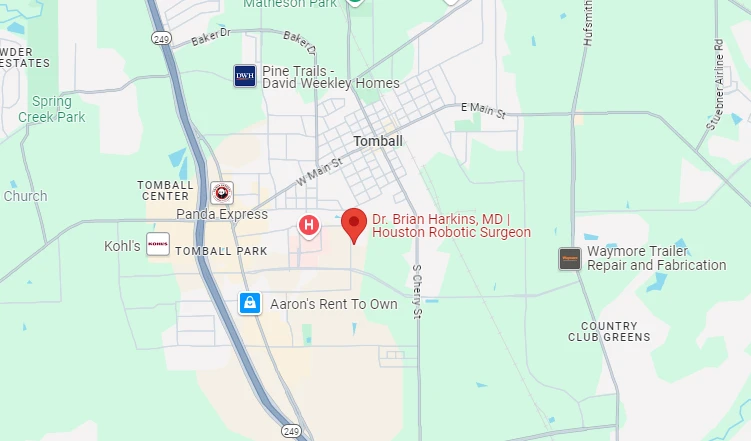
455 School St. Bldg. 1, Suite 10 Tomball, Texas 77375
Mon-Thu: 9:00 am – 5:00 pm | Fri: 9:00 am – 2:00 pm


Most robotic colon surgeries take 150 to 250 minutes (2.5-4 hours), though right-sided procedures average around 238 minutes, left-sided around 250 minutes, and rectal cancer total mesorectal excision can extend to 270-325 minutes. Robotic approaches typically run about 40 minutes longer than laparoscopic but cut conversion rates to open surgery roughly in half and shorten hospital stays to 1-2 days.
If you are facing robotic colon surgery in Tomball, Texas, one of your first questions is probably how long you will actually be in the operating room. Most robotic colorectal procedures take between 150 to 250 minutes, depending on the complexity of your case and which part of the colon is being treated.
While that is roughly 40 minutes longer than traditional laparoscopic surgery, the robotic approach often means less pain, a shorter hospital stay, and faster recovery. Understanding what affects your surgery time helps you set realistic expectations and feel more prepared. Dr. Brian Harkins runs a Tomball-based robotic surgical practice performing high volumes of minimally invasive colorectal procedures at HCA Houston Healthcare Tomball.
When discussing how long robotic colon surgery takes, several distinct time measurements are involved:
Setup and docking typically adds 15-30 minutes to the overall procedure. Within the broader operating room time, anesthetic administration and patient positioning account for additional minutes that are not part of the procedure itself but contribute to total OR utilization.
Robotic right hemicolectomy procedures typically take 130-250 minutes (approximately 2 to 4 hours). In comparative studies, robotic approaches required about 238.5 minutes compared to 183.5 minutes for laparoscopic right hemicolectomy, representing approximately 55 additional minutes. Right-sided procedures are generally the shortest colon surgeries because the anatomy is more accessible and blood vessel connections are more straightforward.
Left hemicolectomy and left-sided procedures take approximately 249.6 minutes for robotic approaches versus 211.7 minutes for laparoscopic. These procedures are generally more technically demanding than right-sided resections, often requiring more extensive mobilization, more challenging vascular control, and more complex reconstruction of the intestinal connection.
Robotic total mesorectal excision (TME) for rectal cancer typically requires 270 to 325 minutes (approximately 4.5 to 5.5 hours). The extended duration reflects the technical demands of working in the confined space of the pelvis. These procedures require precise dissection to achieve adequate margins while preserving nearby nerves that control bowel, bladder, and sexual function.
Table 1: Robotic vs. Laparoscopic Operative Time by Procedure
| Procedure | Robotic (mean) | Laparoscopic (mean) | Difference |
| Right hemicolectomy | 238.5 min | 183.5 min | +55 min |
| Left hemicolectomy | 249.6 min | 211.7 min | +38 min |
| Robotic TME (rectal cancer) | 270-325 min | 230-280 min | +40-45 min |
| Sigmoid colectomy | 220-260 min | 180-220 min | +40 min |
A comprehensive analysis of 17 studies representing 4,342 patients found that robotic colorectal procedures required a mean of 38.8 minutes longer than laparoscopic approaches. This approximately 40-minute differential represents a consistent pattern across multiple research studies.
Open colorectal surgery typically requires 60-120 minutes for straightforward procedures but substantially longer for complex cases. The ASCRS Clinical Practice Guideline for Colon Cancer recommends a minimally invasive approach to elective colectomy when expertise is available, supported by high-quality evidence.
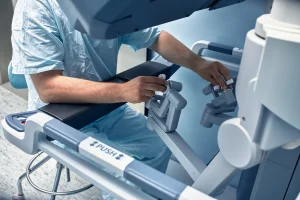
The additional time for robotic surgery reflects the setup and docking process, but the platform also delivers enhanced visualization and articulated instrumentation that can benefit patient outcomes.
Surgeon experience significantly impacts operative time:
This underscores the importance of choosing a surgeon with substantial robotic experience and high annual volume.
Several patient characteristics can extend operative time:
Analysis revealed median setup time of 22 minutes and median docking time of 10 minutes in typical settings. With dedicated teams and refined protocols, setup time has been reduced to as little as 5 minutes for draping and 7 minutes for docking in optimized institutional settings. Facilities performing high volumes of robotic procedures typically achieve faster setup through team coordination and standardized protocols.
Patients undergoing robotic-assisted colorectal surgery were significantly less likely to require conversion to open procedure compared to laparoscopic approaches: 11.27 percent versus 29.78 percent. This benefit was particularly pronounced in patients with obesity, where robotic conversion advantages roughly halved the open-conversion rate.
Conversion to open surgery during a minimally invasive procedure extends operative time, increases complications, and lengthens recovery. The lower conversion rate with robotic surgery often offsets the initial time investment.
Most patients leave the hospital within 1-2 days after robotic colon surgery, compared to:
Among patients aged 75 and older with colorectal cancer, robotic surgery was associated with lower rates of prolonged length of stay (17.1 percent versus 20.7 percent), making the platform particularly attractive for elderly patients where extended hospitalization carries higher risk.
Among elderly patients, robotic approaches were associated with:
These improved outcomes translate to lower overall healthcare costs despite the longer initial operative time.
Table 2: Robotic vs. Laparoscopic Outcome Comparison
| Outcome | Robotic | Laparoscopic |
| Conversion to open surgery | 11.27 percent | 29.78 percent |
| Surgical site infection (elderly) | 2.8 percent | 4.7 percent |
| Bleeding complications (elderly) | 9.2 percent | 16.8 percent |
| Prolonged length of stay (75+) | 17.1 percent | 20.7 percent |
| Typical hospital stay | 1-2 days | 3-5 days |
Tomball and the Houston metropolitan area possess substantial robotic surgical infrastructure. Local capability highlights:
Dr. Brian Harkins offers robotic colorectal surgery services and emphasizes that most patients leave the hospital in 1-2 days and return to desk work within 2-3 weeks. The concentration of experienced surgeons in Tomball means patients can access high-quality care without traveling to distant medical centers.
Most patients undergoing robotic colorectal surgery are discharged from the hospital within 1-2 days of surgery, substantially faster than open surgery recovery. This rapid discharge is possible because of smaller incisions, less tissue trauma, and reduced pain. Full recovery to normal activities typically requires 4-6 weeks, though this varies based on procedure type and individual health.
Table 3: Recovery Milestones After Robotic Colon Surgery
| Timeframe | Typical Activity Level |
| Week 1-2 | Light walking and basic self-care |
| Week 2-3 | Return to desk work and light household tasks |
| Week 4-6 | Gradual return to exercise and normal physical activities |
| Week 6+ | Full return to all activities including heavy lifting |
Your surgeon will provide personalized recovery guidelines based on your specific procedure and individual circumstances.
Before scheduling robotic colon surgery, evaluate your surgeon and facility on these factors:
If you are considering robotic colon surgery in Tomball, Dr. Brian Harkins offers experienced care and advanced technology that can make a real difference in your surgical outcome and recovery.
Call 281-351-5409 to request a consultation and take the first step toward a faster, smoother recovery.
Robotic colon surgery typically takes 150-250 minutes (2.5-4 hours), with right-sided procedures averaging 238 minutes, left-sided around 250 minutes, and rectal cancer TME 270-325 minutes.
Robotic procedures average about 40 minutes longer than laparoscopic due to setup and docking time. The trade-off is enhanced visualization, articulated instruments, and substantially lower conversion-to-open rates.
Most patients leave the hospital within 1-2 days after robotic colon surgery, compared to 3-5 days for laparoscopic and 5-7 days for open surgery. Same-day discharge is possible for some uncomplicated cases.
Most patients return to desk work within 2-3 weeks. Physical labor jobs typically require 4-6 weeks. Your surgeon will provide specific guidance based on your procedure and job demands.
Robotic colorectal surgery has a conversion rate of about 11 percent to open, compared to about 30 percent for laparoscopic. This difference is even more pronounced in obese patients.
Mean console time drops from about 270 minutes for the first 32 cases to 200 minutes after the learning curve. Choose a surgeon with substantial annual robotic colorectal volume.
Higher BMI, prior abdominal surgery with adhesions, larger or unfavorably positioned tumors, prior pelvic radiation, and multiple medical conditions can all extend operative time.
Yes. Among patients aged 75+, robotic surgery showed lower surgical site infection rates (2.8 vs. 4.7 percent) and lower prolonged length of stay rates (17.1 vs. 20.7 percent) compared to other approaches.
Median setup time is about 22 minutes and docking about 10 minutes. Optimized teams can reduce this to 5 minutes for draping and 7 minutes for docking through standardized protocols.
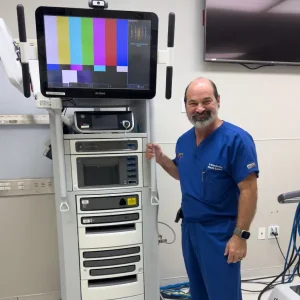
Yes. Dr. Brian Harkins offers robotic colorectal surgery at HCA Houston Healthcare Tomball, a Center of Excellence in Robotic Surgery, using the Da Vinci Xi platform.
Discuss your robotic colon surgery options.
Plan your path to a faster recovery.


Dr. Brian Harkins is a renowned surgeon specializing in advanced, minimally invasive, and robotic surgical techniques. With a dedication to innovation and personalized patient care, he has transformed countless lives by delivering exceptional outcomes.
I want a website like this, where do i start?