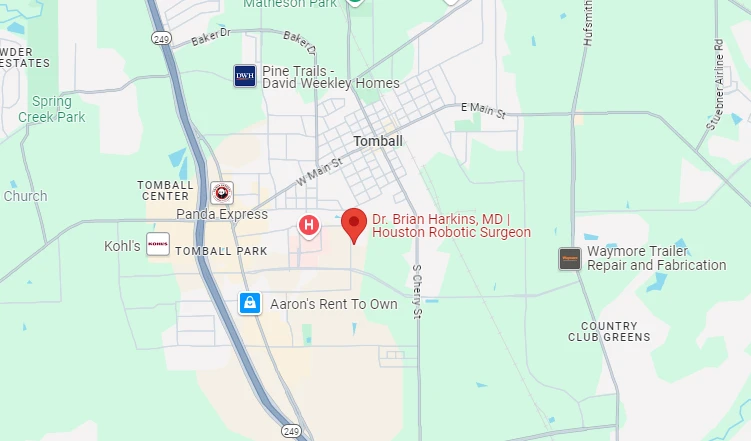
455 School St. Bldg. 1, Suite 10 Tomball, Texas 77375
Mon-Thu: 9:00 am – 5:00 pm | Fri: 9:00 am – 2:00 pm


No. Most robotic-assisted surgery is performed under general anesthesia, meaning you will be completely unconscious and won't feel or remember anything during the procedure. Complete immobilization is required for patient safety, and your anesthesia team monitors you closely from the moment you're sedated until you wake up in recovery.
If you're scheduled for robotic surgery in Tomball, TX, you're probably wondering whether you'll be awake during the procedure. Many patients worry about whether they might wake up mid-procedure, why full anesthesia is necessary, or how it differs from traditional surgery. This article walks you through exactly what to expect regarding anesthesia during robotic surgery, why staying unconscious keeps you safe, and what happens before and after the procedure.
If you're scheduled for robotic surgery in Tomball, TX, you will almost certainly be completely asleep during the procedure. Most robotic surgeries use general anesthesia, which renders patients fully unconscious and pain-free throughout the operation.
The anesthesiologist administers intravenous medications that induce sleep before you lose consciousness. Once anesthesia takes effect, you typically have no awareness of anything occurring during surgery. After induction, an endotracheal tube is placed through the mouth and into the windpipe to facilitate mechanical ventilation.
Robotic-assisted surgery requires patients to remain completely still for critical safety reasons. Unlike conventional laparoscopy, where the surgeon controls all instruments simultaneously, robotic surgery involves the surgeon controlling two robotic arms at any given time while others are held in fixed position.
Any uncontrolled patient movement represents a potentially life-threatening complication that could result in inadvertent organ puncture, vascular injury, or uncontrolled hemorrhage. This is why deep neuromuscular blockade is provided and carefully monitored throughout the entire procedure.
Your body experiences significant physiological changes during robotic surgery that make general anesthesia essential. The combination of carbon dioxide insufflation and steep positioning creates effects that your anesthesia team must manage continuously.
During abdominal insufflation, carbon dioxide is pumped into the peritoneal cavity to create working space for the surgical instruments. This causes upward displacement of the diaphragm and abdominal contents, leading to:
These changes are manageable under general anesthesia with mechanical ventilation but would be dangerous in a conscious or lightly sedated patient.
The steep Trendelenburg position (typically 25 to 40 degrees head-down) compounds these respiratory challenges while simultaneously affecting cerebral and ocular hemodynamics. Head-down positioning impedes venous return, increases intracranial pressure, and dramatically elevates intraocular pressure. General anesthesia is the only approach that allows safe management of these compounding effects over the full duration of surgery.
While general anesthesia remains the standard for most robotic procedures, some alternatives exist for specific cases.
Selected robotic procedures can be performed with neuraxial anesthesia, which includes epidural or spinal anesthesia, achieving a sensory block up to the T4 to T6 level. This approach is limited to procedures that don't require steep positioning or prolonged CO2 insufflation.
For certain less invasive robotic procedures, conscious sedation may be used as an alternative to general anesthesia. With conscious sedation, patients are relaxed and comfortable but can respond to verbal commands. This approach is far less common than general anesthesia in robotic surgery.
| Approach | Consciousness Level | Common Use Case |
| General anesthesia | Fully unconscious | Standard for most robotic procedures |
| Neuraxial (spinal/epidural) | Conscious, lower body numb | Selected procedures without steep positioning |
| Conscious sedation | Relaxed, responsive | Limited minimally invasive procedures |
Many patients worry about waking up during surgery. Anesthesia awareness is extraordinarily rare, occurring in only 1 or 2 of every 1,000 general anesthesia procedures. Patients who do experience awareness may have brief, vague recollections but typically do not feel pain due to the analgesic components of anesthesia.
Brain function monitors such as BIS (bispectral index) monitoring can reduce awareness occurrence. One randomized controlled trial of 2,500 high-risk patients found that explicit recall occurred in only 0.17% of patients when BIS monitors were used, compared to 0.91% without BIS monitoring. Your anesthesia team takes multiple precautions to prevent this rare occurrence.
Certain patient groups carry a slightly higher baseline risk of anesthesia awareness. Understanding where you fall helps your team prepare the right monitoring strategy.
| Risk Factor | Relative Risk Level | Mitigation |
| Prior awareness history | Higher | BIS monitoring, adjusted dosing |
| Cardiac surgery patients | Higher | Continuous EEG-based monitoring |
| Difficult airway | Moderate | Pre-oxygenation, backup airway plan |
| Obesity | Moderate | Weight-adjusted dosing protocols |
| Standard healthy adult | Baseline (0.1–0.2%) | Routine monitoring protocols |
Understanding the timeline of surgery day helps ease anxiety. Below is what typically happens from arrival through recovery.
On surgery day, patients arrive at the surgical center in comfortable clothing and change into a surgical gown. The anesthesia team establishes intravenous access and may administer anxiety-reducing medications through the IV. When you're ready, IV medication is administered for relaxation, causing drowsiness and amnesia before you fully lose consciousness.
Once unconscious, the anesthesia team places an endotracheal tube through the mouth and into the windpipe and administers neuromuscular blocking agents. Compression devices resembling large blood pressure cuffs are placed on the legs to prevent blood clots. Throughout the procedure, you remain completely asleep with no awareness or sensation.
Once the procedure is complete, the anesthesia team reverses the neuromuscular blockade and allows you to gradually wake up. You're transferred to the post-anesthesia care unit (PACU), where nurses continue close monitoring.
| Phase | What Happens | Typical Timeframe |
| Pre-op | IV access, medications, consent review | 30 to 60 minutes before surgery |
| Induction | Anesthesia administered, intubation | 5 to 10 minutes |
| Procedure | Fully unconscious, monitored throughout | Varies by procedure |
| PACU | Gradual waking, monitoring, pain management | 1 to 2 hours |
| Discharge | Walking, eating, discharge instructions | Same day or within 24 hours |
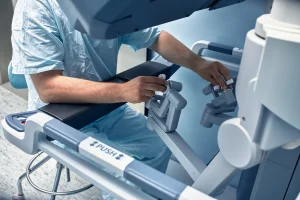
Robotic surgery is robot-assisted, not autonomous. The surgeon maintains complete control of the da Vinci surgical system at all times. The surgeon sits at a console several feet from the patient and directs every robotic arm movement using hand controls. Every movement is deliberate and surgeon-directed. The robot does not initiate any action on its own.
Some patients mistakenly believe they need to be awake to help guide the surgeon during the procedure. In reality, general anesthesia prevents patient feedback entirely. The surgical team anticipates and manages all decisions based on visual imaging and monitoring devices rather than patient communication. This is why surgeon expertise and the advanced imaging capabilities of the robotic system are so critical.
Some patients assume that because robotic procedures involve more physiological changes, the anesthesia risk is higher than with open surgery. In practice, robotic surgery patients experience shorter hospital stays, less blood loss, and lower infection rates, all of which reduce overall perioperative risk. The physiological challenges of CO2 insufflation and Trendelenburg positioning are well-understood and routinely managed by experienced anesthesia teams.
If you're considering robotic surgery in Tomball, you have access to high-quality accredited care. HCA Houston Healthcare Tomball has earned accreditation as a Center of Excellence in Robotic Surgery from the Surgical Review Center (SRC), initially in 2021 and maintained through rigorous ongoing compliance.
This accreditation indicates the facility meets nationally and internationally recognized standards for robotic surgery. The assessment focuses on:
Accreditation is not a one-time award. Facilities must demonstrate ongoing compliance through periodic review, which means the standards are actively maintained rather than met once and forgotten. When choosing where to have your procedure, SRC accreditation is one of the most objective quality benchmarks available to patients.
The Tomball area has access to robotic surgical services across multiple specialties including urology, gynecology, general surgery, and thoracic surgery, meaning you can receive minimally invasive care for a wide range of conditions close to home.
No. General anesthesia renders you completely unconscious. You will not feel pain, pressure, or any sensation during the procedure. The analgesic components of anesthesia also prevent pain awareness even in the rare event of partial awareness.
Most patients begin waking up within minutes of the anesthesia being reversed at the end of surgery. Full alertness typically returns within 30 to 60 minutes in the recovery unit. Grogginess can persist for several hours.
General anesthesia is very safe for most healthy adults. Serious complications are rare. Your anesthesia team reviews your full medical history, current medications, and any prior anesthesia reactions to create a plan that minimizes your individual risk.
Disclose your complete medical history, including any prior anesthesia complications, sleep apnea, acid reflux or GERD, current medications (including supplements), and any history of nausea after anesthesia. This information directly shapes your anesthesia plan and recovery.
In some cases, alternatives like spinal or epidural anesthesia may be appropriate depending on your procedure. However, most robotic surgeries require general anesthesia due to positioning and CO2 insufflation requirements. Discuss your concerns with your surgeon and anesthesiologist before the procedure.
Fasting reduces the risk of aspiration, which occurs when stomach contents enter the lungs during anesthesia induction or emergence. Aspiration can cause serious lung injury. Your care team will provide specific fasting instructions based on your procedure and health status. Following them precisely is essential for your safety. Most protocols require no solid food for 6 to 8 hours and no clear liquids for 2 hours before surgery.
Most patients have no memory of the operating room once anesthesia is induced. Some patients recall brief moments of the pre-op area before losing consciousness. Memory of anything after induction is extremely rare and occurs in only 1 to 2 cases per 1,000 procedures.
Your anesthesia team uses a multimodal approach that may include IV pain medications, nerve blocks, anti-inflammatory drugs, and oral medications during recovery. The goal is to manage pain effectively while minimizing opioid use. Most robotic surgery patients report significantly less postoperative pain than open surgery patients due to smaller incisions and reduced tissue trauma. Your care team will provide a tailored pain management plan before discharge.
Trendelenburg positioning tilts the operating table so your head is lower than your feet, typically at 25 to 40 degrees. This shifts abdominal organs away from the surgical site and improves the surgeon's view. It is commonly used in pelvic and abdominal robotic procedures.
Many patients are able to eat within hours of surgery, depending on the procedure. Your care team will advise you on when to start liquids and solids based on your specific surgery and recovery progress.
Your anesthesia team monitors multiple parameters continuously during the procedure, including heart rate, blood pressure, oxygen saturation, end-tidal CO2, body temperature, and depth of anesthesia via BIS monitoring. Neuromuscular blockade is also measured to ensure adequate muscle relaxation and safe reversal at the end of surgery.
Robotic surgery is performed under general anesthesia, and you will be completely unconscious from induction through the entire procedure. The need for full anesthesia isn't a precaution taken lightly. It's a clinical requirement driven by the physiological demands of CO2 insufflation, Trendelenburg positioning, and the precision required for safe robotic instrument control.
Anesthesia awareness is extremely rare. Your surgical team monitors brain activity, neuromuscular blockade, and vital signs continuously to keep you safe throughout the procedure. The combination of BIS monitoring, carefully calibrated dosing, and experienced anesthesia providers makes awareness an uncommon and well-managed risk. Recovery is typically fast, with most patients walking and eating within hours of waking up.
If you have questions about anesthesia, what to expect during your procedure, or whether robotic surgery is right for your condition, Dr. Brian Harkins is available to walk you through every detail. Call 281-247-0503 or visit the contact page to schedule a consultation in Tomball, TX.
Schedule your robotic surgery consultation in Tomball today.
Contact Dr. Harkins to discuss anesthesia, your procedure, and recovery.


Dr. Brian Harkins is a renowned surgeon specializing in advanced, minimally invasive, and robotic surgical techniques. With a dedication to innovation and personalized patient care, he has transformed countless lives by delivering exceptional outcomes.
I want a website like this, where do i start?