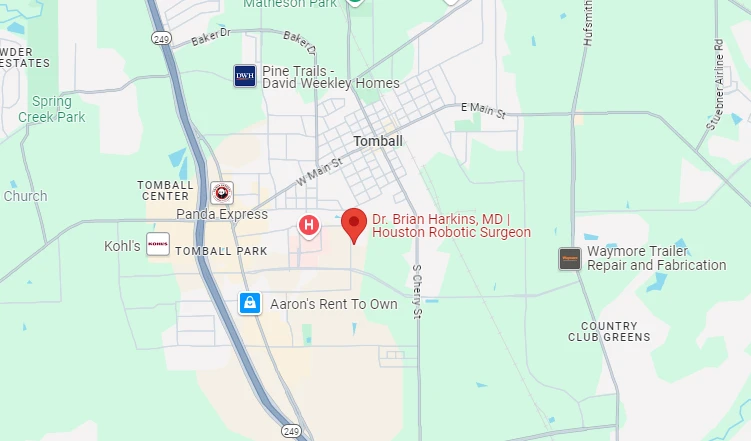
455 School St. Bldg. 1, Suite 10 Tomball, Texas 77375
Mon-Thu: 9:00 am – 5:00 pm | Fri: 9:00 am – 2:00 pm


Occasional coughing will not damage a properly performed hernia repair, because modern mesh is designed to tolerate normal spikes in abdominal pressure. The real risk comes from chronic or violent coughing during the first 4 to 6 weeks, when repeated force can pull sutures through the fascia and increase recurrence risk.
If you've recently had hernia repair or are preparing for surgery, you've probably wondered whether a sudden cough could tear your mesh or undo the repair entirely. This concern is especially common among patients recovering in Tomball, TX, where seasonal allergies and respiratory infections can trigger persistent coughing.
The good news is that modern hernia mesh is designed to withstand normal spikes in abdominal pressure, but understanding when coughing becomes risky, and how to protect your repair during the critical early healing phase, can give you confidence and peace of mind. In this article, you'll learn how coughing affects hernia mesh, what warning signs to watch for, and practical steps to support a smooth recovery.
Hernia surgery aims to push the herniated tissue back into the abdominal cavity and repair the weakened muscle or fascial layer. National health resources such as MedlinePlus note that treatment for a hernia is usually surgery to repair the opening in the muscle wall.
Modern hernia mesh is typically made from synthetic polymers such as polypropylene or polyester, though other materials including expanded polytetrafluoroethylene (ePTFE), biosynthetic absorbable polymers, and biologic collagen-based scaffolds are also available.
By placing mesh across a wide area of the abdominal wall, tension is distributed over a larger surface rather than concentrated along a suture line. This approach reduces hernia recurrence by up to 50 percent compared with primary suture repair, making mesh-based repairs the preferred option for most patients. Understanding that distribution of force is what makes the rest of this article make sense, because it explains why a cough that would strain a single suture line is absorbed across the whole mesh instead.
Hernia repairs can be performed through open, laparoscopic, and robotic-assisted approaches. Each technique has its advantages depending on the type of hernia and patient factors.
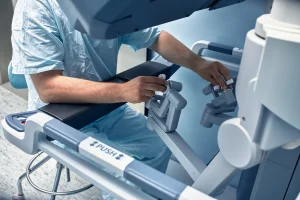
Laparoscopic repair uses several small incisions and often results in less postoperative pain, shorter hospital stays, and quicker return to normal activities compared with traditional open surgery. Robotic approaches build on that foundation with enhanced visualization and instrument control, which can be an advantage in more complex repairs. Your surgeon will recommend the best approach based on your specific situation and the hernia conditions being addressed.
When you cough, your diaphragm and abdominal muscles contract forcefully against a closed airway, sharply increasing pressure inside your abdomen. This pressure spike is why coughing feels uncomfortable after abdominal surgery, and why the discomfort is felt at the repair site specifically rather than spread across the abdomen.
Chronic coughing is explicitly listed among contributing causes of ventral hernias by major medical centers, alongside obesity, previous surgery, pregnancy, and chronic constipation. The repeated pressure spikes can weaken the abdominal wall over time, which is why cough is treated as a risk factor rather than a nuisance. A single cough produces a brief, high spike in pressure, and the concern is never that one spike but the cumulative effect of thousands of them across weeks of an untreated respiratory condition.
In the immediate postoperative period, the mechanical stability of your hernia repair depends primarily on the strength of sutures, tacks, or other fixation devices anchoring the mesh to the fascia. Greater forces on sutures, such as those imposed by chronic coughing or heavy lifting soon after surgery, can cause sutures to cut through the abdominal wall like a cheese cutter, leading to separation of the repair.
As healing progresses, your body lays down new connective tissue within and around the mesh, progressively incorporating it into the abdominal wall. Initial healing after mesh repair occurs over approximately 4 to 6 weeks, but full internal healing and mesh integration may continue for several months. The practical implication is that your repair gets steadily stronger over time, so a cough in week five carries far less risk than the same cough in week one.
Hernia specialists acknowledge that coughing after surgery can be painful and places strain on incisions, but emphasize that a properly performed hernia repair is constructed to tolerate normal coughing. This is an important distinction that helps ease patient anxiety, because pain and structural damage are not the same thing and a cough that hurts is not evidence that anything has come apart.
Patients are usually advised that occasional coughing or sneezing is expected and will not undo the repair, while being cautioned to support the incision with a pillow and manage any underlying conditions that cause persistent cough. The key word here is occasional, since a few coughs or sneezes won't compromise your repair. Surgeons anticipate that patients will cough during recovery and construct the repair with that expectation built in, which is why an isolated cough is not the failure point patients often imagine it to be.
The early postoperative period, typically the first several weeks after surgery, is the time of greatest vulnerability, since the mesh has not yet been anchored by the body's own tissue. Chronic or violent coughing represents a different risk profile, especially in large ventral or incisional hernia repairs.
Repeated high-force coughing could lead to suture pull-through, partial separation of the repair, or enlargement of early seroma or hematoma, thereby increasing recurrence risk. Larger repairs are more exposed to this because the mesh spans a wider defect and the fixation points bear proportionally more load. The table below summarizes how the risk profile shifts.
| Coughing Pattern | Timing | Risk Level |
| Occasional cough or sneeze | Any time | Expected; will not undo a proper repair |
| Chronic or violent coughing | First 4 to 6 weeks | Elevated; suture pull-through and separation possible |
| Normal coughing | After full integration | Low; repair is robust under everyday stresses |
Educational materials from academic hospitals recommend holding a pillow firmly against the incision when coughing or sneezing to support the wound and reduce both pain and stress on the repair. This simple technique, called splinting, can make a significant difference in your comfort and takes no equipment beyond what is already on your bed. Keep a small pillow within reach during the day as well, since coughs and sneezes rarely arrive with warning and the technique only helps if the pillow is already in hand.
Most patients follow a gradual return to activity that protects the repair during early healing:
| Stage | Activity Guidance |
| Days 1 to 4 | Acute rest phase with frequent light walking and incision icing |
| Days 4 to 7 | Return to desk work and light activities; avoid lifting more than 10 to 20 pounds |
| Week 2 | Light aerobic exercise such as gentle walking or stationary cycling; lifting limit around 20 pounds |
| Week 3 | Swimming, light jogging, and light weight training |
| Week 4 and beyond | Return to full activity including heavy lifting and sports, assuming pain is minimal and healing is satisfactory |
Other practices adopt more conservative timelines, recommending that patients avoid lifting more than 10 pounds for up to six weeks. Your surgeon will provide specific guidance based on the complexity of your repair, and where two sets of instructions differ, the one from the surgeon who performed your operation is the one to follow.
Those with COPD, chronic bronchitis, poorly controlled asthma, or heavy smoking history may experience frequent coughing, putting them at increased risk for hernia formation and recurrence. If you have a chronic cough, addressing it before surgery is crucial rather than optional, because the same force that contributed to the original hernia will act on the repair afterward.
Optimization of pulmonary status before surgery is recommended to reduce postoperative pulmonary complications, and may include:
Talk to your surgeon about any respiratory conditions well before your scheduled procedure, since some of these steps take weeks to produce their benefit. Smoking cessation in particular pays off across the entire operation, improving tissue perfusion and wound healing as well as reducing the cough itself.
Knowing what to watch for after surgery helps you catch potential problems early. Contact your surgeon if you experience:
These symptoms don't necessarily mean your mesh is damaged, but they do warrant prompt medical evaluation rather than watchful waiting at home. Several of these signs have benign explanations, and distinguishing a normal postoperative seroma from an early recurrence is not something to attempt on your own.
Mesh repairs commonly last 10 to 15 years or longer, with some series reporting failure rates below 5 percent over 10 years when modern mesh and technique are used. These outcomes represent a significant improvement over older repair methods.
Once fully integrated, mesh repairs are generally robust under normal life stresses including coughing, lifting, and physical activity. After complete healing, most patients can return to all their previous activities without worrying that everyday coughing will damage their repair. That is the reassuring end state, and the restrictions of the early weeks exist specifically to get you there intact.
The bottom line is that while chronic, violent coughing during the early healing phase can stress your repair, occasional coughing is expected and won't damage a properly performed hernia surgery. Focus on managing any chronic respiratory conditions, follow your surgeon's recovery guidelines, and use pillow splinting when you do need to cough. Those three habits cover nearly all of the risk that is actually within your control.
Occasional coughing will not damage a properly performed repair, since modern mesh is built to tolerate normal abdominal pressure spikes. Chronic or violent coughing during the first 4 to 6 weeks is the genuine risk.
In the first weeks, repair stability depends on sutures and tacks holding mesh to the fascia. Excessive force can cause sutures to cut through the abdominal wall, leading to separation before tissue integration occurs.
Initial healing occurs over approximately 4 to 6 weeks as your body lays down connective tissue around the mesh. Full internal healing and complete mesh integration may continue for several months afterward.
Splinting means holding a pillow firmly against your incision when you cough or sneeze. It supports the wound, reduces pain, and lessens the stress transferred to the repair during a pressure spike.
No. Never suppress necessary coughing to the point of compromising lung function. The safer approach is splinting with a pillow and treating any underlying condition causing the cough.
Chronic coughing is listed among contributing causes of ventral hernias, alongside obesity, previous surgery, pregnancy, and chronic constipation. Repeated pressure spikes can weaken the abdominal wall over time.
Optimizing pulmonary status before surgery may include smoking cessation, bronchodilator therapy, treatment of respiratory infections, or pulmonary rehabilitation. Raise it with your surgeon well ahead of your procedure.
Placing mesh across a wide area distributes tension rather than concentrating it along a suture line, reducing hernia recurrence by up to 50 percent compared with primary suture repair.
Mesh repairs commonly last 10 to 15 years or longer, with some series reporting failure rates below 5 percent over 10 years when modern mesh and technique are used.
Watch for a new or returning bulge near the repair site, worsening pain with activity, fever over about 100.4°F, redness or drainage from the incision, or no bowel movement for more than three days.
The short answer is reassuring: a properly performed mesh repair is built to handle the pressure spike of a cough, and the occasional cough or sneeze during recovery will not undo your surgery. What deserves attention is the pattern rather than the single event, since chronic or violent coughing in the first 4 to 6 weeks applies repeated force to sutures that have not yet been reinforced by tissue integration.
That makes the practical advice simple. Splint the incision with a pillow when you cough, treat any underlying respiratory condition before and after surgery, and respect the activity restrictions through the early healing window. Once the mesh is fully integrated, it holds up to normal life, coughing included.
Protect your repair through the critical healing window.
Schedule a consultation with a Tomball hernia specialist today.


Dr. Brian Harkins is a renowned surgeon specializing in advanced, minimally invasive, and robotic surgical techniques. With a dedication to innovation and personalized patient care, he has transformed countless lives by delivering exceptional outcomes.
I want a website like this, where do i start?