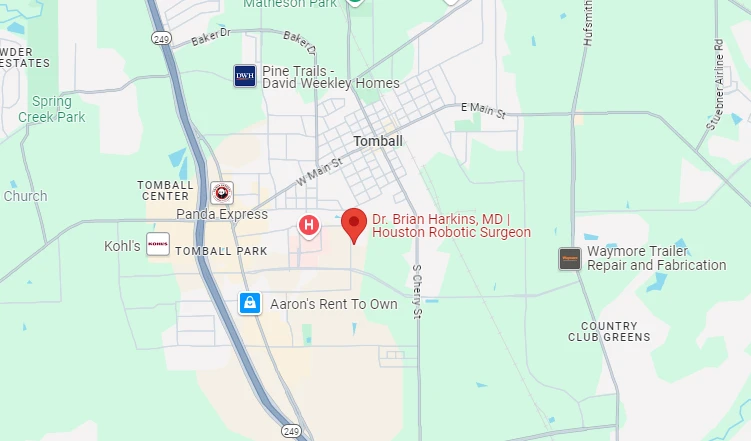
455 School St. Bldg. 1, Suite 10 Tomball, Texas 77375
Mon-Thu: 9:00 am – 5:00 pm | Fri: 9:00 am – 2:00 pm


Recurrent hernias occur in approximately 5 to 15 percent of patients within 5 years of hernia repair, with higher rates for larger or more complex hernias. Robotic re-repair allows access to fresh tissue planes (particularly after a prior open repair) and offers smaller incisions, lower surgical site infection rates, and faster recovery than open re-repair. Strategy depends on the prior operation: a hernia that recurred after open repair often does well with robotic re-repair; a hernia that recurred after prior minimally invasive repair may need open re-repair to address the existing mesh. Surgeon experience with recurrent hernias is the strongest predictor of a durable result.
A recurrent hernia is one of the most discouraging surgical outcomes for any patient: the repair was supposed to be durable, and now there is a bulge in the same area, sometimes with the same symptoms. Recurrence is uncommon at the per-operation level but adds up over time and across the patient population. Across all hernia types, approximately 5 to 15 percent of patients will have a recurrent hernia within 5 years of repair, depending on the hernia type, size, surgical technique, mesh choice, and individual risk factors.
The good news is that recurrent hernia surgery in 2026 is well understood, and the robotic platform has expanded what can be accomplished through small incisions for re-repair. The strategy depends meaningfully on the prior operation: a hernia that recurred after open repair often does very well with a minimally invasive re-repair using the da Vinci Xi system, because the surgeon enters fresh tissue planes rather than scarred ones. A hernia that recurred after prior laparoscopic or robotic repair is a more complex problem and the right approach is more individualized.
This guide walks through why hernias recur, how recurrence is diagnosed, how the right surgical approach is selected for re-repair, what to expect during recovery, and how to choose a surgeon for this specific situation. For patients in the Tomball area who have been through a prior failed repair and are considering Dr. Brian Harkins for re-repair, the goal is a clear, honest picture of what robotic recurrent hernia surgery means. Recurrent hernia repair sits within Dr. Harkins' broader robotic hernia surgery program, part of his larger robotic surgery practice at HCA Houston Healthcare Tomball.

Hernia recurrence is multifactorial. The reasons can be grouped into surgical-technique factors and patient-risk factors:
On the technical side, the most common drivers of recurrence are mesh-related: the mesh has slipped or migrated from its original position, leaving part of the prior defect uncovered; the mesh was placed with insufficient overlap (typically less than 3 to 5 cm) beyond the defect edges, leading to recurrence at the mesh edge; or the fixation (tacks, sutures, glue) failed to hold the mesh in position. Older mesh products were occasionally prone to material fracture or breakdown, though this is rare with modern mesh. A separate technical cause of failure is closing a large fascial defect under tension, which often leads to early breakdown of the repair.
Two other technical factors are particularly important. Tissue-only repair (no mesh) for hernias above approximately 2 cm has historically had high recurrence rates, and modern practice uses mesh for nearly all repairs of meaningful size. Surgical site infection at the prior operation is one of the strongest predictors of recurrence, because infection compromises healing and may require mesh removal. A missed second defect adjacent to the primary repair is another important cause: the original surgeon repaired the obvious hernia, but a smaller adjacent defect went unaddressed and gradually enlarged.
Patient factors carry as much weight as technique. Elevated BMI significantly increases recurrence risk for all hernia types and should be optimized before elective re-repair when feasible. Diabetes (particularly poorly controlled) impairs wound healing and meaningfully raises recurrence rates. Smoking is strongly associated with recurrence, and smoking cessation before elective re-repair improves outcomes substantially. Chronic steroid use or other immunosuppression similarly impairs healing.
Patient factors that increase intra-abdominal pressure also contribute: chronic cough (particularly with COPD or untreated obstructive sleep apnea), chronic constipation or straining, and significant weightlifting without proper technique all stress the repair over time. Connective tissue disorders are rare but real contributors. Age and tissue quality matter as well: older fascial tissue is generally weaker, though many older patients have entirely durable repairs.
A useful conversation at the consultation for recurrent hernia repair includes a discussion of which of these factors may have contributed to the prior failure, and what can be modified before re-repair.
Most recurrent hernias present with familiar symptoms: a bulge in the same area as the prior repair, often with mild dragging discomfort, sometimes with the same pain pattern that prompted the original surgery. Diagnosis typically begins with a physical examination that identifies a bulge becoming more prominent with standing, coughing, or straining; in ventral hernias, the surgeon can often palpate the fascial defect directly. Ultrasound is useful for inguinal hernia recurrence and for confirming a small ventral defect. CT scan is the most useful imaging study for recurrent ventral, incisional, and complex hernias, because it shows the location, size, and contents of the recurrent hernia, the position of the prior mesh, and any associated complications. MRI is occasionally used for recurrent hiatal hernia or for specific anatomic questions.
Imaging is particularly important for recurrent hernia repair planning, because the surgeon needs to know exactly what was done previously, what mesh was placed, where it sits now, and how the recurrent defect relates to the prior repair.
Recurrent hernia symptoms vary by hernia type but generally resemble the symptoms of the original hernia. The most common presenting sign is a bulge in the area of the prior surgery, sometimes smaller initially and often enlarging over time. Patients typically describe a pulling, dragging, or burning sensation, with discomfort on lifting, coughing, or prolonged standing. For groin hernias, discomfort that radiates into the scrotum or labia is common. For ventral and incisional hernias, intermittent obstruction symptoms such as nausea, bloating, or vomiting may appear if a loop of bowel becomes intermittently incarcerated. Recurrent hiatal hernia typically presents as a return of reflux symptoms despite a prior fundoplication.
Severe pain, redness, or systemic symptoms with a recurrent hernia bulge are emergencies and require immediate evaluation.
The right approach for re-repair depends heavily on what was done previously. The general decision framework:
A hernia that recurred after prior open repair is often well suited to minimally invasive re-repair (laparoscopic or robotic) because:
The robotic platform is particularly well suited to this scenario because the wristed instruments help with the precise dissection often required around prior surgical scars.
A hernia that recurred after prior minimally invasive repair is a more complex problem. The challenges:
In selected cases, recurrent hernia after minimally invasive repair can still be approached robotically with careful technique. In other cases, open re-repair is the right choice to allow direct access to the prior repair and a clean technical reset.
Recurrent inguinal hernias are particularly common after older Lichtenstein-style open repairs without mesh. Robotic transabdominal preperitoneal (rTAPP) repair is often ideal for these because:
Recurrent ventral and incisional hernias are often more complex than recurrent inguinal hernias. Strategy considerations:
Recurrent hiatal hernia after prior fundoplication is a particularly complex problem. Considerations:
Mesh decisions are central to recurrent hernia repair. The key questions:
A surgeon performing recurrent hernia repair should be able to discuss the mesh strategy clearly and justify the choices based on your specific prior repair and current anatomy.

Recovery from recurrent hernia repair is generally similar to primary repair but often modestly longer because the dissection is more involved:
Published outcomes for recurrent hernia repair in experienced hands:
These outcomes are population averages. Individual outcomes depend on the prior operation, the current hernia, patient risk factors, and importantly, surgeon experience with recurrent hernia repair.
Recurrent hernia repair is a different problem than primary hernia repair, and the surgeon you select should be evaluated specifically for this work. Ask about specific experience with recurrent hernias, not just general hernia experience: how many recurrent hernias do they repair per year? A surgeon performing recurrent repairs should be experienced in both robotic and open approaches, because the right strategy depends on the prior repair, and should be willing to review your prior operative report and imaging before making a final recommendation. The mesh strategy conversation matters more than in primary repair: what mesh will be used, where it will sit, and how it relates to your prior mesh. A surgeon willing to discuss modifiable risk factors honestly (BMI, smoking, diabetes control) and to optimize you medically before elective re-repair when needed is a surgeon thinking about durability rather than convenience. Ideally the operation happens at a high-volume hernia center with available pathology, imaging, and (if needed) plastic surgery or wound care backup.
For patients in Tomball, Magnolia, Cypress, Spring, and The Woodlands considering recurrent hernia repair, Dr. Harkins performs robotic and open recurrent hernia repair in high volume at HCA Houston Healthcare Tomball's Center of Excellence in Robotic Surgery.
Recurrent hernia surgery is a second (or subsequent) operation to repair a hernia that has come back at or near the site of a prior repair. It is more technically demanding than primary hernia surgery because the surgeon must account for prior surgical scarring, prior mesh placement, and the reasons the first repair failed. Re-repair strategy depends on whether the prior operation was open, laparoscopic, or robotic.
Yes. Even with mesh, hernia recurrence occurs in approximately 5 to 15 percent of patients at 5 years across hernia types. Recurrence is more common with larger hernias, recurrent hernias being repaired again, patients with elevated BMI, diabetes, smoking, chronic steroid use, and in any patient with a surgical site infection at the original operation. Mesh substantially reduces recurrence compared with tissue only repair, but does not eliminate it.
Multiple factors. Common causes include mesh slippage or migration, inadequate mesh overlap beyond the defect, mesh fixation failure, tension on the fascial closure, surgical site infection, a missed second defect adjacent to the primary repair, and patient risk factors (high BMI, diabetes, smoking, chronic cough or constipation, connective tissue weakness). A useful re-repair consultation includes a discussion of which factors may have contributed to the prior failure.
Through physical examination (a bulge in the area of the prior repair), ultrasound for inguinal or small ventral recurrences, and CT scan for ventral, incisional, or complex recurrences. CT imaging is particularly important for re-repair planning because it shows the prior mesh position, the new defect, and any associated complications.
Clinically, the two are essentially the same problem: a hernia at or adjacent to the site of a prior repair. Pathologically, a "recurrent" hernia recurs through the same defect that was originally repaired, while a "new" hernia at the same site develops in adjacent fascia at the edge of the prior repair. Surgical strategy is similar for both.
Yes, in many cases. Recurrent hernias after prior open repair are often particularly well suited to robotic re-repair because the surgeon enters fresh tissue planes rather than the scarred plane of the prior incision. Recurrent hernias after prior minimally invasive repair are more complex and may still be approached robotically in selected cases, though some require open re-repair.
Not necessarily a different type, but typically a different placement plane. Most surgeons leave the prior mesh in place (unless it is infected, migrated, or symptomatic) and add new mesh in a different anatomic plane (for example, retromuscular if the prior mesh was intraperitoneal). New mesh is typically placed with larger overlap (5 to 7 cm beyond the defect on all sides) than for primary repair.
Approximately 10 to 25 percent at 5 years, higher than primary repair recurrence rates of 5 to 15 percent. The recurrence rate after re-repair depends strongly on hernia type, size, prior approach, patient risk factors, and surgeon experience with recurrent hernia repair.
Recovery is generally similar to primary repair but modestly longer because of the more involved dissection. Inguinal re-repair often outpatient with return to desk work in 1 to 2 weeks. Ventral re-repair typically 1 to 3 nights in the hospital with return to desk work in 2 to 3 weeks. Full activity at 6 to 8 weeks for most patients. Some surgeons obtain follow up imaging at 6 to 12 months to confirm durability of the new repair.
Most carefully planned recurrent hernia repairs in experienced hands are durable. If a recurrent hernia recurs after re-repair, the strategy becomes even more individualized and often requires referral to a tertiary hernia center for specialized techniques. Modifiable risk factors (BMI, smoking, diabetes) should be addressed before any second re-repair to optimize outcomes.
A recurrent hernia is not the end of the road, and modern surgical techniques offer real solutions even for patients who have been through a prior failed repair. The right approach depends on the prior operation, the current anatomy, and the surgeon's experience specifically with recurrent hernia repair. The robotic platform has expanded what can be accomplished through small incisions for re-repair, particularly for hernias that recurred after a prior open operation.
If you have a recurrent hernia and would like to discuss robotic re-repair options, schedule a consultation with Dr. Brian Harkins at our Tomball office by calling 281-351-5409 or request an appointment online. We see patients from across the greater Houston area, with recurrent hernia repairs performed at HCA Houston Healthcare Tomball's Center of Excellence in Robotic Surgery. Bring your prior operative report and any imaging from the original surgery to the consultation; it makes the conversation about your specific case much more useful.
Sarah Chen is a healthcare communications specialist with 12+ years of experience in clinical environments. She writes about robotic and minimally invasive surgery for patients and families navigating surgical decisions. Her work is clinically reviewed by Dr. Brian Harkins, MD, FACS, ensuring medical accuracy and evidence-based information.
Based in: Tomball, TX | Serves: Greater Houston Area
This information is educational and is not a substitute for professional medical advice. Recurrent hernia repair is highly individualized. The right surgical approach depends on the prior operation, the prior mesh, the current hernia, comorbidities, modifiable risk factors, and patient preference. Dr. Brian Harkins will discuss whether robotic recurrent hernia repair is right for your specific situation in consultation, ideally with your prior operative report and imaging available for review. Statistics cited reflect published research on aggregate patient populations; individual outcomes vary. This content has been reviewed for medical accuracy by Dr. Brian Harkins, MD, FACS.

Dr. Brian Harkins is a renowned surgeon specializing in advanced, minimally invasive, and robotic surgical techniques. With a dedication to innovation and personalized patient care, he has transformed countless lives by delivering exceptional outcomes.
I want a website like this, where do i start?