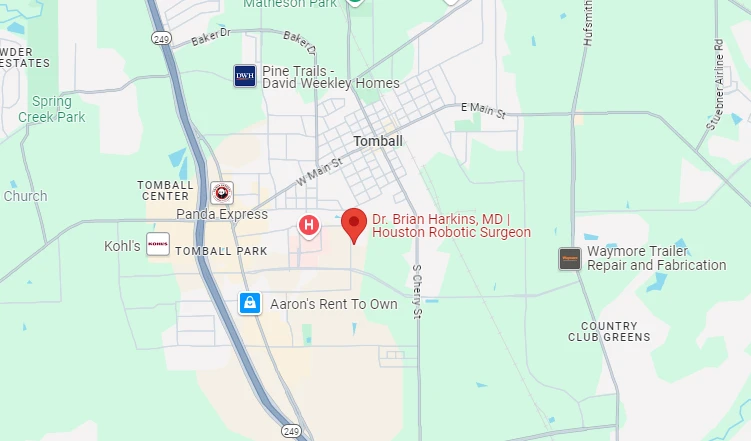
455 School St. Bldg. 1, Suite 10 Tomball, Texas 77375
Mon-Thu: 9:00 am – 5:00 pm | Fri: 9:00 am – 2:00 pm

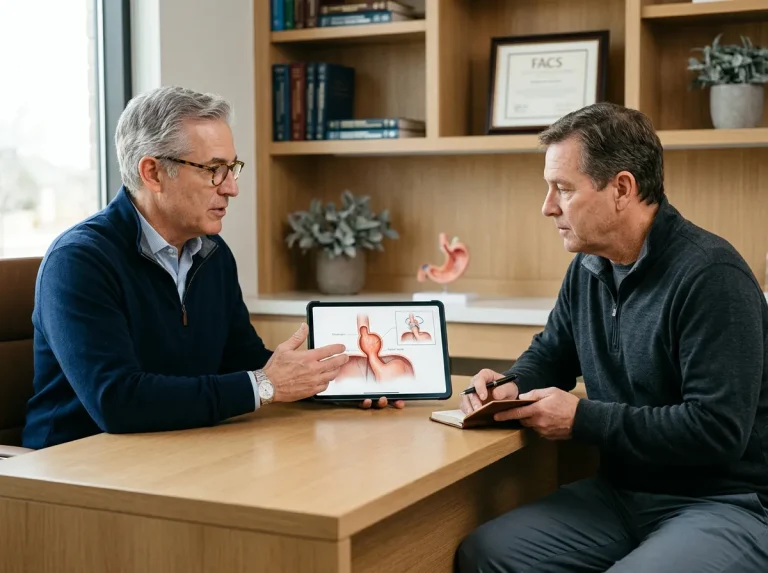
Robotic hiatal hernia repair with fundoplication is a minimally invasive operation that returns the stomach below the diaphragm, closes the widened hiatal opening, and restores the lower esophageal sphincter mechanism using a 360-degree Nissen or partial Toupet wrap. Most patients are discharged after one to two nights, return to a modified diet over 4 to 6 weeks, and reach full activity at 4 to 6 weeks. Published series show approximately 80 to 90 percent of patients achieve significant GERD symptom improvement and proton pump inhibitor (PPI) cessation at one year.
A hiatal hernia occurs when the upper stomach pushes up through the esophageal hiatus in the diaphragm into the chest. Small sliding hiatal hernias are common and often cause no symptoms. Larger hiatal hernias, paraesophageal hernias, and hiatal hernias associated with severe gastroesophageal reflux disease (GERD) can produce chronic heartburn, regurgitation, chest pain, difficulty swallowing, and over time, complications such as esophagitis, Barrett's esophagus, and esophageal strictures. When medical therapy is no longer adequate, when the hernia is large, or when GERD has progressed despite years of proton pump inhibitor (PPI) treatment, surgical repair becomes a real option.
Robotic hiatal hernia surgery, using the da Vinci Xi platform, has become the predominant approach for elective hiatal hernia repair in 2026. The magnified 3D vision and wristed instruments are particularly well suited to the confined retroesophageal space where the operation is performed. This guide walks through when hiatal hernia surgery is appropriate, what the procedure involves (including the fundoplication component), what to expect during recovery, and how published outcomes compare for Dr. Brian Harkins' patients in the Tomball area. The procedure sits within his broader robotic hernia surgery program at HCA Houston Healthcare Tomball, part of Dr. Harkins' larger robotic surgery practice.
The diaphragm separates the chest from the abdomen. The esophagus passes from the chest through a small opening in the diaphragm called the esophageal hiatus, joining the stomach just below it at the gastroesophageal junction. In normal anatomy, the lower esophageal sphincter sits at this junction and prevents stomach contents from refluxing back into the esophagus.
A hiatal hernia occurs when the esophageal hiatus widens and the upper portion of the stomach pushes through into the chest. There are four anatomic types:
When the hiatus is widened and the gastroesophageal junction is displaced, the natural anti-reflux barrier is disrupted. Stomach acid more easily flows back into the esophagus, causing the burning, regurgitation, and chest discomfort of GERD. Over years, this can damage the esophageal lining, lead to Barrett's esophagus, cause strictures that narrow the esophagus, and in rare cases progress to esophageal cancer.
Most patients with mild GERD and small sliding hiatal hernias are well managed with lifestyle measures (weight loss, smaller meals, avoiding trigger foods, not eating close to bedtime, head of bed elevation) and acid-suppressing medications, particularly proton pump inhibitors. Surgery becomes a real conversation when those measures stop working. The most common indication is severe GERD symptoms that persist despite maximal medical therapy with high-dose PPIs and lifestyle changes. Many patients also reach the surgery conversation because they have developed complications of long-standing reflux, including Barrett's esophagus, severe esophagitis, or peptic strictures, where definitive anti-reflux surgery may slow or prevent further progression.
A second category of patients comes to surgery because of the hernia itself rather than reflux alone. Large hiatal hernias (typically over 5 to 6 cm) often produce mechanical symptoms such as regurgitation of undigested food, chest pain, difficulty swallowing, or shortness of breath after meals. Symptomatic paraesophageal hernias (type II, III, or IV) deserve a particularly low threshold for repair because of the risk of gastric volvulus, a surgical emergency. Younger patients facing decades of PPI dependence, and patients concerned about the long-term implications of acid-suppressing medication (potential osteoporosis risk, kidney disease, and nutritional deficiencies), often prefer a definitive surgical solution over indefinite medical therapy.
The decision is individualized and typically follows objective testing: upper endoscopy, esophageal manometry, ambulatory pH testing, and often an upper GI series. These studies help confirm GERD, characterize the hiatal hernia, and select the appropriate surgical procedure.

Robotic hiatal hernia repair almost always includes a fundoplication, an anti-reflux procedure in which a portion of the upper stomach (the fundus) is wrapped around the lower esophagus to recreate the lower esophageal sphincter mechanism. The combination of hiatal repair plus fundoplication is what restores both the anatomic position and the anti-reflux function.
The general steps of robotic hiatal hernia repair:
Total operative time is typically 2 to 4 hours for elective robotic hiatal hernia repair, longer for paraesophageal hernias or reoperative cases.
The robotic platform offers specific technical advantages in hiatal hernia surgery that translate into clinical benefits. Magnified 3D vision in the confined mediastinal space (where laparoscopic 2D vision can be challenging) makes the critical dissection around the esophagus and vagus nerves more precise. Wristed instruments articulate around the esophagus and behind the diaphragm in ways straight laparoscopic instruments cannot, which matters most for crural repair and fundoplication construction. The platform's stability through prolonged dissection helps protect the vagus nerves and esophageal wall. At the patient outcome level, published series show lower conversion to open surgery rates with robotic surgery in obese patients and complex paraesophageal hernias, and lower rates of intraoperative esophageal injury in some series for complex repairs.
Open hiatal hernia surgery is rare in current practice and reserved for select complex cases. Most patients today choose between laparoscopic and robotic approaches, and at high volume centers performing both, outcomes are comparable for straightforward cases while robotic shows advantages for complex paraesophageal repairs.
Paraesophageal hernias (type II, III, IV) are typically larger and more complex than sliding hiatal hernias. They are particularly well suited to robotic repair because:
For symptomatic paraesophageal hernias, robotic repair has become the standard at many high volume hernia centers.
Surgery is not the only option for GERD or hiatal hernia, and several non-surgical or less invasive alternatives are reasonable for selected patients. Continued PPI therapy remains appropriate for patients whose symptoms are well controlled and who tolerate medication well, though long-term PPI use has been associated with bone density loss, kidney effects, and potential B12 and magnesium deficiencies that should be discussed when planning indefinite use. LINX (magnetic sphincter augmentation) places a ring of titanium beads with magnetic cores around the lower esophagus during a minimally invasive procedure; it works best for small or absent hiatal hernias and is not appropriate for large hiatal hernias requiring formal repair. TIF (transoral incisionless fundoplication) is an endoscopic anti-reflux procedure performed through the mouth without abdominal incisions, reasonable for selected patients with small or no hiatal hernia but generally not appropriate for moderate or large hiatal hernias. The Stretta procedure, an endoscopic radiofrequency treatment of the lower esophageal sphincter, has limited modern adoption and variable reported effectiveness.
For patients with moderate to large hiatal hernias and severe GERD, robotic hiatal hernia repair with fundoplication remains the most reliable definitive treatment. LINX and TIF are best for selected patients with smaller or absent hiatal hernias.

Recovery from robotic hiatal hernia surgery is meaningfully different from inguinal or umbilical hernia repair because of the diet progression required while the fundoplication settles.
The diet progression is the most distinctive part of hiatal hernia recovery. Patients should plan for this and stock soft, pureed-friendly foods before surgery.
Published outcomes for robotic hiatal hernia repair with fundoplication in experienced hands are excellent:
Individual outcomes depend on hiatal hernia type and size, GERD severity, esophageal motility, BMI, surgeon volume, and patient adherence to post-operative recommendations.
Most adult patients with symptomatic hiatal hernia and GERD who are healthy enough for general anesthesia are candidates. Specific considerations:
Patients who may not be candidates include those with severe pulmonary or cardiac disease that contraindicates pneumoperitoneum, severe esophageal motility disorders (achalasia, severe scleroderma), or specific anatomic limitations from prior thoracic or upper abdominal surgery. Decision is individualized at consultation.
Robotic hiatal hernia repair is generally safe in experienced hands but carries specific risks worth discussing at consultation. Esophageal or stomach injury during dissection is rare. Vagus nerve injury can affect gastric emptying. Wrap-related dysphagia (difficulty swallowing) is common in the early weeks and usually improves over months. Gas bloat syndrome (difficulty belching with post-operative bloating) typically improves with time. Recurrence of the hernia or GERD over the long term, wrap herniation back into the chest, bleeding, surgical site infection, and the general risks of anesthesia all warrant honest discussion. Conversion from robotic to open surgery is possible but uncommon in experienced hands.
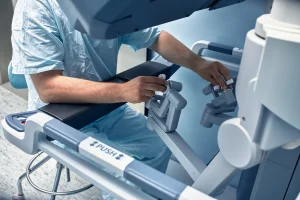
Robotic hiatal hernia surgery is a minimally invasive operation that returns the stomach below the diaphragm, closes the widened hiatal opening with sutures, and wraps the upper stomach around the lower esophagus to restore the anti-reflux barrier (fundoplication). It is performed through 4 to 5 small port incisions using the da Vinci Xi platform, with the surgeon controlling every instrument movement from a console.
Surgery is considered when severe GERD symptoms persist despite maximal medical therapy, when complications of GERD develop (Barrett's esophagus, esophagitis, peptic stricture), when a large paraesophageal hernia is symptomatic, when patients prefer a definitive surgical solution over indefinite PPI use, or in selected emergency cases (gastric volvulus). Decision-making typically requires upper endoscopy, esophageal manometry, and ambulatory pH testing.
For straightforward small sliding hiatal hernia repairs, robotic and laparoscopic produce comparable outcomes in published series. For larger paraesophageal hernias and complex repairs, the robotic platform shows specific advantages: easier mediastinal dissection, more precise crural repair, lower conversion rates in obese patients, and easier suturing for the fundoplication wrap. Surgeon experience with each approach influences outcomes meaningfully.
Fundoplication is an anti-reflux procedure in which the fundus (upper portion) of the stomach is wrapped around the lower esophagus to recreate the lower esophageal sphincter mechanism. Hiatal hernia repair without fundoplication often fails to relieve GERD because closing the diaphragmatic defect alone does not restore the anti-reflux barrier. The combination of hiatal repair plus fundoplication is what produces lasting GERD symptom relief.
Both wrap the fundus around the lower esophagus, but Nissen is a complete 360-degree wrap and Toupet is a partial 270-degree posterior wrap. Nissen has historically been the standard for GERD-focused repair. Toupet is often preferred for patients with esophageal motility disorders or those at higher risk of post-operative dysphagia. The choice is individualized based on esophageal manometry and patient factors.
A paraesophageal hernia is a type of hiatal hernia in which a portion of the stomach herniates alongside the esophagus into the chest (type II, III, or IV). Robotic paraesophageal hernia repair reduces the herniated stomach, dissects the hernia sac, closes the hiatal defect, and performs a fundoplication. Paraesophageal hernias are larger and more complex than sliding hernias, and the robotic platform offers meaningful advantages for these repairs.
Hospital stay is typically 1 to 2 nights. Diet progresses from liquids to pureed to soft to normal foods over 4 to 6 weeks. Most patients return to desk work in 1 to 2 weeks, physical work in 4 weeks, and full activity at 4 to 6 weeks. The diet progression is the most distinctive part of hiatal hernia recovery.
Approximately 80 to 90 percent of patients achieve significant GERD symptom improvement at 1 year after robotic hiatal hernia repair with fundoplication, and approximately 75 to 90 percent are able to discontinue PPI medication. Some patients have residual mild symptoms; some patients require occasional medication. Long-term recurrence of GERD symptoms occurs in roughly 10 to 20 percent over 5 to 10 years. Individual outcomes vary.
LINX (magnetic sphincter augmentation) is a ring of titanium beads with magnetic cores placed around the lower esophagus during a minimally invasive procedure. It is an alternative to formal fundoplication for selected patients with GERD, particularly those with small or absent hiatal hernias. LINX is not appropriate for moderate to large hiatal hernias, which require formal hiatal repair. For most patients with moderate to large hiatal hernias, robotic repair with fundoplication remains the definitive treatment.
Specific risks include esophageal or stomach injury during dissection (rare), vagus nerve injury, wrap-related dysphagia (often improves over months), gas bloat syndrome, recurrence of hernia or GERD, bleeding, surgical site infection, general anesthesia risks, and conversion to open surgery (low but possible). Major complication rates are under 5 percent in experienced hands; mortality is under 1 percent for elective repair.
For patients with severe GERD or a large symptomatic hiatal hernia, robotic hiatal hernia repair with fundoplication offers a minimally invasive definitive solution. The da Vinci Xi platform is particularly well suited to the confined mediastinal space where this operation is performed, and outcomes in experienced hands are excellent. Surgery is not the right answer for every GERD patient, but for those with persistent symptoms despite medical therapy, large paraesophageal hernias, or complications of long-standing reflux, a surgical consultation is worth having.
If you would like to discuss robotic hiatal hernia surgery, schedule a consultation with Dr. Brian Harkins at our Tomball office by calling 281-351-5409 or request an appointment online. We see patients from across the greater Houston area, with robotic hiatal hernia surgeries performed at HCA Houston Healthcare Tomball's Center of Excellence in Robotic Surgery.
Sarah Chen is a healthcare communications specialist with 12+ years of experience in clinical environments. She writes about robotic and minimally invasive surgery for patients and families navigating surgical decisions. Her work is clinically reviewed by Dr. Brian Harkins, MD, FACS, ensuring medical accuracy and evidence-based information.
Based in: Tomball, TX | Serves: Greater Houston Area
This information is educational and is not a substitute for professional medical advice. Every patient is different. The decision to undergo hiatal hernia surgery is individualized based on hiatal hernia type and size, GERD severity, response to medical therapy, esophageal motility, comorbidities, and personal preference. Pre-operative testing typically includes upper endoscopy, esophageal manometry, ambulatory pH testing, and upper GI imaging. Dr. Brian Harkins will discuss whether robotic hiatal hernia repair is right for your specific situation in consultation. Statistics cited reflect published research on aggregate patient populations; individual outcomes vary. This content has been reviewed for medical accuracy by Dr. Brian Harkins, MD, FACS.

Dr. Brian Harkins is a renowned surgeon specializing in advanced, minimally invasive, and robotic surgical techniques. With a dedication to innovation and personalized patient care, he has transformed countless lives by delivering exceptional outcomes.
I want a website like this, where do i start?