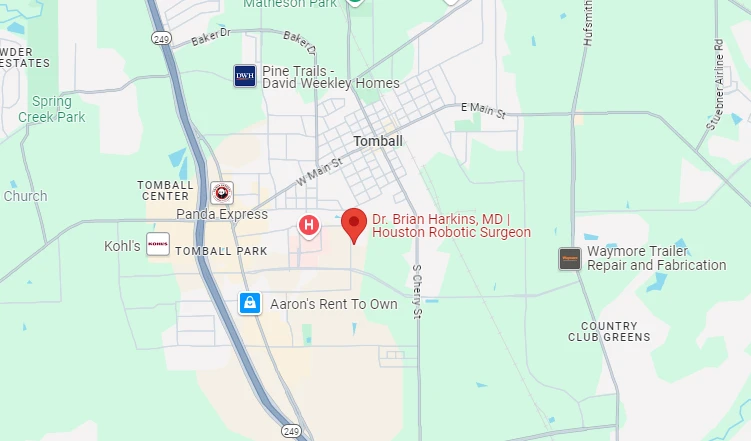
455 School St. Bldg. 1, Suite 10 Tomball, Texas 77375
Mon-Thu: 9:00 am – 5:00 pm | Fri: 9:00 am – 2:00 pm


Robotic inguinal hernia repair is a minimally invasive operation performed through 3 to 4 small port incisions using the da Vinci Xi system. The surgeon reduces the hernia, closes the defect, and reinforces the area with mesh, all from a console controlling wristed instruments with magnified 3D vision. Most patients are discharged the same day, return to light activity in 7 to 10 days, and reach full activity in 4 to 6 weeks. Published recurrence rates are under 5 percent at 5 years for primary inguinal hernia repair in experienced hands.
The inguinal hernia is the most common hernia in adults, accounting for roughly three quarters of all hernia repairs performed in the United States each year. It occurs when abdominal contents push through a weakened area in the inguinal canal in the groin. Surgical repair is the only definitive treatment; the hernia does not go away on its own. The question is not whether to repair it, but how.
Robotic inguinal hernia repair has become a standard option over the last decade, joining traditional laparoscopic and open repair as a mainstream surgical approach. The robotic platform offers magnified 3D vision, wristed instruments, and tremor filtration that are particularly useful in the tight anatomic space of the inguinal canal. This guide walks through who is a candidate, what the procedure actually involves, what to expect during recovery, and what published outcomes data shows. For patients in the Tomball area considering Dr. Brian Harkins, robotic inguinal hernia repair sits within his broader robotic surgery program at HCA Houston Healthcare Tomball.
An inguinal hernia is a defect in the abdominal wall in the inguinal canal, the natural anatomic passage in the groin where the spermatic cord (in men) or round ligament (in women) traverses from the abdomen to the external genital region. There are two main types:
Inguinal hernias usually present as a bulge in the groin that becomes more prominent with standing, coughing, lifting, or straining. Symptoms range from a mild dragging sensation to significant discomfort. Some patients have a visible bulge with no pain; others have pain with no obvious bulge. The hernia can enlarge over time and carries a risk of incarceration (contents stuck outside the abdomen) or strangulation (blood supply cut off), which is a surgical emergency.
Because the inguinal canal will not heal on its own, surgical repair is the definitive treatment for symptomatic or progressive inguinal hernias. Asymptomatic hernias in low risk patients can be observed (watchful waiting), but the majority of patients eventually require repair.
Most adult patients with a symptomatic inguinal hernia who are healthy enough for general anesthesia are candidates for robotic inguinal hernia repair. The robotic approach is often particularly favored over laparoscopic or open repair in patients with bilateral inguinal hernias (where a single operation addresses both sides), in patients with a recurrent inguinal hernia after prior open repair (where entering fresh tissue planes is preferable to working through the scarred prior incision), and in those with a femoral hernia or a combined femoral and inguinal hernia, where the robotic 3D view aids identification of critical structures. Difficult anatomy from elevated BMI or prior pelvic surgery, and patient prioritization of faster return to work or sport, are additional reasons to favor the robotic approach.
Patients who may not be candidates for minimally invasive repair (robotic or laparoscopic) include those with severe pulmonary or cardiac disease that contraindicates pneumoperitoneum (the carbon dioxide insufflation used during minimally invasive surgery), severe coagulopathy, or specific anatomic limitations. In these cases, open repair under regional or local anesthesia may be safer.
The decision is individualized at consultation based on your hernia, your anatomy, your overall health, and your surgeon's experience.
There are three modern approaches to inguinal hernia repair. All three are well established and supported by extensive published outcome data:
For straightforward primary unilateral inguinal hernia repair, the three approaches produce comparable short term and long term outcomes in published research: similar recurrence rates, similar chronic pain rates, and similar return to activity timelines for the minimally invasive approaches. The robotic platform shows specific advantages in bilateral repair, recurrent hernia repair, and complex anatomy.

Robotic inguinal hernia repair is most commonly performed as a robotic transabdominal preperitoneal (rTAPP) repair. The general steps:
Total operative time is typically 60 to 120 minutes for unilateral primary repair, longer for bilateral repair or recurrent hernias.

Most patients are discharged the same day as surgery. The general recovery timeline:
Patients with bilateral repairs, recurrent hernias, or physically demanding jobs may need slightly longer recovery.
The procedure is anatomically the same on either side, with port positions adjusted slightly to optimize the surgeon's working angles. Outcomes (operative time, recovery, recurrence) are similar between right and left inguinal hernia repair. A small percentage of patients have bilateral inguinal hernias that may both be repaired in a single robotic operation.
Bilateral inguinal hernias (defects on both sides) occur in roughly 15 to 20 percent of patients undergoing inguinal hernia surgery. Robotic bilateral inguinal hernia repair is an area where the robotic platform offers a meaningful advantage:
For patients with bilateral inguinal hernias, robotic repair is often the most efficient and least disruptive approach.
Published outcomes for robotic inguinal hernia repair in experienced hands are excellent. Aggregate data from large registry analyses and cohort studies:
Individual outcomes depend on hernia characteristics, surgeon volume, mesh choice, and patient factors (age, BMI, smoking, diabetes, prior surgery).
Like any operation, robotic inguinal hernia repair carries risk. Most complications are minor and manageable. Bleeding or hematoma, surgical site infection, and mesh-related complications (chronic pain, infection, migration, all uncommon) are the most commonly discussed risks. Chronic post-operative groin pain occurs in roughly 5 to 10 percent of patients in modern series, with fixation technique and mesh choice mattering more than the platform. Recurrence rates are low but real, as discussed earlier. Rare but important risks include injury to spermatic cord structures (which can affect fertility in young men if bilateral and severe), bowel injury during dissection, and bladder injury. General anesthesia carries its own well-described risks. Conversion from robotic to open surgery is uncommon but possible in difficult anatomy.
A thorough informed consent conversation at consultation should review these in the context of your specific case.
Most commercial insurance plans, Medicare, and Medicaid cover robotic inguinal hernia repair when medically indicated, at the same rate as laparoscopic or open. Copays and deductibles are typically identical across the three approaches. The practice's billing team can verify your specific benefits before surgery is scheduled.
Useful questions for any inguinal hernia consultation:
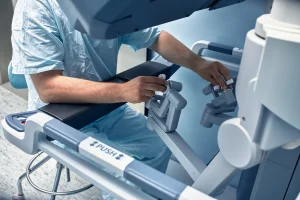
Robotic inguinal hernia repair is a minimally invasive operation performed through 3 to 4 small port incisions using the da Vinci Xi platform. The surgeon sits at a console and controls every instrument movement; the robot translates those movements into precise actions inside the abdomen using magnified 3D vision and wristed instruments. The same surgical operation (reduce the hernia, close the defect, place mesh) is performed as in laparoscopic or open repair, with the technology adding precision in the tight anatomic space of the inguinal canal.
For most uncomplicated primary inguinal hernias, robotic and laparoscopic repair offer smaller incisions, lower surgical site infection rates, and faster recovery than open repair, with comparable recurrence rates. Open repair remains an excellent choice for select patients, particularly those who cannot tolerate general anesthesia or pneumoperitoneum. The right approach depends on the patient and surgeon experience.
Most patients are discharged the same day as surgery, return to desk work within about 1 week, drive within 3 to 5 days (off prescription opioid pain medication), and reach full activity including lifting and exercise within 4 to 6 weeks. Patients with bilateral repairs or physically demanding jobs may need slightly longer.
rTAPP stands for robotic transabdominal preperitoneal repair. It is the most common robotic technique for inguinal hernia repair. The surgeon enters the abdomen, opens the peritoneum, dissects into the preperitoneal space to expose the hernia defect, places mesh covering the entire myopectineal orifice, and closes the peritoneum over the mesh.
Yes. Robotic bilateral inguinal hernia repair addresses both sides in a single operation through the same port placement. Operative time is shorter than two separate procedures, and recovery time is similar to unilateral repair. Bilateral repair is particularly well suited to the robotic platform.
Published 5 year recurrence rates for robotic inguinal hernia repair are under 5 percent for primary repair in experienced hands. Chronic post-operative groin pain rates range from 5 to 10 percent in modern series. Surgical site infection rates are 1 to 3 percent. Individual outcomes depend on hernia characteristics, surgeon volume, mesh selection, and patient factors.
Yes, but the scars are small and usually well healed by 6 to 12 months. Robotic inguinal hernia repair uses 3 to 4 ports of 8 to 12 mm each. After healing, the scars are typically faint and far less visible than the longer incision from open repair.
Yes, and the robotic platform is often particularly well suited to recurrent inguinal hernia repair after prior open repair, because the surgeon enters fresh tissue planes in the preperitoneal space rather than scarred tissue. Recurrent hernias after prior minimally invasive repair are more complex and the approach is individualized.
Yes. Robotic inguinal hernia repair requires general anesthesia because the abdomen needs to be insufflated with carbon dioxide gas, which is not tolerated under regional or local anesthesia alone. Open inguinal hernia repair can sometimes be performed under regional or local anesthesia with sedation, but the minimally invasive approaches require general.
These are the same operation performed on the right or left side. The procedure technique, port configuration, recovery, and outcomes are essentially identical between right and left robotic inguinal hernia repair. Some patients have bilateral hernias requiring repair on both sides in the same operation.
Inguinal hernia repair is one of the most common surgical procedures performed in the United States, and in 2026 patients have real options. Robotic inguinal hernia repair offers the precision of the da Vinci Xi platform combined with the recovery advantages of a minimally invasive approach. For straightforward primary repair, it produces outcomes comparable to laparoscopic and open repair, with specific advantages in bilateral, recurrent, and complex cases.
If you would like to discuss robotic inguinal hernia repair for your specific case, schedule a consultation with Dr. Brian Harkins at our Tomball office by calling 281-351-5409 or request an appointment online. We see patients from across the greater Houston area, with surgeries performed at HCA Houston Healthcare Tomball's Center of Excellence in Robotic Surgery.
Sarah Chen is a healthcare communications specialist with 12+ years of experience in clinical environments. She writes about robotic and minimally invasive surgery for patients and families navigating surgical decisions. Her work is clinically reviewed by Dr. Brian Harkins, MD, FACS, ensuring medical accuracy and evidence-based information.
Based in: Tomball, TX | Serves: Greater Houston Area
This information is educational and is not a substitute for professional medical advice. Every patient is different. The decision to undergo robotic inguinal hernia repair is individualized based on hernia characteristics, anatomy, comorbidities, surgical history, and personal preference. Dr. Brian Harkins will discuss whether robotic inguinal hernia repair is right for your specific situation in consultation. Statistics cited reflect published research on aggregate patient populations; individual outcomes vary. This content has been reviewed for medical accuracy by Dr. Brian Harkins, MD, FACS.

Dr. Brian Harkins is a renowned surgeon specializing in advanced, minimally invasive, and robotic surgical techniques. With a dedication to innovation and personalized patient care, he has transformed countless lives by delivering exceptional outcomes.
I want a website like this, where do i start?