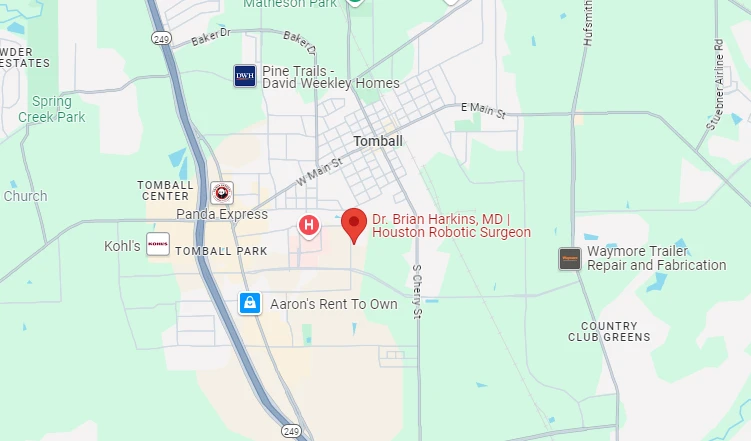
455 School St. Bldg. 1, Suite 10 Tomball, Texas 77375
Mon-Thu: 9:00 am – 5:00 pm | Fri: 9:00 am – 2:00 pm


Robotic surgery does take longer than traditional approaches, typically 40 to 70 minutes more than laparoscopic surgery. But the extra time is spent on system setup, docking, and precision preparation, not on slower surgical work. The result is less blood loss, shorter hospital stays, and faster recovery, making the trade-off worth it for most patients.
If you're considering robotic surgery in Tomball, TX, you've probably heard it takes longer than traditional approaches and wondered why. Factors like system setup, surgeon experience, and procedure complexity all play a role. Yet patients often experience less blood loss, shorter hospital stays, and faster recovery despite the extended operative time. This article breaks down exactly why robotic procedures take longer, what contributes to that extra time, and whether the trade-offs are worth it for your health and recovery.
When patients undergo robotic-assisted surgery, total time in the operating room extends well beyond the actual surgical work. The complete procedure encompasses patient entry through exit, including anesthesia induction, positioning, system setup, docking, console time, undocking, closure, and emergence.
Console time refers specifically to the period when the surgeon actively controls the robotic instruments at the console. This represents the actual surgical work being performed. Non-surgical, patient-independent time accounts for approximately 37 to 40% of total procedure time, a substantial portion that includes all mechanical and technical preparation required before surgery begins.
Operative time varies significantly by procedure complexity. The table below shows typical time ranges across common robotic procedures.
| Procedure | Console Time | Total OR Time |
| Robotic cholecystectomy | 45 to 75 min | 90 to 120 min |
| Robotic radical prostatectomy | 2.5 to 3.5 hrs | 4 to 5 hrs |
| Robotic colectomy | 3 to 4 hrs | 4 to 5.5 hrs |
| Robotic hysterectomy | 2.5 to 3 hrs | 3.5 to 5 hrs |
For robotic-assisted radical prostatectomy specifically, average total procedure time reaches approximately 233.6 minutes, with system preparation consuming 45.1 minutes and docking requiring 7.0 minutes on average.
The da Vinci surgical system requires extensive preparation before any surgical work can begin. This process involves careful patient cart positioning, calibration of robotic arms, trocar site mapping, and docking with precise alignment. Docking alone requires between 4 and 29 minutes depending on surgeon experience and procedure complexity.
System preparation encompasses multiple technical requirements that cannot be rushed:
This preparation phase requires 33.5 to 45.1 minutes depending on the system. Even at high-volume centers, these technical necessities remain largely unavoidable. High-volume centers demonstrate docking times declining from 8.9 minutes in the second year to 5.5 minutes by the third year, showing that experience improves efficiency but cannot eliminate the time requirement entirely.
Each instrument change during robotic surgery requires a multi-step process. The surgical team must undock the robotic arm, remove the current instrument, retrieve the new instrument, and redock. Time required for each instrument change is substantially longer in robotic versus laparoscopic approaches.
In robotic versus laparoscopic distal gastrectomy, effective surgical time was only 15.3 minutes longer for robotic approaches (145.9 versus 130.6 minutes). However, instrument setup, docking, and positioning added 41.5 minutes (127.8 versus 86.2 minutes). This reveals that the temporal penalty is primarily attributable to mechanical necessities rather than dissection complexity. The surgeon isn't working more slowly. The technology simply requires more preparation.
Loss of haptic feedback requires surgeons to rely entirely on visual cues, contributing to more cautious movements that can extend operative time. Without the ability to feel tissue resistance, surgeons must use visual assessment to gauge appropriate force and tissue handling. Camera fogging occasionally requires camera retraction and lens cleaning, though robotic systems experience this less frequently than laparoscopic approaches.
Surgeon experience dramatically impacts operative time. For robot-assisted laparoscopic prostatectomy, operative time declined by approximately 96 minutes from initial experience to proficiency. The learning curve required approximately 308 cases or 1,398 days (roughly four years) to reach the point where operative time stabilized.
At one institution, robotic-assisted radical prostatectomy operative time decreased from a median of 160 minutes in 2019 to 118 minutes in 2023. Radical cystectomy operative times decreased from 286 minutes to 260 minutes across the same period. For gynecologic oncology procedures, total surgical time improved from 250 minutes in year one to 165 minutes in year two.
These improvements confirm that experience matters significantly, but even highly experienced surgeons cannot eliminate the inherent time requirements of robotic technology.
Resident presence is associated with an average increase in surgery time of 38.6 minutes. Surgery time involving residents decreased by 8.7 minutes after four months into the academic year and by an additional 5.1 minutes in the following four-month interval, showing residents improve with experience. Teaching hospitals must balance educational missions with operative efficiency, and patients should ask whether resident involvement is expected during their procedure.
Several patient-specific factors directly correlate with extended operative times regardless of surgical approach. The time impact may be magnified when combined with the inherent setup requirements of robotic systems.
BMI significantly predicts operative time across robotic procedures. In robotic inguinal hernia repair, patients with BMI below 25 required 83.5 minutes for bilateral repair, compared to 98.4 minutes for BMI 25 to 29.9 and 97.8 minutes for BMI 30 and above. In robot-assisted radical prostatectomy, higher BMI is associated with smaller pelvic working space and narrower pelvic anatomy, directly increasing operative difficulty and time.
Additional factors that extend operative time include:
| Factor | Additional Time Impact |
| BMI 25 to 30 | +14 minutes average |
| BMI 30 and above | +14 to 20 minutes |
| Prior abdominal surgery | Variable, often significant |
| Larger prostate volume | Increases console time |
| Extreme BMI (100+) | Up to 437 min total OR time documented |
Entire surgical teams demonstrate learning curves as they develop standardized protocols and optimize workflow. Robotic surgery requires tight coordination among surgeons, anesthesiologists, surgical technicians, and nursing staff. Inexperienced teams took approximately 10 to 15 procedures to match the efficiency of experienced teams. Non-surgical patient-independent time decreased from 97.2 minutes initially to 85.8 minutes by cases 10 to 15.
Research examining preventable delays found that 75% of cases experienced delays, with an average of 1.6 delays per case and an average delay length of 3.6 minutes. The most common issues involved equipment failure, missing equipment, and staff unfamiliarity. Institutions with standardized protocols for setup, patient positioning, instrument arrangement, and procedural steps demonstrate more rapid learning curves and shorter operative times.
Meta-analytic evidence confirms robotic surgery requires longer operative times across all specialties. The table below summarizes the documented differences.
| Procedure | Robotic Time | Laparoscopic Time | Difference |
| Colorectal surgery | Longer | Baseline | +39.26 min |
| Gastrectomy | Longer | Baseline | +62 to 66 min |
| Right colectomy | Longer | Baseline | +25 to 42 min |
| Cholecystectomy | 75.7 min | 64.37 min | +11 min |
| Hysterectomy | 351 min | 283 min | +68 min |
These differences remain consistent even when comparing experienced robotic surgeons to experienced laparoscopic surgeons, indicating that technology rather than skill accounts for the time difference.
Prolonged anesthesia duration is associated with increased odds of overall complications, and surgical site infection risk increases approximately 13% for every 15 additional minutes of operative time. These are legitimate concerns. However, robotic surgery demonstrates offsetting benefits that consistently outweigh the time penalty.
For hysterectomy, robotic surgery produces 106 mL of blood loss versus 546 mL for open surgery. Hospital stays average 1.9 days versus 7.2 days. Minor complication rates are 19% versus 63%. According to Intuitive Surgical, comparable or lower infection rates are observed despite longer operative duration. The longer time is spent achieving greater precision, not reflecting inferior efficiency.
As a robotic surgeon in Tomball, Dr. Brian Harkins performs one of the highest volumes of robotic general surgery cases in the nation. HCA Houston Healthcare Tomball is accredited as a Center of Excellence in Robotic Surgery by the Surgical Review Corporation, reflecting rigorous standards for volume, outcomes, and patient care protocols.
The hospital began offering robotic surgery in 2005 and has pioneered single-port robotic cholecystectomy on the da Vinci Xi system. This extensive institutional experience directly translates to shorter setup times, fewer preventable delays, and better-coordinated surgical teams for every patient.
The primary reason is system setup and docking, not slower surgical work. The da Vinci system requires 33 to 45 minutes of preparation before surgery begins. Instrument changes also take longer robotically than laparoscopically. The actual dissection time is only about 15 minutes longer on average.
It depends on the procedure. For some operations like hysterectomy, robotic surgery is actually faster than open surgery (351 minutes versus 283 minutes for laparoscopic, but significantly shorter than open). For others, robotic surgery takes longer than both open and laparoscopic approaches.
Yes, significantly. Operative times can decrease by up to 96 minutes as a surgeon moves from initial experience to proficiency. However, even highly experienced surgeons cannot eliminate the inherent setup time required by the robotic system itself.
Likely yes. BMI above 25 adds approximately 14 to 20 minutes to robotic procedures due to reduced working space and increased anatomical complexity. Discuss your specific situation with your surgeon to get a realistic time estimate for your procedure.
Extended anesthesia duration does carry some incremental risk, including slightly higher odds of complications and infection. However, for most patients, these risks are outweighed by the precision and outcome benefits of robotic surgery. Your surgeon and anesthesiologist will assess your specific risk profile before recommending an approach.
Yes. Resident involvement adds an average of 38.6 minutes to operative time. However, residents improve quickly, and by the second half of the academic year, that added time decreases substantially. Ask your surgeon whether residents will participate in your procedure.
Some efficiencies can be gained through experience and standardization, and high-volume centers do demonstrate faster setup times over time. However, certain steps such as sterile draping, instrument calibration, and arm positioning cannot be rushed without compromising safety or surgical outcomes.
Total OR time includes anesthesia induction, positioning, setup, the surgery itself, and emergence from anesthesia. For a robotic prostatectomy, expect 4 to 5 hours total. For a robotic cholecystectomy, expect 90 to 120 minutes. Your surgeon can give you a specific estimate based on your procedure and anatomy.
No, the opposite is true. Despite longer operative time, robotic surgery patients recover faster than open surgery patients, going home sooner and returning to normal activity more quickly. The precision of robotic surgery reduces tissue trauma, which is what drives recovery speed.
Single-port robotic approaches are associated with shorter hospital stays and less postoperative pain, but setup time can be comparable to or slightly longer than multi-port approaches depending on the procedure. The benefits are primarily in patient comfort and recovery rather than OR efficiency.
Robotic surgery takes longer in the operating room, and that is largely unavoidable given the system setup, docking, and instrument management the technology requires. But the extra time is not wasted time. It is the cost of achieving a level of precision, visualization, and minimally invasive access that consistently translates to less blood loss, shorter hospital stays, and faster recoveries for patients.
The right way to evaluate robotic surgery is not by clock time but by what happens after you leave the OR. The data is clear: patients do better. Fewer complications, shorter stays, and faster return to normal life are the outcomes that matter most, and robotic surgery delivers them despite the longer operative window.
To discuss whether robotic surgery is the right approach for your procedure, call 281-247-0503 or contact us to schedule a consultation with Dr. Brian Harkins in Tomball, TX.
Schedule your robotic surgery consultation in Tomball today.
Contact Dr. Harkins to discuss your procedure, timeline, and expected recovery.


Dr. Brian Harkins is a renowned surgeon specializing in advanced, minimally invasive, and robotic surgical techniques. With a dedication to innovation and personalized patient care, he has transformed countless lives by delivering exceptional outcomes.
I want a website like this, where do i start?