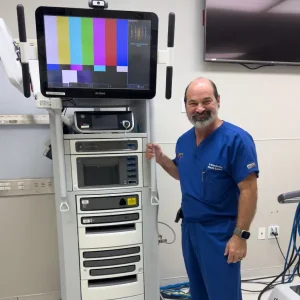
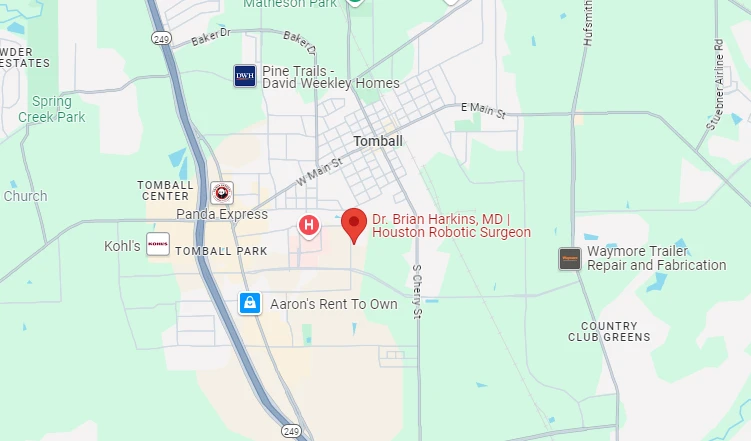
455 School St. Bldg. 1, Suite 10 Tomball, Texas 77375
Mon-Thu: 9:00 am – 5:00 pm | Fri: 9:00 am – 2:00 pm


Nerve-sparing rectal cancer surgery protects four things at once: a clean cancer margin, bladder control, sexual function, and, whenever the tumor's position allows, the sphincter muscles that keep you continent. It works by removing the rectum inside its intact envelope of fat and lymph nodes along a natural tissue plane, which leaves the pelvic nerves in place on the other side.
When people hear the words "rectal cancer," the first thing they ask about is survival, and it is the right first question. The second thing on their mind is usually harder to say out loud, and it tends to come out in the parking lot rather than the exam room. They want to know whether they will need a bag, whether they will still be able to control their bladder, and whether their sex life will survive the treatment.
Those questions deserve straight answers, especially as rectal cancer becomes more common in people who are still working and raising families. The American Cancer Society reports that rectal cancer now makes up about 32 percent of colorectal cancer diagnoses, up from 27 percent in the mid-2000s, and that colorectal cancer rates in adults under 50 are rising by about 3 percent a year.
This guide walks through what nerve-sparing surgery is built to protect, one function at a time, and what can make each protection harder to keep.
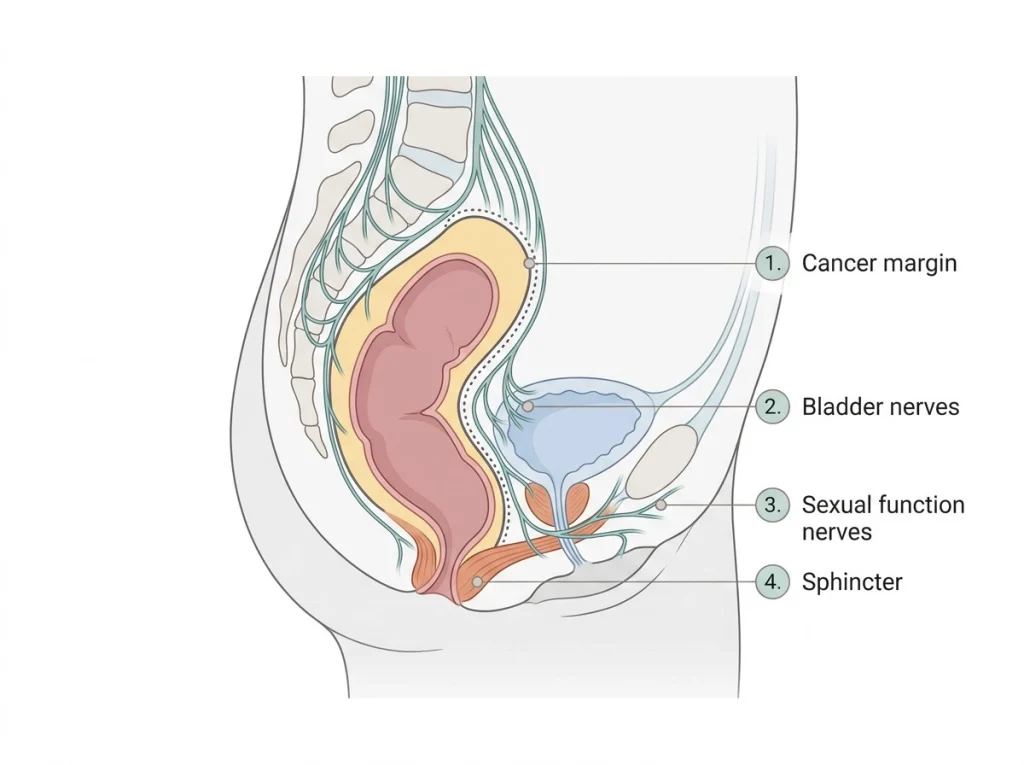
Nerve-sparing is not an extra step bolted onto the cancer operation. It is what happens when the cancer operation follows the right tissue plane from start to finish.
The rectum sits deep in the pelvis, wrapped in a layer of fat, blood vessels, and lymph nodes called the mesorectum. That layer is enclosed in a thin, shiny membrane, and just outside that membrane runs a network of small autonomic nerves. Those nerves work automatically, without you thinking about them, and they control the bladder, sexual response, and part of bowel function.
The standard operation for most rectal cancers is called total mesorectal excision, often shortened to TME. The surgeon removes the rectum together with the whole mesorectum in one intact package, working in the thin, almost bloodless gap between that package and the nerves. When the gap is followed carefully, the cancer comes out wrapped in healthy tissue and the nerves stay where they are.
| What is protected | What controls it | What protecting it depends on |
| A clean cancer margin | The intact mesorectal envelope | Removing the envelope whole, without tearing it |
| Bladder control | Autonomic nerves along the pelvic sidewalls | Staying in the correct plane on both sides |
| Sexual function | The same nerve network, plus nerves in front of the rectum | Careful dissection near the prostate or vagina |
| Continence | The anal sphincter muscles | Enough healthy tissue between the tumor and the sphincter |
The first three protections come from the same surgical discipline, because holding the plane protects the margin and the nerves together. The fourth is different, since it depends mostly on where the tumor sits.
Keeping the cancer from coming back in the pelvis is the first job of the operation, and it depends on removing the mesorectal envelope intact.
Before TME became the standard, surgeons often cut close to the bowel wall and left pieces of the mesorectum behind, and because stray cancer cells tend to sit inside that fatty layer, cancer came back in the pelvis far more often than it does today.
After surgery, a pathologist examines the specimen and reports on a few things that tell you how well this protection was achieved:
These terms will appear in your pathology report, and you are entitled to have each one explained in plain language.
The nerves that tell your bladder when to empty run along the side walls of the pelvis, only millimeters from the mesorectal envelope.
Bladder problems after rectal surgery usually show up as a weak stream, a feeling of not emptying fully, or reduced sensation of fullness. Occasionally someone needs a catheter for a short time after going home. Most of these problems come from nerve injury during the operation rather than from radiation, which is why surgical technique matters so much here.
The numbers have improved over time. Long-term data from the Dutch TME trial, one of the largest rectal cancer studies ever run, found urinary problems in about one in three patients. More recent work focused specifically on nerve preservation has done much better. In the randomized PUF-01 trial of 242 men, published in Nature Communications in 2023, urinary dysfunction two weeks after surgery occurred in 6.3 percent of patients whose protective fascia in front of the rectum was preserved, compared with 25.7 percent when it was removed.
That trial also found no difference in three-year survival or disease-free survival between the two groups. Protecting function did not come at the cost of cancer control, which is the central argument for this approach.
Sexual function is the protection most often left out of the conversation, and it matters just as much for women as it does for men.
The same nerve network that controls the bladder also controls erection and ejaculation in men and arousal and lubrication in women. In front of the rectum, these nerves pass very close to the prostate in men and the back wall of the vagina in women, so the front of the dissection needs particular care.
| Men | Women | |
| Functions governed by pelvic nerves | Erection, ejaculation | Arousal, natural lubrication, sensation |
| Most common problems reported | Erectile difficulty, dry or reduced ejaculation | Vaginal dryness, pain with intercourse |
| Added effect of radiation | Contributes to erectile problems | Contributes to dryness, narrowing, and early menopause in younger women |
| Treatments that help | Oral medications, pelvic floor therapy, urology referral | Moisturizers, vaginal dilators, pelvic floor therapy, gynecology referral |
Honest counseling means acknowledging that sexual changes after rectal cancer treatment are common. In the Dutch TME trial, more than half of patients reported some decline in sexual function, and women's problems were reported just as often as men's even though they are discussed far less. Radiation adds to this independently of surgery.
The good news is that nerve-sparing technique has changed the long-term picture. In the PUF-01 trial, men whose front fascia was preserved had better erectile function scores throughout the first year. Many patients who see an early drop in function recover gradually over twelve months, and the treatments in the table above help many of those who do not recover fully on their own.

Most people having rectal cancer surgery today keep their sphincter and do not end up with a permanent colostomy.
Whether the sphincter can be saved depends mainly on how close the tumor sits to it. When there is enough healthy tissue between the bottom of the tumor and the sphincter muscles, the surgeon removes the rectum and joins the colon to what remains. When the tumor grows into the sphincter itself, removing the sphincter is the only way to remove the cancer completely.
| Operation | What is removed | What that means for you |
| Local excision | The tumor and a small margin of rectal wall | No ostomy; only suitable for small, early tumors |
| Low anterior resection | The rectum and mesorectum, with the colon rejoined low in the pelvis | Often a temporary ileostomy for about two to three months |
| Intersphincteric resection | The rectum plus the inner layer of sphincter muscle | Temporary ileostomy, then a connection just above the anus |
| Abdominoperineal resection | The rectum, anus, and sphincter muscles | Permanent colostomy |
A temporary ileostomy is not the same as a permanent colostomy. A low connection heals more safely when stool is diverted away from it for a few months, after which the opening is closed in a much shorter second operation.
Keeping the sphincter does not mean bowel habits return exactly to how they were. The rectum used to store stool, and once it is gone many people notice frequency, urgency, or clustering of bowel movements. This pattern is called low anterior resection syndrome, or LARS. A 2018 meta-analysis in the International Journal of Surgery estimated that about 41 percent of patients have major LARS, with the risk highest after radiation and when the join is very low in the pelvis.
LARS usually improves over the first one to two years, and a lot can be done to manage it:
For a closer look at the weeks after the operation itself, our guide to robotic colorectal surgery recovery time walks through the hospital stay, the first month at home, and when most people return to normal activity.
Want to know which of these protections applies to your tumor? The answer depends on your MRI and where the tumor sits, and a consultation is the place to go through it. Call 281-351-5409 or contact us to schedule a visit.
Some patients face a harder operation because of their anatomy or treatment history, and knowing this in advance helps set realistic expectations.
Two people with the same stage of cancer can face very different operations, mostly because of factors nobody controls.
| Factor | Why it makes the operation harder |
| A low tumor, close to the sphincter | Less room to rejoin the bowel, and a higher chance of LARS |
| A narrow pelvis, more common in men | Less space to see and work in the deepest part of the dissection |
| Radiation before surgery | Tissue planes become stiffer and harder to separate |
| Higher body weight | More pelvic fat makes the plane harder to see |
| A tumor on the front wall of the rectum | Brings the dissection close to the prostate or vagina and the nerves beside them |
| Previous pelvic surgery | Scar tissue can blur the normal boundaries |
None of these rule out a nerve-sparing operation, but they explain why results vary and why experience matters most in exactly these cases.
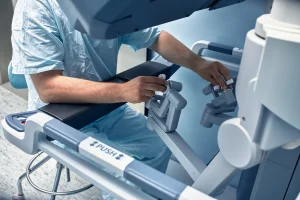
Robotic surgery does not change which operation is done. It gives the surgeon a clearer, steadier view and better instrument control in the tightest part of the pelvis.
A low anterior resection is the same operation whether it is performed open, with standard laparoscopy, or with robot assisted surgery. The difference lies in what the surgeon can see and reach. Standard laparoscopic instruments are straight and rigid, and the camera is held by an assistant. Robotic instruments bend like a wrist, the surgeon controls a stable, magnified 3D camera, and small hand tremors are filtered out.
Those advantages matter most in the difficult situations listed in the previous section. They matter least in an easy pelvis, where an experienced laparoscopic surgeon will do an excellent operation anyway. The research reflects that balance:
The fair summary is that robotic rectal cancer surgery is a strong tool for holding the plane in difficult anatomy, rather than a guarantee of a better result for everyone. For a broader comparison of approaches, see our overview of robotic colorectal surgery in Tomball and our look at the pros and cons of robotic colorectal surgery.
For a growing number of patients, treatment before surgery works so well that the operation can be delayed or avoided altogether.
Many locally advanced rectal cancers are now treated with chemotherapy and radiation before any operation, an approach called total neoadjuvant therapy. In a meaningful share of patients, the tumor disappears completely on examination, endoscopy, and MRI. In the OPRA trial, roughly half of patients who received this approach were able to keep their rectum at three years.
Those patients may be offered a watch-and-wait plan, with intensive surveillance instead of immediate surgery and an operation only if the tumor grows back.
A smaller group of tumors, called mismatch repair deficient, has responded remarkably to immunotherapy alone. In the first report of a trial at Memorial Sloan Kettering, published in the New England Journal of Medicine in 2022, all 12 treated patients had a complete clinical response without chemotherapy, radiation, or surgery. That is why testing the tumor for mismatch repair status is now a standard part of the workup. The National Cancer Institute's patient guide to rectal cancer treatment explains how these options are matched to each stage.
The most useful consultation is one where you leave knowing which protections apply to you and what the realistic trade-offs are.
Bring your colonoscopy report, biopsy results, and any scans already done, so the first visit can focus on your own anatomy. These are the questions patients most often wish they had asked:
If the answers feel vague, it is reasonable to ask again or to seek a second opinion.
Rectal cancer is best treated by a coordinated team, with surgery planned around the full staging picture rather than scheduled first.
A complete workup usually includes colonoscopy with biopsy, a pelvic MRI to show how deep the tumor goes and whether nearby lymph nodes are involved, and CT scans of the chest, abdomen, and pelvis to check for spread. Once those results are in, the order of treatment is decided together with medical and radiation oncology.
Dr. Brian Harkins is a board-certified general surgeon and robotic surgeon who performs colorectal cancer surgery at HCA Houston Healthcare Tomball. He sees patients from Tomball, Magnolia, Spring, Cypress, The Woodlands, and across the greater Houston area. His practice treats the full range of colon and rectal conditions, from diverticulitis to cancer, and patients comparing organ-specific operations can also read our guide to colon cancer surgery.
Yes. Removing the rectum and the tissue around it is a major abdominal and pelvic operation done under general anesthesia. Most patients stay in the hospital for two to five days after a minimally invasive procedure and avoid heavy lifting for four to six weeks. Robotic and laparoscopic approaches shorten recovery and reduce pain compared with open surgery, but the operation itself is still significant.
Yes, in many cases. Rectal cancer that has not spread beyond the pelvis is treated with the goal of cure. The chance of cure depends on the stage at diagnosis, how well the tumor responds to any treatment before surgery, and whether the surgeon removes the mesorectal envelope intact with a clear margin. Regular follow-up after treatment helps catch any recurrence early.
Most people return to work, exercise, travel, and normal family life. The main adjustments involve bowel habits, which may be more frequent or urgent for a year or two, and in some patients changes to bladder or sexual function. Diet changes, pelvic floor therapy, and medication help most people manage these changes, and many improve steadily over time.
Most patients go home within two to five days and return to ordinary daily activities in about six weeks. Full functional recovery takes longer. Bladder function usually settles within a few months, sexual function often improves over the first year, and bowel habits can keep adjusting for one to two years, especially after radiation or a very low connection.
Most patients do not need a permanent colostomy. Many have a temporary ileostomy for about two to three months to protect the new connection while it heals, followed by a short operation to close it. A permanent colostomy is only needed when the tumor involves the sphincter muscles, since removing them is then the only way to remove the cancer completely.
No. Nerve-sparing technique lowers the risk of bladder and sexual problems but cannot remove it entirely. Tumor position, a narrow pelvis, radiation before surgery, and the need to remove nearby tissue can all affect results. Many patients see a temporary dip in function that improves over months, and specific treatments help those whose function does not fully return.
Yes. Women can experience vaginal dryness, reduced arousal, and pain during intercourse after rectal cancer surgery, particularly when radiation is part of treatment. These effects are reported about as often as men's sexual side effects but are discussed less often. Vaginal moisturizers, dilators, pelvic floor therapy, and referral to a gynecologist can help, so it is worth raising early.
Low anterior resection syndrome, or LARS, is a group of bowel symptoms that can follow removal of the rectum, including frequent movements, urgency, clustering, and occasional leakage. It happens because the rectum no longer stores stool the way it did. LARS is more likely after radiation and very low connections, and it usually improves over one to two years with diet changes, medication, and therapy.
Sometimes. Patients whose tumors disappear completely after chemotherapy and radiation may be offered a watch-and-wait plan with close monitoring instead of immediate surgery. Tumors that are mismatch repair deficient have responded to immunotherapy alone in clinical trials. Both options need careful selection and frequent follow-up, and surgery remains available if the cancer returns.
Both are minimally invasive and give similar cancer outcomes in experienced hands. Robotic surgery offers a stable 3D view and wristed instruments, which help most in a narrow pelvis, after radiation, or in patients with higher body weight. Some studies show faster recovery of bladder and sexual function after robotic surgery. The best choice depends on your anatomy and your surgeon's experience.
Rectal cancer surgery asks a lot of one operation. It has to remove the cancer completely while protecting the functions that make daily life feel normal, including bladder control, sexual function, and, whenever possible, bowel control through the sphincter. Modern nerve-sparing technique makes it possible to aim for all of these at once, because the same careful plane that clears the cancer also leaves the nerves in place.
If you have a new rectal cancer diagnosis, an MRI you would like explained, or a treatment plan you want reviewed, schedule a consultation with Dr. Brian Harkins by calling 281-351-5409, and bring any reports or scans you already have so the visit can focus on your own treatment plan.
Protect What Matters Most. Schedule Your Consultation Today.
Rectal Cancer Diagnosis? Get Answers From Dr. Harkins.
Sarah Chen is a healthcare communications specialist with 12+ years of experience in clinical environments. She writes about robotic and minimally invasive surgery for patients and families navigating surgical decisions. Her work is clinically reviewed by Dr. Brian Harkins, MD, FACS, ensuring medical accuracy and evidence-based information.
Based in: Tomball, TX | Serves: Greater Houston Area
This information is educational and is not a substitute for professional medical advice. Rectal cancer treatment depends on tumor location, stage, mismatch repair status, response to treatment before surgery, prior surgery, other health conditions, and findings during the operation.
The statistics and timelines in this article come from published research and typical patient groups, and individual results vary. Nerve preservation is a goal of the operation, not a guarantee, and bladder, bowel, and sexual function after treatment are also affected by radiation and tumor position.
Dr. Brian Harkins and his clinical team provide personalized guidance for each patient, and their instructions take priority over any general information here. This content has been reviewed for medical accuracy by Dr. Brian Harkins, MD, FACS.

Dr. Brian Harkins is a renowned surgeon specializing in advanced, minimally invasive, and robotic surgical techniques. With a dedication to innovation and personalized patient care, he has transformed countless lives by delivering exceptional outcomes.
I want a website like this, where do i start?